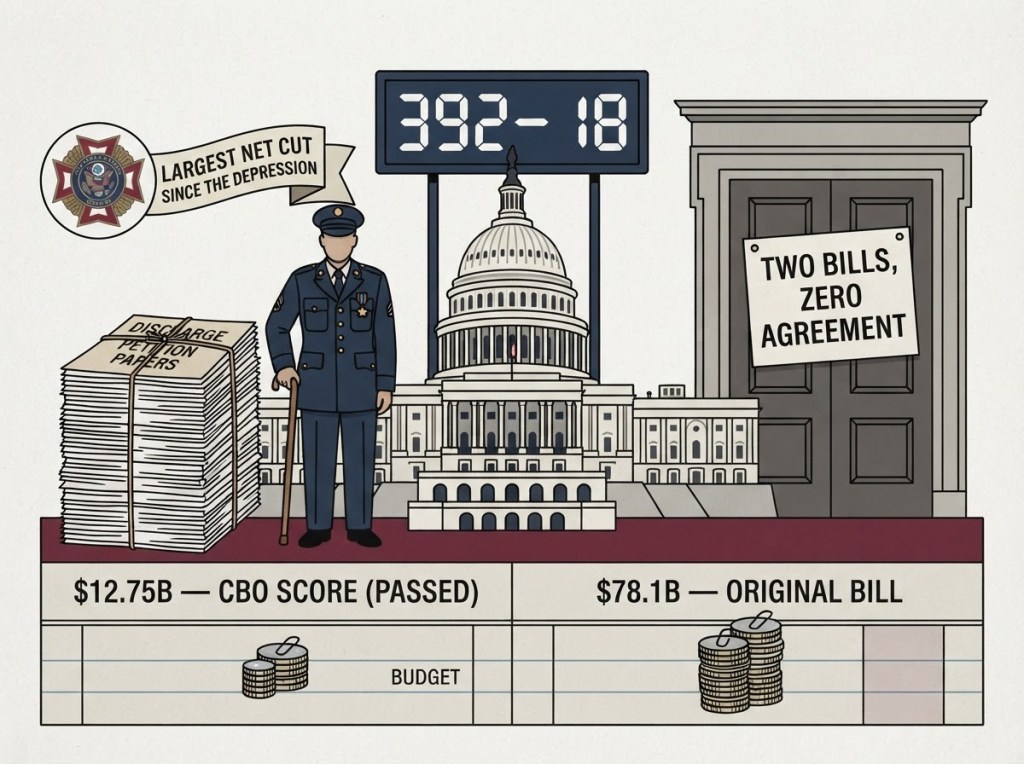
The House passed the Major Richard Star Act on Thursday by 392 to 18. It would let roughly 59,000 combat injured veterans, medically retired with fewer than 20 years of service, collect full retirement pay and full VA disability compensation together.
The vote happened because Democrats forced it. Rep. Mark Takano’s discharge petition reached 218 signatures in September.
The rule that brought the bill up passed 271 to 135. Democrats voted 210 to 0, while Republicans split 60 to 135, with Majority Leader Steve Scalise among the no votes.
Armed Services Chairman Mike Rogers also voted no on the rule. He then rose to call his support for the bill “reluctant” and asked the Senate to pass a different one, H.R. 9237, the Take Care of America’s Veterans Act.
That bill passed the House by voice vote on Wednesday and bundles the Star Act with other veterans programs. It pays for them by changing how future tinnitus and sleep apnea claims are rated.
The VFW calls it the largest net benefit cut since the Great Depression. Republicans say Democrats never asked for a recorded vote.
The cost argument depends on which bill is being scored. CBO put the original Star Act at $78.1 billion in direct spending. The version that passed scores at $12.75 billion, mainly because two provisions were removed.
Chairman Mike Bost told the House the bill costs a combined $20 billion, fully unpaid for, and placed the CBO estimate in the Record. That estimate shows a deficit effect of $12.75 billion over 2027 to 2036. A footnote says the $7.45 billion in payments into the Military Retirement Fund are intragovernmental and have “no net effect on federal spending.”
Both bills now sit in the Senate. It has no discharge procedure, and earlier unanimous consent attempts were blocked.
Also in the Record
Majority Leader John Thune pushed the 494 page Bipartisan American Affordability and Jobs Act on the floor. Its vehicle is H.R. 2347, a House passed tax bill about damages for abuse survivors.
Thune said the package would make data centers cover their own energy costs. Critics, including Oil Change International, say it favors fossil fuel projects. Cloture on the substitute comes Monday evening.
The Senate confirmed Gregory Cook to a federal district court in Alabama, 49 to 27. It also invoked cloture on Tenth Circuit nominee Daniel Desmond Domenico, 51 to 27, and Fifth Circuit nominee Anna St. John, 49 to 26.
Twenty members of the Democratic caucus missed the first vote. Majority Whip John Barrasso promised two dozen judges before the session ends.
The Senate also received four nominations to financial regulators. Steven Levine would replace Hester Peirce at the SEC, and Kristin Johnson would take Caroline Crenshaw’s seat. Nathan Anonick and Matthew Rowland would fill CFTC seats.
The Hill reports these are Trump’s first Democratic picks for either agency.
Fifty two days remain in the 119th Congress, by the majority whip’s count. The veterans have waited six years, and the Senate now holds two bills that disagree about who pays.

