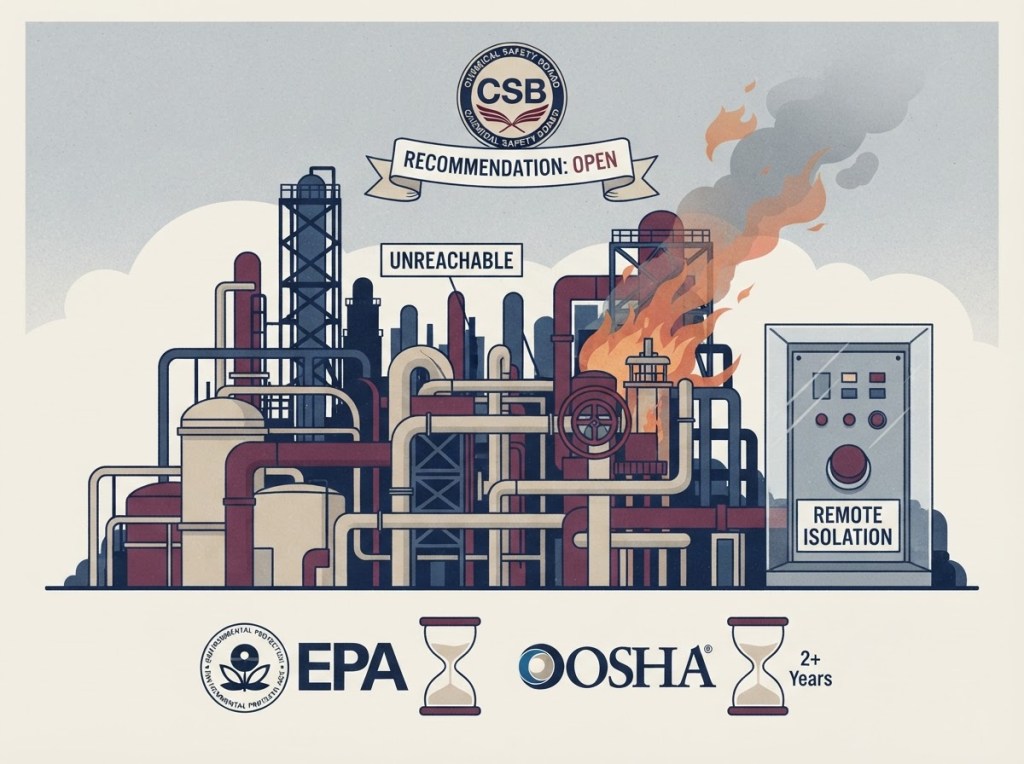
The U.S. Chemical Safety and Hazard Investigation Board (CSB) has released a new safety video urging chemical facilities to install equipment capable of shutting off hazardous material flows during emergencies. Behind the educational message lies a continuing federal oversight question: More than two years after the agency recommended stronger safeguards, two recommendations directed at federal regulators remain open.
The November 12, 2026 announcement introduces RIPE for Change, a video examining three catastrophic industrial incidents from 2019 in which fires and explosions escalated because workers could not safely reach equipment needed to stop the flow of hazardous chemicals.
The video draws on the CSB’s July 2024 Remote Isolation of Process Equipment safety study, which concluded that existing industry guidance had not been consistently followed and that stronger requirements were necessary.
The problem is relatively straightforward. Chemical plants, refineries, and storage terminals rely on valves to control the movement of flammable and toxic materials. When equipment ruptures or catches fire, operators may need to close those valves to prevent additional chemicals from feeding the emergency. But a valve is of limited practical value when reaching it requires walking into an active fire or potentially explosive environment.
Remote isolation equipment addresses that problem by allowing personnel to stop hazardous material flows from a safer location or through automatic activation. According to the CSB, the absence of effective remote isolation capabilities contributed to the severity of three major industrial disasters in 2019. The agency is now renewing its warning while federal recommendations intended to address those vulnerabilities remain unresolved.
Three Disasters, One Recurring Safety Problem
The first incident occurred in March 2019 at the Intercontinental Terminals Company bulk liquid storage terminal in Deer Park, Texas. A fire involving chemical storage tanks spread through the facility and burned for days, producing enormous smoke plumes over the Houston area. Investigators identified deficiencies involving equipment integrity, fire protection, and the ability to isolate hazardous materials. As the fire developed, personnel could not safely access certain valves needed to control the release.
Three months later, in June 2019, a fire and explosions devastated the Philadelphia Energy Solutions refinery in Pennsylvania. The CSB documented the release of approximately 676,000 pounds of hydrocarbons and more than 5,200 pounds of highly toxic hydrofluoric acid. The incident caused an estimated $750 million in property damage, and the refinery ultimately closed permanently. The investigation identified inadequate isolation capabilities among the factors that allowed the initial release to escalate.
In November 2019, another catastrophic incident occurred at the TPC Group chemical plant in Port Neches, Texas. Explosions damaged the facility and surrounding properties, prompting a community evacuation. Fires continued within the plant for more than a month. The CSB reported approximately $450 million in on-site property damage and another $153 million in damage to nearby homes and businesses.
Although the initiating failures differed, investigators found a common weakness across the three incidents. Once hazardous materials began escaping, the facilities lacked adequate remote isolation capabilities to safely stop the flow. Remote isolation equipment would not necessarily have prevented the initial mechanical or operational failures. Its purpose is to limit the consequences after a release occurs.
The Recommendations That Followed
On July 25, 2024, the CSB published its Remote Isolation of Process Equipment safety study, examining lessons from these and other incidents. The study resulted in three recommendations directed at the American Petroleum Institute (API), the Environmental Protection Agency (EPA), and the Occupational Safety and Health Administration (OSHA).
The API recommendation called for stronger industry guidance identifying circumstances in which remote isolation equipment should be required. The CSB specifically sought mandatory language rather than provisions framed merely as recommended practices.
The EPA recommendation called for changes to the agency’s Risk Management Program regulations under 40 CFR Part 68. Those changes would require facilities to evaluate the need for remote isolation equipment during hazard assessments, hazard reviews, and process hazard analyses. The OSHA recommendation sought corresponding changes to the Process Safety Management standard under 29 CFR 1910.119, incorporating remote isolation evaluations into existing process hazard analysis requirements.
The recommendations did not demand remote-operated valves on every piece of equipment at every chemical facility. Instead, they sought formal evaluations of where such safeguards are necessary, considering the hazards, quantities, and characteristics of the materials involved.
More than two years later, the CSB’s public recommendation tracker shows different outcomes. The API recommendation, identified as 2024-01-H-1, is classified as Closed – Acceptable Action, indicating that the organization completed action meeting the Board’s objectives. The EPA recommendation, 2024-01-H-2, and OSHA recommendation, 2024-01-H-3, both remain classified as Open – Awaiting Response or Evaluation/Approval of Response.
The open classifications alone do not establish the full extent of agency activity. However, in a written response to Bureaucracy Times on November 17, 2026, CSB representative Hillary Cohen said the Board has received no response from either EPA or OSHA and is unaware of any action on the recommendations. That statement goes beyond the public tracker, while leaving open the possibility of internal work not communicated to the Board.
The CSB Says Neither Federal Agency Has Responded
“To date, we have not received a response from either the EPA or OSHA and are not aware of any action,” Cohen told Bureaucracy Times in response to a November 13 media inquiry. The statement is attributable to the CSB and describes what the Board has received or learned, rather than independently establishing that no internal agency work has occurred.
Cohen said acceptable closure would require both agencies to initiate rulemaking, with EPA addressing its Risk Management Program rule and OSHA its Process Safety Management standard. Each final rule would need to include an evaluation of the need for remote isolation devices for major process equipment, capable of activation from a safe location or automatically during a release. The recommendation therefore concerns evaluating the need for such equipment, not imposing an indiscriminate installation requirement at every facility.
Bureaucracy Times is seeking the agencies’ explanations of their response and rulemaking status. EPA subsequently supplied its position and confirmed a November 19 response to the CSB; OSHA’s position remains outstanding.
EPA Defends Existing Rules and Requests Closure
In a written response to Bureaucracy Times received November 23, EPA confirmed that it formally responded to the CSB on November 19, 2026. The timing is important: when CSB representative Hillary Cohen said on November 17 that the Board had received no EPA or OSHA response, EPA had not yet delivered the letter it now describes. The two accounts are therefore not necessarily contradictory.
EPA said it evaluated the remote isolation recommendation but considers existing Risk Management Program requirements sufficient. It cited the hazard-analysis provisions at 40 CFR 68.50 and 68.67, along with safety-information provisions at 68.48 and 68.65. In EPA’s view, facility operators already must analyze hazards, consider appropriate equipment during design, and follow recognized engineering practices.
The agency characterized the program as performance-based rather than prescriptive, arguing that it cannot conclude a remote isolation evaluation must be expressly required in every circumstance. EPA stated that such an evaluation is already inherent in existing hazard-analysis obligations. That is EPA’s interpretation; its response did not identify a provision expressly naming remote isolation devices or provide enforcement data showing how consistently facilities evaluate them.
EPA also confirmed that its pending Common Sense Approach to Chemical Accident Prevention proposal contains no specific remote isolation provisions. The agency identified no separate rulemaking timetable for implementing the CSB’s requested amendment.
The letter’s conclusion makes the disagreement explicit: “Given this information, EPA requests that CSB close this recommendation.” Cohen had previously told Bureaucracy Times that acceptable closure would require rulemaking and a final regulation incorporating an evaluation of the need for remote isolation devices. EPA’s request does not mean the Board has agreed to close the recommendation. Its disposition remains to be confirmed.
EPA’s quoted letter labels the recommendation 2024-01-H-R2; the CSB tracker and earlier correspondence use 2024-01-H-2. The differing formats refer to the EPA-directed recommendation in the July 2024 study.
An Agency That Can Recommend but Cannot Enforce
The CSB’s position within the federal oversight system helps explain why its findings do not automatically translate into enforceable requirements. The independent agency investigates serious chemical incidents, identifies contributing causes, and recommends corrective measures. Unlike OSHA or EPA, however, it does not issue regulatory citations or impose fines.
Its effectiveness depends partly on whether companies, industry organizations, and federal regulators implement its recommendations. That limitation is particularly relevant when recommendations call for changes to federal regulations. The CSB can document a safety deficiency and recommend corrective action, but it cannot independently amend OSHA’s workplace safety standards or EPA’s chemical accident prevention regulations.
The November 2026 video therefore represents more than a review of historical accidents. It is another effort to persuade facilities and regulators to address a hazard the agency has already documented.
In the announcement, CSB Director of Recommendations Charles Barbee emphasized that industry guidance on remote isolation has existed for years but has not been consistently followed. He argued that both industry standards and federal regulations should require appropriate remote isolation capabilities. CSB Chairperson Steve Owens similarly urged chemical facilities to evaluate and install the equipment where necessary, even before formal requirements are established.
The agency’s message is that facilities need not wait for regulatory changes before addressing an identified safety risk.
Industry Standard Strengthened in May 2026
Cohen explained that the CSB closed its broad 2024 recommendation to the American Petroleum Institute after API published the third edition of Recommended Practice 553, Refinery Valves and Accessories for Control and Safety Instrumented Systems, in May 2026. According to the CSB status-change summary she supplied, the revision moved emergency block valve material into a dedicated chapter and changed “should” to “shall” in several provisions addressing installation, actuators, fireproofing and control stations. It also added requirements for emergency block valves on storage vessels containing flammable liquids and guidance on hazard analysis, including a reference to API RP 2001.
The revised wording represents stronger industry guidance, but the inclusion of “shall” in an API document does not by itself make the provision a universally enforceable federal regulation. That is precisely why the unresolved EPA and OSHA recommendations remain consequential.
A Separate Philadelphia Recommendation Remains Open
The broader 2024 study is not the only source of outstanding recommendations concerning remote isolation. The CSB’s earlier investigation into the Philadelphia Energy Solutions refinery disaster produced a separate recommendation to API concerning safeguards for hydrofluoric-acid refinery operations. That recommendation, identified as 2019-04-I-PA-4, also remains open in the agency’s public records.
Cohen explained that the 2024 recommendation has broad application across the chemical industry, including the PES refinery, while the 2019 recommendation specifically concerns safe operation of hydrofluoric acid alkylation units. API published the sixth edition of Recommended Practice 751, Safe Operation of Hydrofluoric Acid Alkylation Units, in October 2026. CSB staff are reviewing the new edition and expect to propose a status determination to the Board after that evaluation. The earlier recommendation therefore remains open pending review, not necessarily because API has failed to publish a revision.
The Question of Federal Follow-Through
The CSB’s new video arrives more than seven years after the three disasters and more than two years after the agency formally recommended changes to federal safety requirements. Its public records establish that the industry recommendation has been closed while the EPA and OSHA recommendations remain open. On November 17, the Board said neither regulator had responded; EPA subsequently confirmed delivering its own formal response on November 19 and requested closure without a new remote isolation rule.
Those distinctions matter. The CSB’s account documents a lack of reported progress and communication, but the agencies must be given an opportunity to explain any internal evaluations or regulatory developments. Bureaucracy Times has also asked whether the CSB has identified additional incidents since the 2024 study in which inadequate remote isolation worsened a release, fire or explosion. Cohen said an answer to that question would follow.
For workers and communities near facilities handling large quantities of hazardous chemicals, the underlying concern remains immediate. When a major release occurs, the ability to shut off its source can determine whether an emergency is contained or continues escalating.
The CSB has documented that problem repeatedly, identified corrective measures, and renewed its warning through a public safety video. EPA has now described its evaluation and declined to pursue the specific regulatory amendment; the CSB has not yet confirmed whether it accepts that explanation. OSHA’s position and any rulemaking plans remain unresolved.
The fires of 2019 are long extinguished. The questions about the safeguards intended to prevent similar catastrophes are not.
Source documents: November 2026 CSB announcement | 2024 safety study and recommendation tracker | Philadelphia investigation | TPC investigation

