The central bank plans higher fees and reduced operating hours in 2027, but its own projections show a widening financial gap in maintaining the nation’s aging check-processing infrastructure.
The Federal Reserve is preparing to raise fees and reduce certain check-processing operations in 2027, even as its own financial projections show that the service will recover less than 80 percent of its costs. The changes mark the beginning of a multiyear effort to preserve an increasingly expensive payment system that Americans continue to use, although far less frequently than in previous decades.
In a November 12 announcement, the Federal Reserve Board said prices for its established payment services would increase an estimated 1.4 percent on average beginning January 1, 2027. Across those services, the Reserve Banks expect to recover 101.5 percent of their actual and imputed expenses.
Those aggregate figures, however, conceal a substantially different financial outlook for check processing.
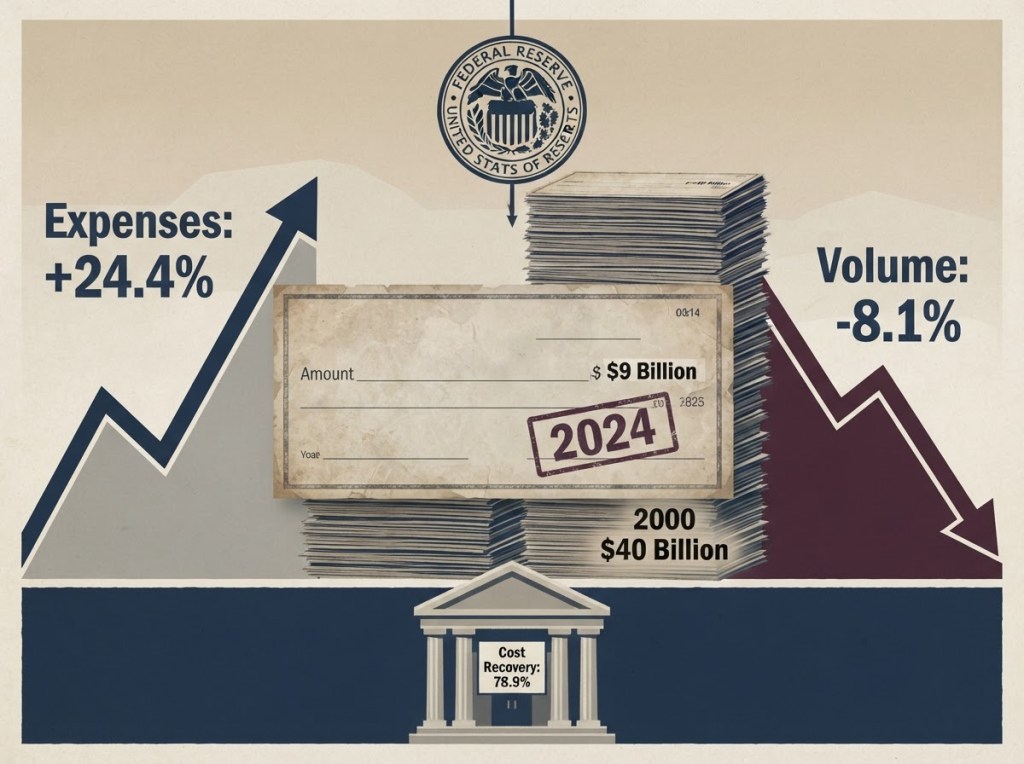
According to the accompanying Federal Register notice, the Federal Reserve expects its check-processing operation to recover just 78.9 percent of its expenses and targeted return on equity in 2027, compared with 94.5 percent forecast for 2026 and 99.6 percent achieved in 2025.
The decline is not simply the result of fewer Americans writing checks. The Federal Reserve is also confronting the costs of maintaining aging infrastructure, a problem that becomes more difficult to finance as transaction volumes continue to fall.
More Spending, Fewer Checks
The Federal Reserve’s projections illustrate the financial pressure facing the operation.
Check-service revenue is expected to increase from $107.4 million in 2026 to $110.8 million in 2027. Expenses, meanwhile, are projected to climb from $110.7 million to $137.7 million, an increase of approximately 24.4 percent.
That leaves a projected operating shortfall of approximately $26.8 million in 2027, before accounting for the targeted return on equity included in the Federal Reserve’s cost-recovery calculation.
The projected shortfall is particularly notable because the Reserve Banks are simultaneously increasing certain check-processing fees. The average Check Services customer is expected to face an estimated 5.4 percent price increase, although individual institutions may experience different changes depending on the services they use.
The underlying transaction volumes offer little relief. Through August 2026, commercial forward-check volume had declined 8.7 percent compared with the same period in 2025, while returned-check volume had fallen 4.2 percent.
For the full year, the Federal Reserve anticipates declines of 8.1 percent and 3.8 percent, respectively.
The long-term trend is even more pronounced. According to Federal Reserve payment statistics cited in the notice, approximately 40 billion checks were written in the United States in 2000. By 2024, that number had fallen to roughly 9 billion.
The country has not stopped using checks, but the infrastructure supporting them must operate with a fraction of its former transaction volume.
That creates a familiar problem for large institutions. When operating costs remain largely fixed but usage steadily declines, maintaining the same service becomes increasingly expensive on a per-transaction basis.
A Payment System That Cannot Simply Disappear
The Federal Reserve has already spent decades consolidating its check-processing operations.
In a December 2025 request for public comment, the Board explained that the Reserve Banks had reduced their check-processing centers from 48 to one between 1979 and 2010.
The remaining operation, however, continues to require substantial infrastructure and maintenance.
The Board warned at the time that aging systems would soon require significant investments and outlined several possible approaches, including simplifying services, upgrading infrastructure, maintaining existing operations with limited investment, or substantially winding down the Reserve Banks’ check-processing role.
The latter possibility would represent a considerable change in the Federal Reserve’s participation in the nation’s payment infrastructure.
Public feedback appears to have complicated any such decision.
The Board received more than 330 unique comments from financial institutions, businesses, trade organizations, service providers, consumer groups, and individual check users.
Many respondents emphasized that checks continue to serve purposes not fully addressed by electronic alternatives. Others highlighted the Federal Reserve’s nationwide reach and its importance to smaller financial institutions that may have fewer options for obtaining check-processing services.
The Federal Reserve ultimately decided to continue providing core check-processing services, at least for now.
But preserving that service will come with changes.
Shorter Processing Windows and Higher Fees
Beginning in May 2027, the Reserve Banks plan to expand their standard weekend and holiday maintenance windows, reducing the hours during which check-processing services are available.
The standard weekend maintenance window will increase from 16 hours to 39 hours. Under the revised schedule, check processing will generally close at 4 a.m. Eastern on Saturday and reopen at 7 p.m. Eastern on Sunday.
The Federal Reserve says the changes are intended to concentrate operations during periods of greater demand while allowing additional time for maintenance and system management.
Certain low-use services will also be discontinued, including Presentment Point offerings and SDS Presentment.
Other changes will increase charges for specific check-processing functions, including image delivery and selected adjustment services.
These measures are not expected to resolve the financial problem immediately. Indeed, the Federal Reserve’s projections show a substantial deterioration in cost recovery despite the higher fees and operational reductions.
The Board acknowledges that additional changes will likely be necessary over the next several years.
The distinction matters. This is not a single annual fee adjustment intended to restore financial balance. It is the opening phase of a broader restructuring whose ultimate scope has not yet been determined.
The Federal Reserve has also emphasized that the changes do not prevent consumers or businesses from writing, depositing, or receiving checks. They affect the services financial institutions obtain from the Reserve Banks, not the legal or practical availability of checks as a payment method.
Whether banks and credit unions eventually pass along some of the additional costs to their customers remains a separate question. The Federal Reserve’s announcement does not establish that such increases will occur.
The Cost-Recovery Requirement
The Federal Reserve’s pricing decisions are governed in part by the Monetary Control Act of 1980, which requires the Reserve Banks to establish fees sufficient to recover the costs of providing payment services over the long run.
Those calculations include direct operating expenses, indirect costs, and certain expenses and returns that a private-sector provider would ordinarily incur.
The latter are incorporated through what the Federal Reserve calls the private-sector adjustment factor.
For 2027, the Board approved a $35.3 million adjustment factor for mature priced services.
The Federal Reserve generally evaluates long-run cost recovery over a rolling 10-year period rather than requiring each individual service to recover all costs every year.
From 2016 through 2025, the Reserve Banks recovered 103.7 percent of their aggregate mature-service costs under the applicable calculation. Check Services independently recovered 104.6 percent over that period.
Consequently, the projected 2027 shortfall does not, by itself, establish a violation of the statutory cost-recovery requirement.
It does, however, raise questions about the sustainability of the existing arrangement if declining volumes and increasing expenses persist.
The broader payment-services portfolio is expected to remain above full cost recovery in 2027. FedACH, for example, is projected to recover 114.7 percent of its costs, while Fedwire Securities is expected to recover 113.8 percent.
Check processing is the exception.
The difference illustrates how the Federal Reserve’s various payment services are moving through different stages of technological and financial development. Some established electronic services remain comfortably above their cost-recovery targets, while the older check-processing operation faces increasingly difficult economics.
The newer FedNow instant-payment service is reported separately because it has not yet reached the relatively stable operating conditions associated with mature services.
A Broader Restructuring of Federal Reserve Payment Fees
The check-processing changes accompany a wider revision of how the Federal Reserve charges financial institutions for access to its payment systems.
Beginning in January, the Reserve Banks will introduce a monthly Federal Reserve Financial Services access fee of $300 at the parent-institution level, with additional charges for qualifying routing numbers.
At the same time, several existing FedLine connectivity charges will be reduced or eliminated.
The Federal Reserve describes the changes as an effort to simplify pricing and make its services more accessible. It expects the enterprise-level restructuring to be revenue-neutral in 2027.
The new schedule also includes a substantial charge for institutions that have not completed a required network migration.
Customers that fail to complete the mandatory FedLine Direct Primary Wide Area Network transition by December 31, 2026, will face an additional $15,000 monthly surcharge per affected circuit.
The Federal Reserve says the migration, underway since 2025, is intended to improve reliability and security for financial traffic.
These changes reflect a broader modernization effort occurring alongside the struggle to maintain older payment infrastructure.
The Reserve Banks are investing in newer networks and electronic payment capabilities while continuing to operate a check-processing system whose underlying transaction volumes have been declining for decades.
The Question the Federal Reserve Has Not Resolved
The Federal Reserve’s decision to maintain core check-processing services addresses an immediate concern raised by banks, businesses, and individual users. It does not resolve the longer-term question of how those services will be financed.
The Board’s own projections identify the central problem. Even with higher fees and reduced operating hours, check-processing expenses are expected to grow considerably faster than revenue in 2027.
Further price increases could improve cost recovery, but they could also make Federal Reserve check services less attractive to institutions already operating in a shrinking market.
Reducing services could lower expenses, but doing so may place additional burdens on smaller financial institutions and customers who continue to depend on checks.
Major infrastructure investments could preserve reliability, although those expenditures would themselves need to be recovered through future service charges.
The Federal Reserve has not announced a timetable for withdrawing from check processing, nor has it decided to eliminate the service. Its current approach is to preserve core operations while gradually changing fees, operating schedules, and service offerings.
Nevertheless, the Board has left open the possibility of reassessing the nature and scope of the Reserve Banks’ check-processing role if the financial outlook continues to deteriorate.
That leaves a significant accountability question.
How much should financial institutions be required to pay to preserve a nationwide payment service whose usage is steadily declining, and what level of service must remain available to those who still depend on it?
For now, the Federal Reserve is attempting to maintain the infrastructure while reducing its operating burden.
Its own numbers suggest that the difficult decisions are still ahead.
Source documents: Federal Reserve Board, November 12, 2026 press release; Federal Register notice, Docket OP-1883; and December 2025 request for information on the future of check services.

