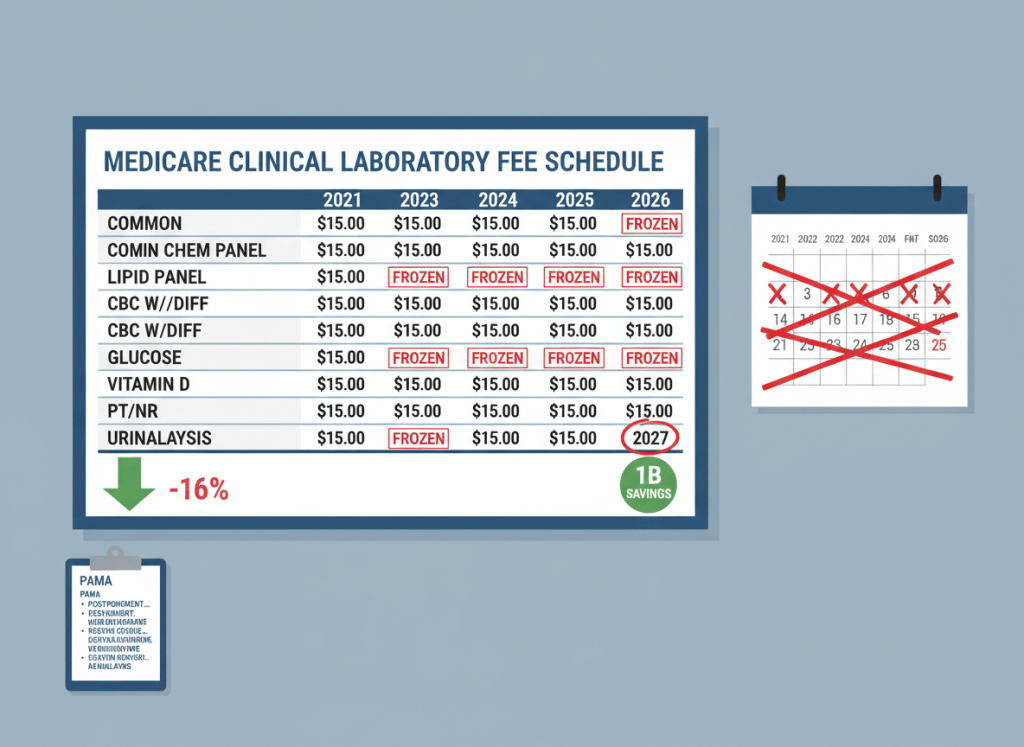
Congress created a market-based system for Medicare laboratory payments because the government had a fairly familiar problem: it was paying more than private insurers for many of the same tests. CMS’s preliminary 2027 Clinical Laboratory Fee Schedule is now the latest evidence of what happened when Congress spent six years preventing that system from correcting itself.
The solution sounded straightforward enough.
Collect what private insurers actually pay laboratories. Calculate the market rate. Use those numbers to periodically reset what Medicare pays.
Then Washington spent years postponing the resets.
Now, after finally collecting a fresh round of private-payer data, the Centers for Medicare & Medicaid Services says existing Medicare laboratory payment rates are approximately 16 percent higher, on average, than rates calculated from the private market.
CMS estimates correcting that difference will save taxpayers about $1 billion annually.
It is an impressive savings announcement.
It is also the latest chapter in a pricing system that Congress repeatedly prevented from doing precisely the thing it was designed to do.
The Government Builds a Market
The Protecting Access to Medicare Act of 2014, better known as PAMA, fundamentally changed how Medicare establishes prices under the Clinical Laboratory Fee Schedule.
Instead of relying primarily upon an administratively constructed fee schedule with historical roots, Congress directed CMS to collect payment information from laboratories and use the weighted median of private-payer rates to establish Medicare prices.
The logic was difficult to quarrel with.
If private insurers were routinely buying the same laboratory services for less money, Medicare should probably know about it.
There was considerable money at stake.
GAO later reported that Medicare paid approximately $7.1 billion for 433 million laboratory tests in 2017, the year before the first PAMA market-based rates took effect. The watchdog also found that Medicare had generally been paying more than private insurers before the transition.
The first new rates arrived in 2018.
Even that transition was hardly seamless.
GAO subsequently concluded that CMS’s implementation methodology had produced an estimated $733 million in additional Medicare spending between 2018 and 2020 compared with an alternative baseline GAO believed better reflected congressional intent.
Still, the underlying mechanism was now in place.
Private prices would be collected. Medicare prices would be recalculated. The exercise would be repeated periodically so that the government’s laboratory fee schedule would remain connected to the market it was supposed to reflect.
Then the updating largely stopped.
Six Years at Zero
The history is hiding in plain sight on CMS’s own Clinical Laboratory Fee Schedule page.
For 2020, Medicare laboratory payment reductions were limited to 10 percent.
For 2021, the reduction limit was zero.
Then zero again in 2022.
And 2023.
And 2024.
And 2025.
And 2026.
That six-year stretch was not the product of some unnoticed administrative malfunction inside CMS. Congress repeatedly altered the statutory schedule.
Beginning in late 2019 and continuing through pandemic relief legislation and subsequent congressional extensions, lawmakers postponed reporting periods and delayed the application of additional PAMA reductions.
Each intervention had its own legislative context. Taken together, however, they produced a remarkably simple result: for six consecutive calendar years, the ordinary PAMA mechanism could not impose further reductions on the vast majority of laboratory tests that otherwise would have been subject to them.
The market continued moving.
The Medicare schedule largely did not.
And Medicare continued buying laboratory tests by the hundreds of millions.
HHS’s Office of Inspector General reported $7.6 billion in Medicare Part B laboratory spending in 2018 and $7.7 billion in 2019. Spending reached $8 billion in 2020.
MedPAC’s broader Clinical Laboratory Fee Schedule figures show spending climbing to $10.7 billion in 2021 before declining to $9.8 billion in 2022 and $9 billion in 2023.
OIG reported that Part B laboratory spending reached $8.4 billion in 2024, a 5 percent increase from the previous year in its Part B dataset.
Those numbers should not be mistaken for a running ledger of money lost because Congress delayed PAMA reductions. They aren’t.
The laboratory market itself was changing dramatically during the same period.
Genetic testing is the most obvious example. OIG found that Medicare Part B spending on genetic tests exceeded $3.6 billion in 2024 and accounted for approximately 43 percent of total Part B laboratory spending.
Medicare was not simply buying the same basket of tests year after year at frozen prices.
But that changing market is precisely why periodically obtaining current market data was supposed to matter.
Then CMS Checked the Market Again
CMS finally received a substantial new batch of private-payer information this year.
The data underlying its preliminary 2027 Clinical Laboratory Fee Schedule cover private-payer transactions conducted between January 1 and June 30, 2025.
Laboratories reported those transactions to CMS between May and July 2026.
The resulting dataset was not trivial.
CMS says 6,411 laboratories submitted information covering 1,947 billing codes. The agency calculated weighted-median private-payer rates for 1,528 of them.
After years of statutory delays, Medicare once again had a contemporary private-market yardstick against which to measure its laboratory prices.
The yardstick delivered an inconvenient answer.
According to CMS, existing Medicare payment rates are approximately 16 percent higher, on average, than the new rates calculated using private-payer data.
CMS estimates that bringing Medicare’s rates into alignment will save taxpayers approximately $1 billion every year.
There is an almost perfect bureaucratic circle to the story.
Congress created PAMA because Medicare needed laboratory prices that better reflected the private market.
Congress then repeatedly postponed the process intended to keep those prices connected to that market.
CMS eventually obtained fresh market information.
And the government discovered Medicare was once again paying considerably more.
The $1 Billion We Cannot Backdate
The temptation at this point is obvious.
Six years of frozen reductions. One billion dollars in projected annual savings.
Multiplication is easy.
It would also be misleading.
CMS’s $1 billion estimate is based on the newly reported private-payer information and the preliminary payment rates calculated for 2027. It does not tell us what the correct market rate would have been in 2021, 2022 or any other year during the freeze.
We therefore cannot responsibly multiply the current savings estimate by six and declare that the delays cost taxpayers $6 billion.
Determining the actual fiscal effect of the repeated postponements would require reconstructing private-payer prices for those earlier periods and modeling what Medicare payments would have been had the scheduled reporting and reductions occurred.
The available federal records establish something narrower, but hardly insignificant.
Congress repeatedly postponed the system designed to update Medicare laboratory prices.
CMS imposed no PAMA-driven reductions from 2021 through 2026.
Medicare continued spending billions of dollars annually on laboratory services.
And when CMS finally compared its existing rates against a substantial new collection of private-payer data, it found Medicare’s prices approximately 16 percent higher on average.
The agency now expects correcting the discrepancy to save roughly $1 billion annually.
Even the Correction Has a Speed Limit
Medicare will not simply erase the difference on January 1.
Federal law continues to limit how quickly individual laboratory payment rates can fall. For calendar years 2027 through 2029, reductions for individual tests generally cannot exceed 15 percent in a single year.
That means some prices substantially above their newly calculated private-market rates will require multiple years to reach them.
The preliminary 2027 rates are being finalized this fall and are scheduled to take effect January 1.
So, more than a decade after Congress created a market-based laboratory pricing system, the government is preparing to resume the process of bringing Medicare prices closer to the market.
CMS is presenting the result as a significant taxpayer savings initiative, and $1 billion annually certainly qualifies.
But the savings announcement also raises the question sitting quietly beneath it.
If periodically checking Medicare’s prices against the private market can save taxpayers a billion dollars a year, what happens when Washington spends six years postponing the check?
For now, the government has not provided that number.
It has, however, provided a rather compelling reason to ask.

