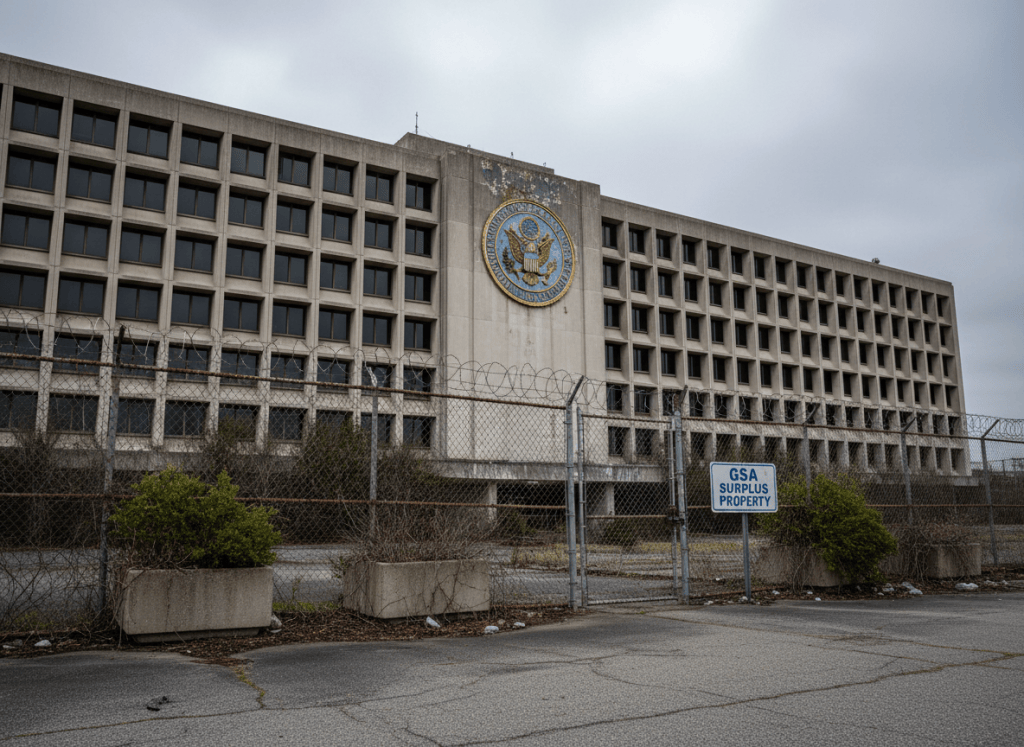
The federal government has spent a decade trying to prove it can sell its own buildings faster than it can grow moss on them. In 2016, Congress passed the Federal Assets Sale and Transfer Act, a law with a genuinely tidy premise. Create an independent board to identify unneeded federal real estate, let the General Services Administration sell it, and use the proceeds to fund the next round of sales. A self-perpetuating disposal machine, powered by its own output.
Then Congress built the machine, filled the tank once, and walked away for three years.
A Fund in Name Only
FASTA created the Asset Proceeds and Space Management Fund, a pool meant to hold sales revenue and reinvest it in future disposal costs. It is, on paper, an elegant piece of institutional design. Sell an unneeded federal warehouse, use a slice of the proceeds to relocate the tenants of the next unneeded building, repeat until the government’s real estate footprint stops costing taxpayers billions a year in upkeep on buildings nobody uses. A recent GAO report found that the government owns hundreds of thousands of buildings, and that disposing of the ones nobody needs can take years or decades while the bills keep coming.
The catch, tucked into every appropriations-dependent fund since the invention of the federal budget, is that money sitting in an account is not the same as money an agency is allowed to spend. Congress has to appropriate it first, round by round, year by year, at its own discretion. FASTA’s authors either didn’t anticipate how easily that discretion could evaporate, or didn’t care.
The Three Years Nobody Noticed
Between 2016 and 2022, Congress appropriated a cumulative $90 million from the fund, a modest but functioning start. Then, from fiscal year 2023 through 2025, it appropriated nothing. Zero dollars, three consecutive years, while GSA’s High-Value Round sales kept depositing proceeds into an account it increasingly could not touch. By the end of fiscal year 2022 the fund held roughly $194 million in sales revenue. The government had money sitting in the bank for a program built entirely around the premise of using its own proceeds efficiently, and it declined to authorize a withdrawal.
It is worth sitting with that for a moment. This isn’t a story about an agency losing track of paperwork or missing a deadline. It’s a story about a fund functioning exactly as designed, generating exactly the revenue it was supposed to generate, and then being denied access to that revenue by the same legislative body that wrote the design. The fund didn’t fail. It was throttled.
In 2026, with the program’s last recommended round underway and the Public Buildings Reform Board set to dissolve at year’s end, Congress appropriated roughly $143 million more, bringing the cumulative total to $233 million against a fund that, by then, held about $538 million following the long-delayed sale of a California property called Laguna Niguel. The gap between what the fund held and what GSA was permitted to spend ran as high as $300 million at points between 2022 and 2026. That gap is not an accounting curiosity. It is nine months of stalled relocation for the Railroad Retirement Board, an agency officials said would find self-funding “devastating to its mission.” It is a Chicago federal building whose tenant is waiting on a $19.5 million allocation that GSA has repeatedly flagged as “in flux.”
Self-Funding Was Always the Fine Print
GSA didn’t sit still during the drought. The agency requested funding for a separate initiative called the Optimization Program, eventually lining up roughly $470 million across fiscal years 2025 and 2026 to plug the gap FASTA’s own fund wasn’t allowed to fill. But that money comes with its own leash. Projects above a statutory cost threshold require congressional prospectus approval before the funds can even be obligated, and as of August 2026, only the House side of that approval had come through. The Senate side hadn’t. So GSA now sits on two separate pots of money it can see but, in one case, still cannot spend, for two separate bureaucratic reasons layered on top of each other like sediment.
Meanwhile, the law itself quietly changed the plumbing. Amendments passed in 2025 now route proceeds from the program’s second round and beyond directly to whichever agency owned the building, bypassing the central fund entirely, still subject to the same appropriations process that starved the fund in the first place. GSA officials told auditors the change granted no new efficiencies. It just moved the choke point somewhere else.
The Self-Funding Machine, Unfunded
None of this required a scandal, a whistleblower, or a single act of malice. It required Congress to write a law premised on reinvested proceeds, then treat the reinvestment step as optional for three budget cycles running. The Public Buildings Reform Board will cease to exist by the end of this year, having recommended more disposals than the appropriations process was willing to underwrite. What’s left is a machine that works exactly as designed, sitting mostly idle, waiting on a permission slip that took Congress three years to sign.

