The National Nuclear Security Administration would like you to know that it has learned something about contract oversight. In 2014, when it awarded the contract to build a new uranium processing facility at the Y-12 National Security Complex in Oak Ridge, Tennessee, it did something it almost never does. It gave the project its own line item, separate from the sprawling, undifferentiated blob of “management and operating” work that otherwise governs how NNSA pays its contractors. A separate fee plan. A separate performance evaluation. Isolated accountability, in theory, for a single, isolable piece of work.
According to a new GAO report on how NNSA uses contract line items, this was the pilot. The one meant to prove that separating deliverables out of the M&O morass would sharpen contractor performance and protect the government from the kind of cost bleed that has made NNSA’s acquisitions program a fixture on GAO’s High Risk List for over a decade.
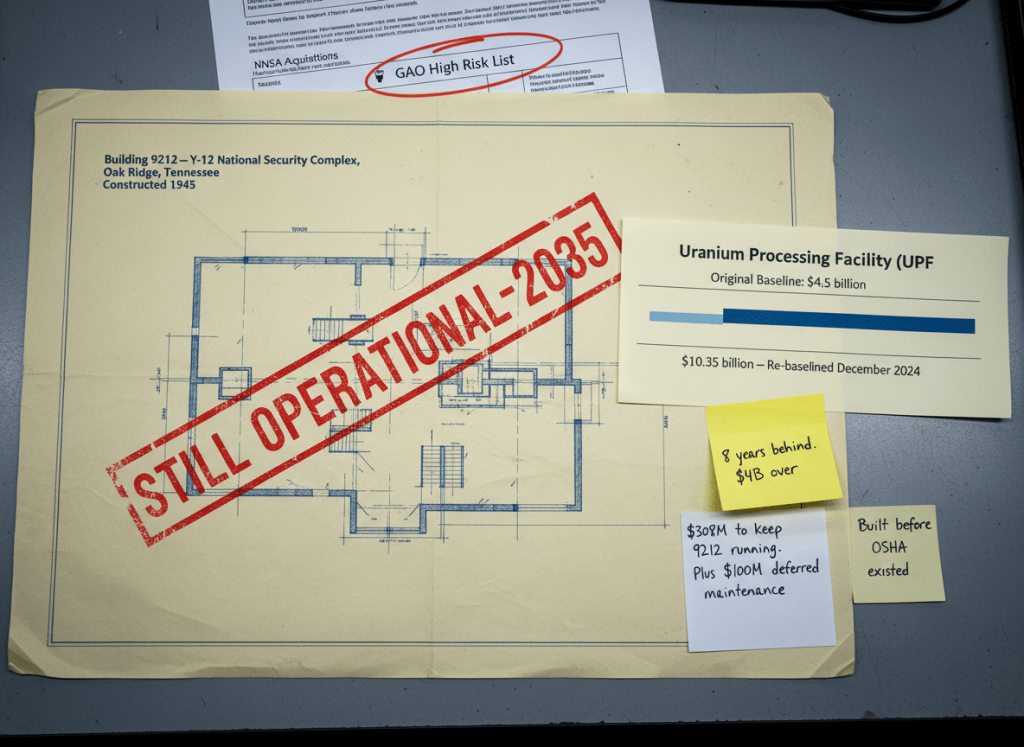
Here is how the pilot is going. The Uranium Processing Facility is nearly four billion dollars over its cost baseline and eight years behind schedule. NNSA re-baselined the project in December 2024, at a new estimate of $10.35 billion, more than fifty percent above where the project stood before. And because the replacement facility still is not ready, NNSA is now paying to keep the building it was supposed to replace alive, Building 9212, poured in 1945, older than the Atomic Energy Commission that once ran it, and not built to a code that anticipated an earthquake or a derecho hitting Oak Ridge. The Y-12 contractor’s own estimate for keeping 9212 in service is over $308 million, plus another $100 million in deferred maintenance nobody wants to put off any longer.
The Fee Structure That Was Supposed to Fix This
The theory behind giving a project its own line item is straightforward enough that GAO states it almost apologetically in the new report; separate the deliverable, separate the fee, and the contractor has a reason to hit the target instead of coasting on whatever else is going well across the site. NNSA officials told GAO they used exactly this logic for the Uranium Processing Facility, and for a while, on paper, it worked as designed. The line item let NNSA withhold fee when performance lagged. Officials told GAO that over the years since 2014, NNSA paid the contractor less than $40 million out of roughly $220 million in available fee, precisely because the fee was isolated and precisely because performance was bad.
Withholding fee is not the same as finishing a building. The project kept slipping anyway, right up until the 2024 re-baseline, at which point, GAO notes, the contractor’s cost and schedule performance apparently improved. Which raises the obvious question nobody in the report quite asks out loud: did the line item fix the contractor, or did NNSA just eventually agree to pay for the delay it had spent a decade complaining about, at which point the delay, unsurprisingly, stopped generating friction?
Separately, GAO’s February 2026 assessment of NNSA’s twenty eight major construction projects found that the UPF’s Main Process Building and Salvage and Accountability Building, the two subprojects riding under that pioneering line item, are responsible for roughly eighty percent of the $4.8 billion in cumulative cost overrun across the entire NNSA major projects portfolio, and forty percent of its thirty years of cumulative schedule delay. The flagship example of contract-oversight reform is also the single largest driver of the exact problem the reform was supposed to solve.
A Building That Predates the Concept of a Safety Code
None of this is abstract for the people who still have to run Building 9212 while its replacement crawls toward completion. The building processes enriched uranium for nuclear weapons components and Navy reactor fuel. It was constructed during the Manhattan Project‘s industrial buildout, before the National Environmental Policy Act, before OSHA, before DOE’s own seismic design standards existed in anything resembling their current form. GAO’s September 2025 review found that NNSA does not have a comprehensive, agreed-upon plan for how to keep operating it safely through the additional years the delay has bought it.
The $308 million is not a hypothetical either. It is the contractor’s own figure, submitted as part of planning for continued operations through 2035, one year past NNSA’s current target date for the new facility to be fully operational, itself a date GAO’s reporting suggests deserves some skepticism given the project’s history of missing every prior one. Consolidated Nuclear Security, the M&O contractor at Y-12, is simultaneously the entity being paid an isolated, performance-linked fee to finish the new facility and the entity submitting cost estimates to keep the old, code-noncompliant facility running because the new one is not finished. It is worth sitting with how neatly those two roles cancel each other out as accountability mechanisms.
What the Line Item Actually Bought
To be fair to GAO’s broader report, and to NNSA, nobody involved is claiming the line item made things worse. NNSA officials told GAO the tailored fee structure gave them leverage they would not otherwise have had, and withholding $180 million in fee over a decade is not nothing. The report’s two recommendations, that NNSA document its criteria for when to use line items and formally capture lessons learned from the ones it has used, are modest and NNSA has already agreed to both, with target dates in the spring of 2027.
But modest is the operative word, and it is worth being precise about what a documented criteria policy will and will not fix. It will not shrink Building 9212’s price tag. It will not un-spend the $4 billion the UPF re-baseline added to the government’s bill. What it will do, at best, is make NNSA’s next attempt to isolate a construction project’s fee and performance evaluation slightly more consistent across sites than the current, undocumented, case-by-case process that has left Los Alamos with zero project line items despite a $1.86 billion pit production subproject sitting well past the threshold the agency’s own officials cite for other sites.
The uranium processing facility was supposed to be the proof that separating the fee from the noise made contractors perform. Instead it produced a decade of withheld fee, a $4 billion rebaseline, and a Manhattan Project era building that will now run a year past NNSA’s own optimistic new deadline, on a budget nobody is calling a placeholder because the money has already been spent. If this is what accountability looks like when NNSA does it on purpose, on its single best-documented example, it is fair to ask what the agency’s much larger, entirely undocumented middle ground of construction spending is actually buying the country.
Sources: GAO, NNSA Contract Line Items: Agency Should Document Criteria for Use and Capture Lessons Learned (GAO-26-108409, September 2026); GAO, NNSA Construction Projects: Cost and Schedule Performance (GAO-26-107777, February 2026); GAO, Uranium Processing Facility: DOE Needs to Address Cost, Schedule, and Risk Challenges (GAO-25-107330). Related: The Design Standard NNSA Lowered to Keep Its Plutonium Factory on Schedule.

