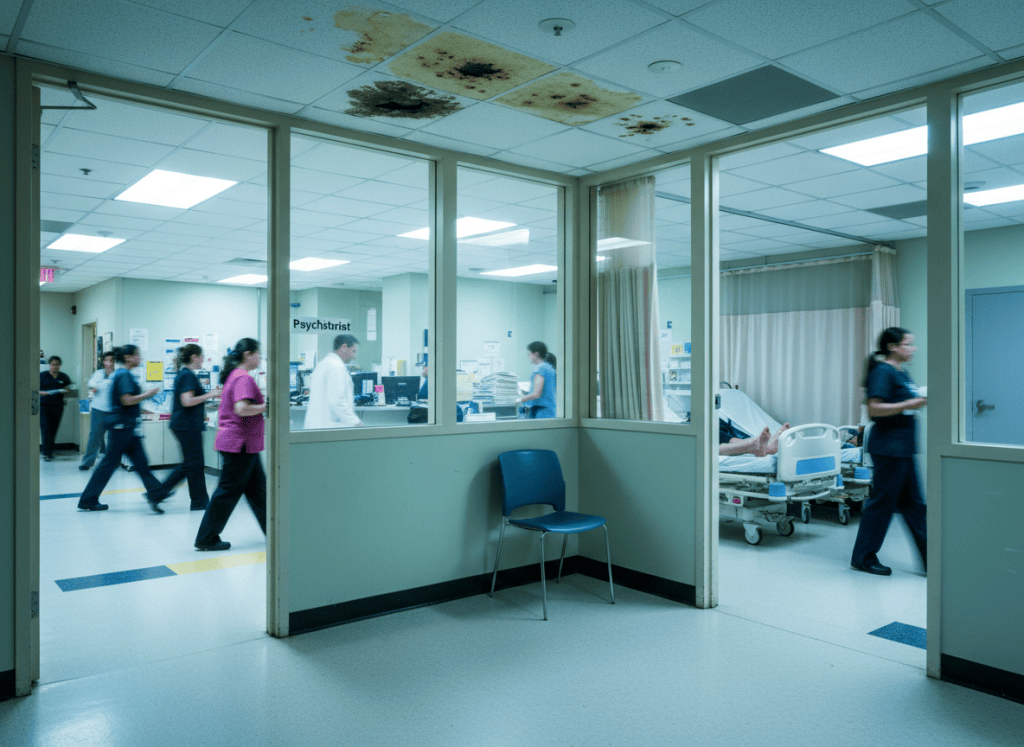
The VA Office of Inspector General inspects every VHA medical facility on roughly a three year cycle, which means that for roughly three years at a stretch, nobody with subpoena-adjacent authority is required to walk into the emergency department at the Manhattan campus of the VA NY Harbor Healthcare System and ask why psychiatric patients are being interviewed in a glass box. When inspectors finally did, in March 2026, they discovered the box already had a name. The emergency medicine chief and the associate chief of staff for psychiatry both called it “the fishbowl,” a phrase presumably retired the moment anyone from outside the building was in earshot. A label on the door, more literal than the nickname deserved, read “Psychiatrist.” Patients being asked about suicidal ideation or sexual trauma were doing so visible from multiple angles, inside the department and out.
The facility’s privacy officer, asked directly, said she had never observed two stretchers sharing a single bay during her environment of care rounds, an arrangement inspectors documented as ongoing. The emergency medicine chief, asked the same question, said the setup had existed for at least six years. Both statements can be true. That is the finding.
An Emergency Department Held Together by Load-Bearing Cardboard
VA NY Harbor is not a small operation. It runs three medical centers, in Manhattan, Brooklyn, and Queens, plus two outpatient clinics and two mobile units, on a fiscal year 2025 medical care budget of roughly $955 million, serving about 44,000 veterans a year. Brooklyn and Queens came through the inspection clean; the OIG had no environment of care findings at either site. Manhattan did not fare as well.
In the emergency department, inspectors found exposed plywood where laminate had worn off the nurses’ station desk, dirty ventilation, stained and gapped ceiling tiles, cracked floors, and a broken latch on the isolation room door. In the dental clinic one floor or hallway away, they found rusted metal cabinets, chemicals and supplies stored under sinks, dirt beneath eyewash station covers, food and drink sitting in the dental laboratory (a documented violation of VA’s own infection control standards for dental clinics), and, repeatedly, corrugated cardboard boxes, the kind that harbor pests and dust and add combustible load to a room full of chemicals. Two oral surgery rooms had ceiling gaps directly above the surgical chairs.
None of this had been flagged during the facility’s own recent comprehensive environment of care rounds, the internal inspection process that exists precisely to catch it. When the OIG team came back the next day for a reinspection, staff had already started cleaning some of it up, which is its own small confession; the fixes were achievable on short notice, which means the problem was never a resourcing question. It was a noticing question.
Two Stretchers, One Bay, and a Six-Year Argument With Itself
The privacy finding is the more instructive one, because it is not really about physical space. It is about what an institution’s own oversight function is capable of seeing. The facility has a privacy officer whose job includes environment of care rounds. Those rounds, by her account, never turned up two patients sharing a curtain-less bay. The department’s own chief clinician says that configuration is not new; it is closer to institutional furniture.
The Joint Commission’s Rights and Responsibilities of the Individual standard requires hospitals to protect patient privacy, and the OIG noted the practical stakes plainly; patients who cannot get privacy for sensitive complaints, mental health crises, sexual trauma, substance use, are patients who may simply decline to raise them at all, or who leave the encounter feeling exposed rather than treated. The facility’s own response to the finding was immediate and almost too easy; ED staff pulled one stretcher out of each affected bay the moment the recommendation landed, eliminating the shared space rather than solving it with a curtain, which raises the obvious question of why a curtain, or a policy, or literally anyone’s attention, hadn’t managed that six years earlier. For the fishbowl itself, the facility’s fix leans on VA’s own emergency department design guidance, which calls for psychiatric screening rooms to allow direct staff observation, meaning the transparency was not an accident so much as an unexamined design tradeoff between clinical monitoring and patient dignity that nobody had revisited since whoever built the room made the call.
A Test Result Workflow That Exists Everywhere Except Where It’s Needed
The OIG’s third finding is duller on its face and structurally identical underneath. VHA Directive 1088(1) requires every service line to maintain a documented workflow specifying which non-provider staff, nurses, licensed practical nurses, medical support assistants, are authorized to communicate which kinds of test results to patients. The facility has a general policy stating that licensed or certified staff may relay non-critical results. What it does not have, across “several specialty care services,” is the service-level documentation the directive actually requires, the part that would tell a nurse in cardiology or dermatology whether calling a patient about a scan result is her job or someone else’s.
Leaders confirmed the gap themselves when asked. Nobody was hiding it. It had simply never been built, in the same way the cardboard boxes had simply never been thrown out and the privacy officer had simply never seen what her colleague had been describing for six years. The facility’s own quality tracking mechanisms, the Joint Patient Safety Reporting system, the Good Catch program, the External Peer Review Program, the monthly committee meetings, exist in some abundance. What they apparently do not do reliably is surface a problem that a Manhattan ED nurse could have told you about on any given Tuesday.
The Oversight Cycle Doing What It’s Designed to Do, Which Is Not Enough
Give the facility this much; leadership concurred with all three recommendations, submitted corrective action plans, and in the case of the environment of care findings, moved fast enough that some of it was already fixed by the time the OIG came back the following day. The VISN director signed off. The interim facility director signed off. Everyone involved said the right things in the appendixes.
But the report itself arrives with a footnote worth sitting with; the VISN structure it describes, the one responsible for overseeing this facility, no longer exists in the form the report uses to describe it. In the months surrounding this inspection, VA consolidated its 18 Veterans Integrated Service Networks down to 5, a reorganization announced in pieces between December 2025 and July 2026, mid-stream of the very inspection cycle meant to hold the old structure accountable. The report’s own authors had to add a disclaimer explaining that recommendations addressed to a now-defunct VISN director apply to whoever holds the equivalent job in the new one.
That is the pattern underneath all three findings, scaled up. A privacy officer who does rounds but doesn’t see what’s in front of her. A directive that exists in policy but not in the one department that needed it. A three-year inspection cycle checking on an organizational chart that gets redrawn faster than the cycle completes. The OIG can only inspect the facility that exists on the day the team walks in. Everything else, six years of a fishbowl, a fiscal year of cardboard boxes, an oversight structure reorganized out from under its own paperwork, keeps running on the honor system until somebody happens to look.

