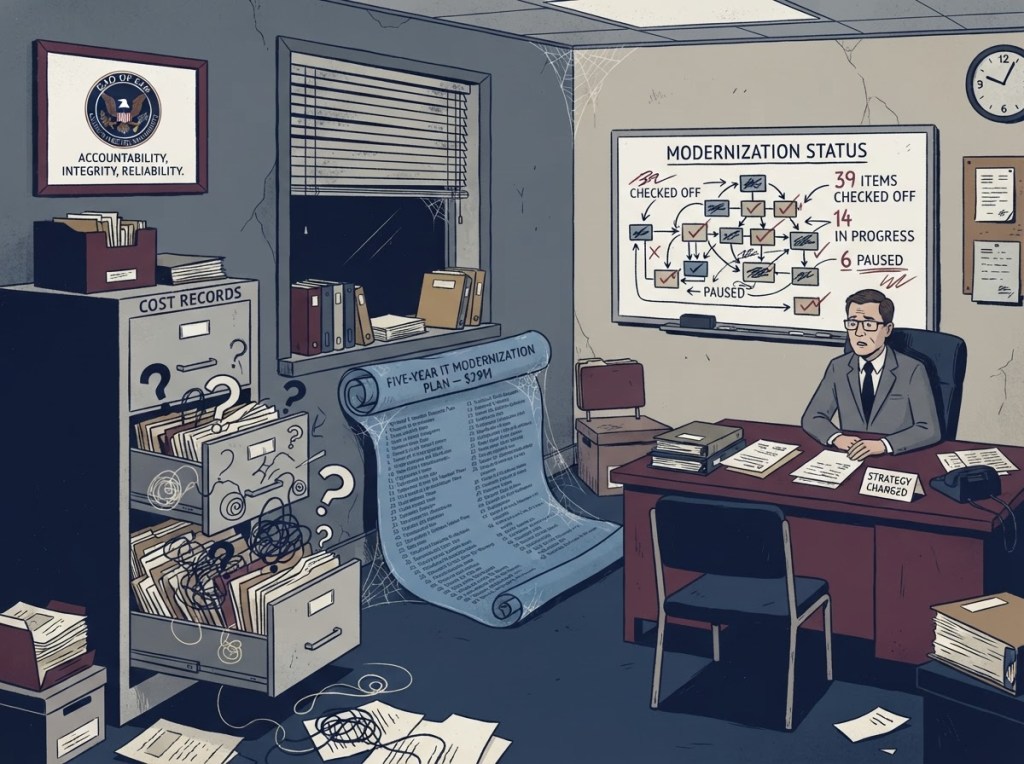
The congressional watchdog’s own Inspector General found that incoming technology leaders could not reconstruct a major strategic decision, modernization costs were difficult to isolate, and contract-rate corrections required years of follow-up.
The Government Accountability Office regularly examines whether federal agencies document major technology decisions, track spending, and maintain the financial controls necessary to protect taxpayer dollars. Its own Inspector General has now identified shortcomings in those areas inside GAO.
In 2021, GAO paid approximately $1 million for a five-year information technology modernization plan containing 61 initiatives with projected costs of about $29 million. Less than 18 months after the plan was finalized, the agency had shifted away from using it as its governing strategy. The decision was not adequately documented, and incoming technology leaders could not reconstruct why the change had occurred.
The agency continued modernization work. By May 2026, it reported completing 39 of the original initiatives. But its cost records did not readily identify total expenditures associated with the original plan. A GAO official told the Inspector General that reconstructing the complete costs would not be cost-effective.
A separate acquisition audit found that GAO paid approximately $94,000 above previously negotiated labor rates under a facility-maintenance arrangement before completing the necessary contract modifications. An initial retroactive correction in 2023 omitted two relevant contract line items; additional corrections followed in 2026.
Neither audit establishes that the $29 million projected for modernization was lost or that the $94,000 was fraudulently paid. Together, however, they reveal weaknesses in documenting management decisions, reconstructing project costs, and ensuring that payments correspond to properly modified contracts.
A $1 Million Roadmap With 61 Initiatives
GAO commissioned the five-year modernization plan to guide technology improvements, including cloud capabilities, application modernization, and supporting infrastructure. The approximately $1 million paid to develop the roadmap was distinct from the roughly $29 million estimated for the initiatives it described.
The original plan was not simply abandoned in the sense that all work stopped. The Inspector General’s August 2026 audit, OIG-26-2, accounted for the status of all 61 initiatives as of May 2026: 39 completed, 14 ongoing, six paused, one canceled, and one replaced.
Those counts describe initiatives, not their dollar values or measured benefits. Completing approximately 64 percent of the initiatives does not establish that GAO completed the same proportion of the planned spending or achieved 64 percent of the intended outcomes.
The distinction is central to the audit. The OIG was not reporting that modernization ceased. It was examining whether the agency preserved the decisions and financial information needed to explain what changed, what continued, and what the work cost.
Incoming Technology Leaders Found the Plan Was No Longer in Use
The OIG’s chronology places the strategic shift before two changes in technology leadership. A former acting chief information officer who assumed the role in February 2023 found that the five-year plan was no longer actively used. Another chief information officer who assumed the role in May 2023 encountered the same situation.
The audit does not identify who originally authorized the change or establish its exact date. GAO officials explained that modernization initiatives continued and that earlier leaders may have regarded the shift as an evolution of the program rather than a single decision requiring a formal record.
The Inspector General nevertheless found the missing documentation significant. Subsequent leaders could not fully reconstruct the rationale for moving from the original five-year roadmap to a rolling modernization approach.
The plan also had a congressional audience. In fiscal year 2022, Congress requested an action plan addressing the schedule, cost, and implementation of secure and resilient data-center infrastructure. GAO responded by summarizing its modernization plan. The roadmap therefore was not solely an internal planning exercise.
Changing a technology strategy is not inherently improper. A plan developed for a five-year horizon may need adjustment as security requirements, funding, and technology evolve. The accountability issue is whether the reasons for a significant change are preserved for future managers and congressional oversight.
The Costs Could Be Tracked, but Not Readily Reconstructed
GAO officials maintained that the agency tracked its information technology expenditures. The OIG did not find that GAO lacked ordinary accounting records. Instead, it found that the available records did not readily isolate the costs associated with every initiative in the original modernization plan.
Some smaller modernization activities were grouped under larger projects without identifiers linking their spending back to the 61-initiative roadmap. Determining the full cost of the original effort would therefore have required manual review of the underlying records.
An agency official told the Inspector General that calculating the total cost associated with the original modernization plan would not be cost-effective. That was GAO’s management assessment, not a finding that the records had vanished or that reconstruction was impossible.
Still, the explanation raises a practical oversight question. If an agency cannot readily determine what its planned modernization initiatives cost, assessing the relationship between expenditures, completed work, and program benefits becomes more difficult.
The Inspector General recommended stronger documentation of significant technology decisions and improved controls to track and report the costs of future major projects. GAO agreed with the recommendations.
A Governance Board and Promised Corrections
GAO reported establishing a Technology and Data Governance Board in June 2026 to strengthen oversight of internal technology decisions. It also described plans to incorporate documentation controls into operating procedures and strategic planning.
Management expected documentation and budget-review improvements by December 2026 and additional decisions concerning project-level cost tracking and implementation by February 2027.
These dates are management targets, not evidence that the work has been completed. Both technology recommendations remained open at the September 30 reporting cutoff. Their eventual closure depends on the Inspector General’s assessment of the corrective evidence.
A Separate Audit Reveals a Contract-Rate Problem
The OIG’s September 2026 acquisition management audit, OIG-26-3, identified a different weakness in GAO’s internal financial controls.
The audit examined a sample of four time-and-materials orders and 19 invoices under a facility-maintenance blanket purchase agreement established in fiscal year 2019. After modifications, the agreement had a maximum value of approximately $119 million. That ceiling is context for the contracting arrangement, not the amount questioned by the audit.
The Inspector General found that GAO approved payments using higher labor rates resulting from a collective bargaining agreement without first properly modifying the governing blanket purchase agreement and associated orders. During the second option year, the rates paid were approximately $94,000 higher than the previously negotiated rates.
The audit did not conclude that the entire $94,000 represented theft, fraud, or a recoverable loss. The documented problem was the absence of the contract modifications required to support the changed payment terms.
A Correction That Initially Missed Two Line Items
The chronology reveals that correcting the problem was not a single administrative step. GAO paid the higher rates in 2021. The Inspector General notified the agency about the discrepancy in February 2023.
In May 2023, GAO retroactively modified the blanket purchase agreement, but the modification omitted two contract line items, 0213 and 0217, associated with the invoices examined by the OIG.
The audit also described a misunderstanding by the contracting officer’s representative, who believed that modifying an individual order was sufficient to change the underlying blanket purchase agreement.
GAO later provided evidence of additional corrective modifications in August 2026, allowing the Inspector General to close the corresponding recommendation.
The agency also acknowledged that the labor-rate issue affected additional orders beyond the OIG’s sample and said it was reviewing those orders for appropriate action. The public audit does not establish whether that review found further discrepancies or any additional financial consequences.
The sample itself was limited. Eighteen of the 19 invoices reviewed involved the adjusted labor rates. The finding should not be presented as a comprehensive examination of every transaction under the $119 million agreement.
Procurement Guidance Needed Attention, Too
The acquisition audit also identified opportunities to improve GAO’s procedures for reviewing subcontracting costs, including the risk of excessive pass-through charges when prime contractors add costs without contributing commensurate value.
The OIG did not establish that excessive pass-through charges had actually been paid in the transactions examined. It identified insufficiently clear guidance for evaluating the risk.
The audit also called for clearer instructions on procurement procedures involving General Services Administration schedules. GAO agreed with the recommendations and reported developing additional guidance.
Two acquisition recommendations were closed in September 2026, while four remained open. Further invoice-review, contracting, and procurement guidance improvements were scheduled into early 2027.
GAO’s Own Oversight Standards Apply
GAO’s Standards for Internal Control in the Federal Government emphasize documentation of significant events and the use of quality information. The Inspector General relied on those principles when assessing the agency’s technology management.
GAO has also applied comparable principles in its public oversight of other agencies’ modernization programs, including examinations of incomplete planning and unreliable cost and schedule information. Those external findings concern different programs and should not be treated as equivalent in scale or severity to GAO’s internal problems.
The comparison nevertheless underscores the central point. Documentation, reliable cost information, and sound contract controls are not optional simply because the institution being examined is itself an auditing agency.
The Test Is What GAO Can Demonstrate
GAO’s responses to the two audits were generally cooperative. The agency accepted recommendations, created governance arrangements, corrected contract documentation, and established timelines for further changes. Some recommendations had already been closed.
That record deserves recognition. But agreement with an audit is not the same as completing corrective action, and a management deadline is not proof that a weakness has been resolved.
The technology findings leave questions about who approved the original strategic shift and whether the full cost of the 61-initiative modernization effort can now be reconstructed. The acquisition findings leave a separate question about the outcome of GAO’s review of additional maintenance orders outside the OIG’s sample.
The answers may emerge from future Inspector General reporting, agency records, or narrowly targeted inquiries. Until then, the established findings are sufficient to show why the congressional watchdog’s own administrative decisions require sustained independent review.
GAO’s credibility does not require a claim that it never encounters management failures. It requires that its own failures be documented, corrected, and subjected to the same scrutiny it expects of the agencies it audits.
Source note: Principal sources are GAO Office of Inspector General reports OIG-26-2, Information Technology Modernization, and OIG-26-3, Acquisition Management, with context from the Fall 2026 Semiannual Report to Congress, OIG-27-1SP. Recommendation statuses reflect the dates covered by those reports.

