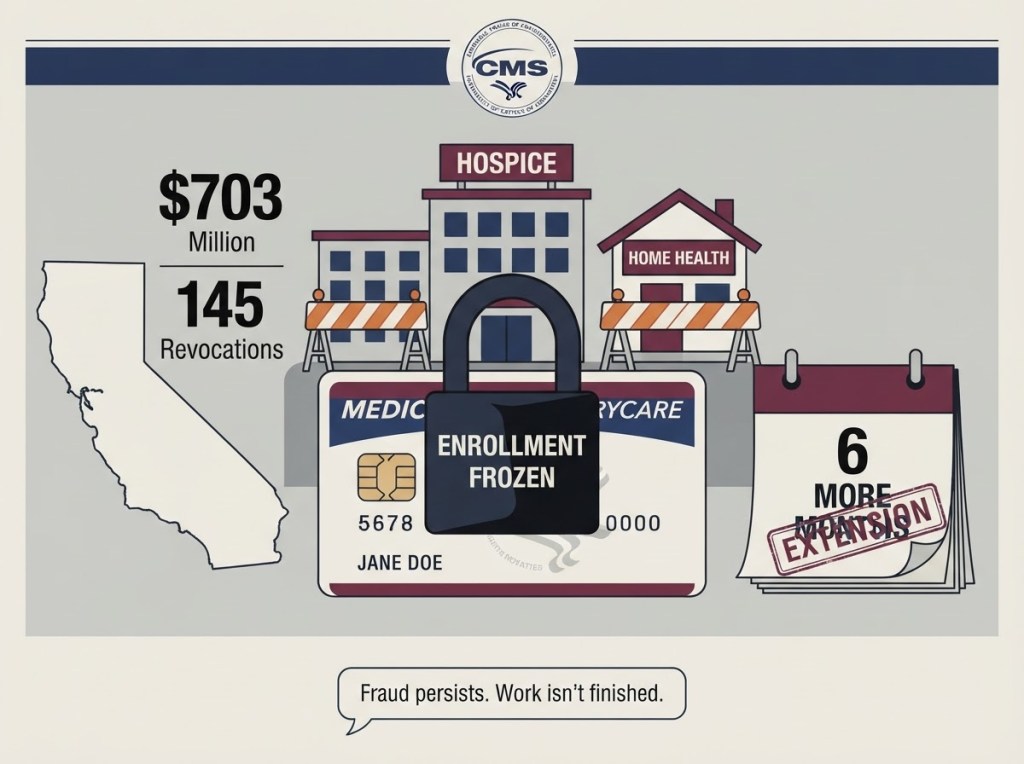
Six months after imposing nationwide restrictions on new hospice and home health providers, federal officials say the conditions that prompted the crackdown remain unresolved.
Six months after freezing new Medicare enrollments for hospice and home health agencies nationwide, the Centers for Medicare & Medicaid Services (CMS) is extending the restrictions for another six months, acknowledging that the fraud risks behind the original intervention have not sufficiently diminished.
The November 12 announcement continues one of the federal government’s broadest enrollment restrictions on two categories of healthcare providers serving elderly, seriously ill, and homebound Americans. It also introduces an exception allowing existing providers to expand their operations, raising questions about how CMS intends to balance fraud prevention against access to legitimate care.
Perhaps the most striking figure in the announcement concerns California, where CMS says a two-day enforcement operation in October resulted in 145 provider revocations associated with more than $703 million in Medicare and Medicaid payments.
That figure is significant, although it requires an important qualification. CMS did not establish in its announcement that the entire $703 million represented fraudulent payments, improper expenditures, or recoverable taxpayer losses.
The distinction illustrates a larger accountability question surrounding the extended restrictions: What measurable results has the federal government achieved during the first six months, and how much fraud has actually been prevented or recovered?
Six Months Later, the Threat Remains
CMS originally imposed the nationwide enrollment moratoria on May 13, 2026, using authority established under the Affordable Care Act to restrict new providers when federal officials identify significant potential for fraud, waste, or abuse.
The restrictions prevent new hospices and home health agencies from enrolling in Medicare and cover certain changes in majority ownership that require a new enrollment application. Existing enrolled providers may continue delivering services.
In separate Federal Register notices covering hospices and home health agencies, CMS determined that the conditions justifying the original moratoria have not abated sufficiently to permit their removal.
The extensions are effective November 12 under the notices, although CMS’s enrollment guidance lists November 13. Both notices are scheduled for Federal Register publication on November 16.
CMS Administrator Dr. Mehmet Oz acknowledged that the agency’s work remains unfinished.
“We’ve made real progress over the past six months, but fraud in hospice and home health persists and our work isn’t finished,” Oz said.
The nationwide scope is particularly noteworthy. Earlier Medicare enrollment moratoria, beginning in 2013, generally targeted specific states, counties, or metropolitan areas. Those restrictions were extended and expanded over several years before the last of that series expired in 2019.
The current approach prevents operators from avoiding enrollment restrictions simply by relocating to another state. It also means legitimate new providers in areas without documented concentrations of fraud face the same Medicare enrollment barrier as those seeking to enter historically problematic markets.
CMS can extend the restrictions in additional six-month increments if it determines they remain necessary.
California Enforcement Raises a $703 Million Question
CMS identified an October enforcement operation in California as evidence of its continuing efforts to remove problematic providers from federal healthcare programs.
According to the agency, site visit teams conducted a two-day operation targeting hospices and home health agencies, resulting in 145 provider revocations associated with more than $703 million in Medicare and Medicaid payments.
The announcement does not explain how much of that payment total was determined to be fraudulent, how much constituted improper payments, or whether CMS expects to recover any particular amount.
Nor does the release identify the period covered by the payments or provide a breakdown of the revocations by provider category.
A provider’s revocation from Medicare enrollment can result from various regulatory or enrollment violations. Such action does not, by itself, establish that every payment previously received by that provider was fraudulent.
The distinction is important because the financial scale of an enforcement operation can appear considerably different depending on whether the amount represents total historical payments, identified overpayments, or money actually recovered.
CMS has not supplied those distinctions in the November 12 announcement.
The California operation may represent a substantial enforcement achievement. Determining its financial impact, however, requires more information than the agency has publicly provided in this release.
Existing Providers Gain an Expansion Exception
While continuing to block new Medicare enrollments, CMS is modifying the moratoria to allow currently enrolled hospices and home health agencies to add practice locations under their existing enrollments within the same state.
The original restrictions prohibited these additions.
The modification could help established providers expand into communities needing additional hospice or home health services without requiring the creation of entirely new Medicare-enrolled organizations.
It also creates a regulatory distinction between established operators seeking to expand and prospective providers attempting to enter the Medicare program for the first time.
CMS has not detailed in its announcement how it will evaluate fraud risks associated with those additional locations or whether particular safeguards will distinguish legitimate expansion from attempts to exploit existing enrollment privileges.
That does not mean the exception is inherently problematic. Existing Medicare providers already operate within an established regulatory framework, and permitting expansion may reduce some of the access concerns created by nationwide restrictions.
Nevertheless, the exception places additional importance on CMS’s ability to identify problematic ownership structures, questionable management arrangements, and suspicious billing patterns among providers already participating in Medicare.
Protecting Taxpayers Without Restricting Care
The enrollment freeze also presents a challenge that extends beyond fraud enforcement.
Hospice providers deliver end-of-life care, while home health agencies provide services to patients who may have difficulty accessing treatment outside their homes. Restrictions on new providers can therefore have consequences beyond the businesses seeking Medicare enrollment.
The nonprofit aging-services association LeadingAge expressed concern about the extension, arguing that fraud prevention and access to care should not become competing priorities.
The organization said its initial support for the moratoria reflected their limited duration and the opportunity for CMS to develop more targeted safeguards.
The agency’s decision to permit additional practice locations may address some expansion concerns, but it does not resolve the broader question of whether legitimate new providers are being prevented from serving communities where additional capacity is needed.
The underlying federal statutory framework recognizes that access matters. Medicaid provisions generally require states to comply with federal enrollment moratoria but allow exceptions when restrictions would adversely affect beneficiaries’ access to care.
Whether the nationwide Medicare restrictions have produced measurable access problems, and whether the revised exception adequately addresses them, remains an important question for federal oversight.
New Rules Expand CMS Enforcement Authority
The moratoria are only one component of CMS’s broader enrollment enforcement strategy.
The agency also pointed to changes finalized in the Calendar Year 2027 Home Health Prospective Payment System rule, including provisions making Medicare enrollment revocations retroactive to the date a provider became noncompliant.
That change is intended to strengthen the government’s ability to recover payments made during periods when providers failed to satisfy applicable requirements.
Other provisions expand grounds for enrollment denial or revocation and address ownership changes, licensing problems, geographic concentrations of providers, and management arrangements that may indicate inadequate oversight.
Among the arrangements receiving additional scrutiny are individuals serving as medical directors or administrators for multiple hospices, including situations where geographic distance could prevent meaningful performance of required duties.
Taken together, the changes suggest CMS is pursuing both immediate enrollment restrictions and longer-term regulatory measures intended to make questionable providers easier to identify and remove.
The effectiveness of those measures will ultimately depend on enforcement results, not merely the number of new regulatory authorities available to the agency.
The Unanswered Questions
CMS has presented the extension as a necessary continuation of its campaign against Medicare fraud. Its announcement also leaves several important measurements unresolved.
How much of the $703 million associated with California’s revoked providers represents established improper payments or recoverable losses? How many fraudulent enrollments have been prevented since May? And what evidence demonstrates that the nationwide freeze is reducing fraudulent billing rather than simply delaying the entry of new providers?
Equally important is whether CMS has assessed the consequences for legitimate organizations and beneficiaries seeking access to hospice and home health services.
The agency’s decision to extend the moratoria does not establish that its enforcement strategy has failed. Persistent fraud risks may justify continued restrictions, particularly when federal healthcare programs face organized attempts to exploit enrollment and payment systems.
But an additional six months of nationwide restrictions also creates an additional six months in which the government should be expected to demonstrate results.
For taxpayers, providers, and Medicare beneficiaries, the essential measure is not how long the enrollment freeze remains in place. It is whether the intervention produces demonstrable reductions in fraud while preserving access to legitimate healthcare.
CMS has given itself another six months to pursue that objective. The public still needs a clearer accounting of what the first six months accomplished.

