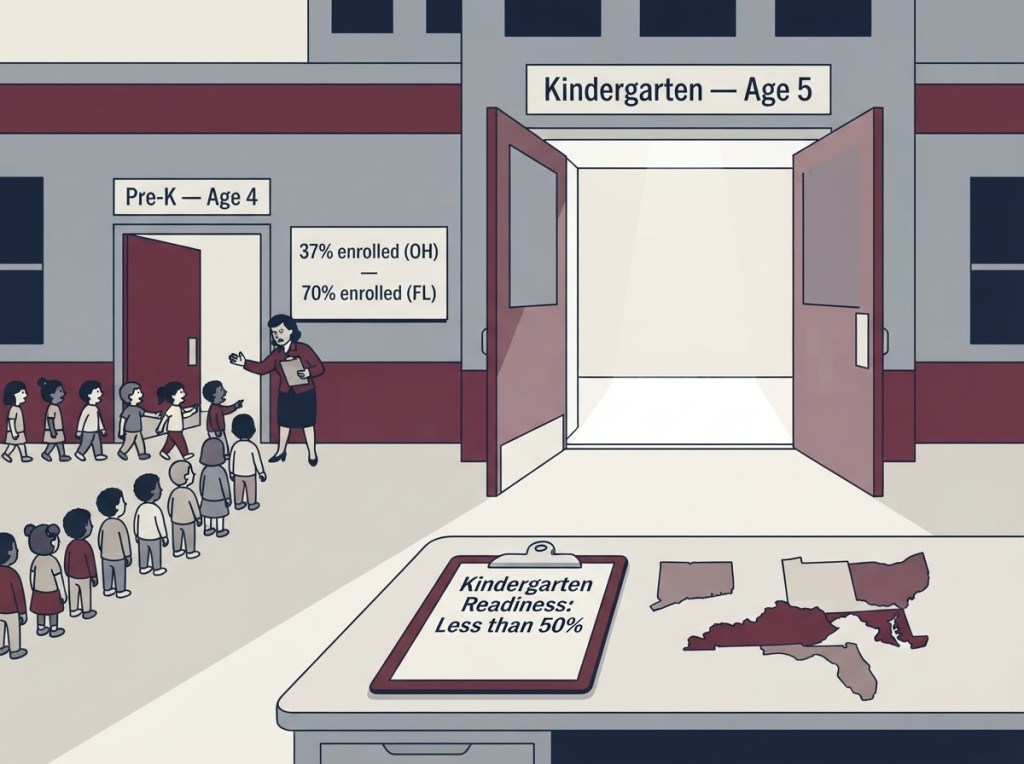
Less than half of kindergartners were ready for school in each of five states examined by a new GAO report. The report counts how many children arrived unready. It does not count how many were offered a way to get ready.
Public school opens its doors at five. Nothing equivalent opens at four.
That gap sits underneath a GAO report released Thursday finding that less than half of kindergartners were ready for kindergarten in each of five states it examined. The report counts how many children arrived unready. It does not count how many were offered a way to get ready.
A Front Door at Five, a Waiting Room at Four
GAO describes kindergarten as the main entry point to public school. The skills it measures at that door are built earlier, at home, in child care, and in preschool, wherever a family could find a seat.
Those seats are not evenly distributed. The National Institute for Early Education Research’s 2025 yearbook found that 44 states and DC fund preschool, yet only 37 percent of 4-year-olds and 9 percent of 3-year-olds were enrolled in state programs in 2024-25. Just twelve states enrolled more than half of their 4-year-olds.
Add special-education pre-K and Head Start, and NIEER’s Table 4 puts the national figure for 4-year-olds at 46 percent. NIEER warns that total may overcount because of overlap.
Private preschool fills some of the remainder for families who can pay. Federal data show 48.8 percent of 3- and 4-year-olds were enrolled in any preschool or kindergarten program in 2023.
Less Than Half of Whom?
GAO analyzed kindergarten entry assessments from Connecticut, Florida, Kentucky, Maryland, and Ohio. Ohio came in at 37 percent ready, Florida at 43, Maryland at 44 (from 2023-24, because the state skipped a test in 2024-25), and Kentucky at 46.
Connecticut reports no overall number. GAO counted four of its six developmental areas below half. GAO also says the results cannot be compared across states, because each sets its own benchmark.
The report finds that districts with more preschool enrollment had higher readiness in Connecticut, Kentucky, and Ohio, and no significant link in Florida or Maryland. GAO says those regressions are not causal, use district-level data, and rely on Census estimates that combine public and private enrollment.
The report does not separate children who had a seat available from children who did not. Nor does it use data on whether individual children attended. The Department of Education had no comments on the draft.
NIEER’s Table 4 supplies the access picture. Here is the share of 4-year-olds in any public program (state pre-K, special-ed pre-K, or Head Start):
- Florida: 70 percent
- Maryland: 44 percent
- Kentucky: 37 percent
- Connecticut: 30 percent
- Ohio: 29 percent
So about seven in ten Ohio 4-year-olds were in no public program. Ohio also had the lowest readiness number in the report.
Florida complicates any tidy story. It enrolled 63 percent of 4-year-olds in state pre-K and ranked 44th in state spending per child, at $2,946. GAO found no significant link between preschool enrollment and readiness there, and one of its 11 reviewed studies found no association for Florida’s program. Only 43 percent of Florida kindergartners were ready. NIEER’s spending ranking is context, not an explanation. The report does not say why Florida differs.
The Data GAO Didn’t Use
Two of the five states already track who attended preschool, and GAO’s report does not use that data.
Ohio’s children and youth office has collected parent-reported preschool attendance for two years. Its impact brief shows 42.7 percent of attendees demonstrating readiness, versus 22.3 percent of non-attendees. Among economically disadvantaged children the split is 29.8 versus 15.6. The figures appear to belong to the fall 2024 cohort, the one GAO analyzed, though the brief’s layout makes the labeling hard to confirm.
The brief’s headline says attendees were four times as likely to be ready. The percentages beside it imply roughly 1.6 to 1.9 times. The brief does not explain the difference.
Maryland collects the same information. In 2022-23, 68 percent of children attended a formal early learning program the year before, and 49 percent of them demonstrated readiness. Among children in informal care, it was 26 percent.
The inference here is ours. It rests on those two state reports. Even among children who attended preschool, fewer than half were ready in Ohio (42.7 percent) and Maryland (49 percent), so a seat alone does not appear to explain the headline.
The limits are real. The data is parent-reported, Ohio’s brief says it lacks hours and quality information, and families who enroll their kids differ from families who do not. GAO also declined to report effect sizes for the studies it reviewed.
Fewer Doors Than a Decade Ago
The federal program built for the poorest children has shrunk. An August HHS analysis found Head Start funded slots fell from 915,603 in FY16 to 666,923 in FY25, a 27 percent drop. Children actually served fell from about 1.07 million to 771,000.
A June Heritage Foundation backgrounder reads that trend differently. It argues Congress kept raising funding even as enrollment fell. Both accounts agree on the seat count.
State programs are not uniformly growing either. NIEER found enrollment declined in six states in 2024-25, including Florida and Ohio. Ohio’s program enrolled 23,594 children, down 4,550 from the year before.
A Center for American Progress analysis estimates 46 percent of children under six live in licensed child care deserts, rising to 70 percent in remote rural areas. That measures child care broadly, not pre-K alone, and CAP is a progressive think tank.
No one publishes a national count of pre-K waitlists. The local pictures are inconsistent. About 2,900 families applied for public pre-K and were waitlisted across four metro Atlanta districts in 2025-26. In South Carolina, hundreds were waitlisted while thousands of seats sat open elsewhere. Sometimes the shortage is seats, and sometimes it is the match between a family and a seat.
GAO measured what happens at the kindergarten door. What happens before it, and who gets a way in, is left to the states to count, and some of them already do.

