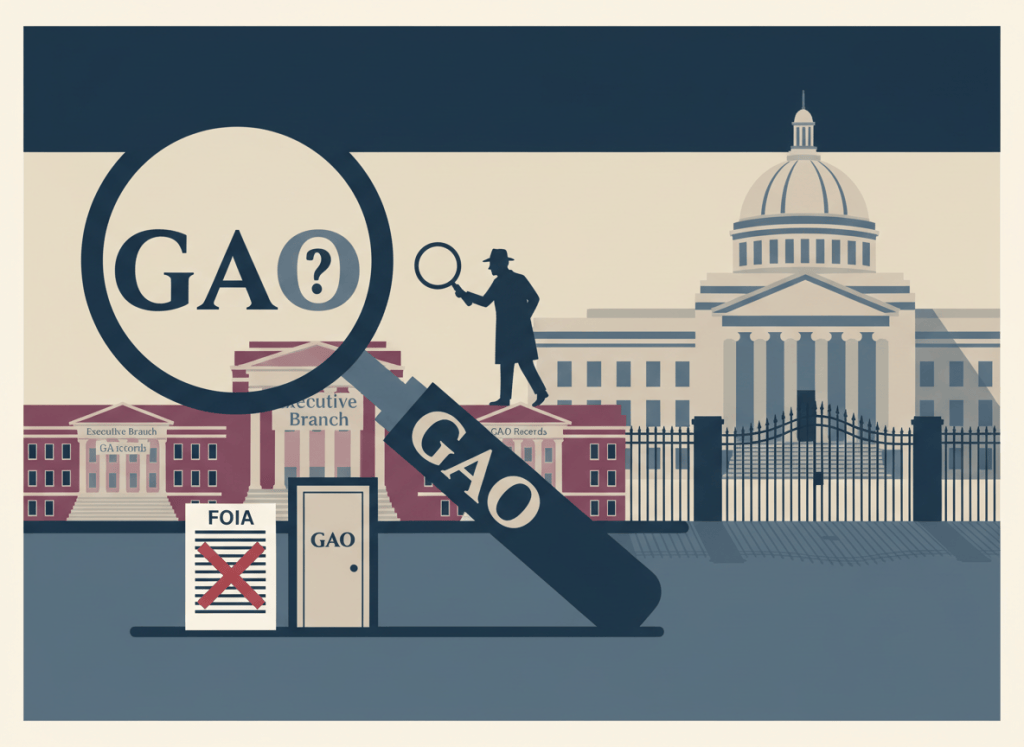
The Government Accountability Office spends its days examining how federal agencies manage public money, comply with the law, and account for their decisions. Its investigators scrutinize government programs, uncover waste, identify weaknesses in oversight, and recommend corrective action. Congress relies on its findings, and taxpayers rely on the resulting reports to understand what their government is doing.
But when members of the public want records from the government’s principal investigative watchdog, they encounter an unusual limitation. The Freedom of Information Act, the federal law that allows Americans to demand records from executive agencies and challenge improper withholding in court, does not apply to GAO.
The explanation is rooted in the structure of the federal government. GAO belongs to the legislative branch, while FOIA principally governs executive-branch agencies. Congress established an enforceable public-records system for the executive branch without extending that same statutory framework to its own investigative arm.
GAO has adopted a separate disclosure system under 4 CFR Part 81. The agency says its policy follows the spirit of FOIA, and the regulations provide procedures for requesting records, receiving determinations, and filing administrative appeals. What they do not provide is the same statutory right to sue under FOIA when a requester believes records have been improperly withheld.
That distinction is not merely academic. A federal lawsuit decided earlier this year illustrates what happens when a requester attempts to challenge GAO’s disclosure decisions through the ordinary FOIA process.
A Watchdog Beyond FOIA’s Reach
FOIA was enacted in 1966 and substantially strengthened in 1974, giving the public broader access to executive-branch records and greater ability to challenge agency secrecy. The statute’s definition of an agency, however, does not encompass Congress or its legislative-branch institutions.
GAO’s exclusion therefore does not arise from a special exemption the agency awarded itself. It follows from the law’s jurisdictional boundaries.
The distinction has persisted for decades, even as Congress expanded FOIA’s procedural requirements and judicial remedies. GAO has independently adopted some comparable disclosure practices, including regulations revised in 2003 to incorporate aspects of the Electronic Freedom of Information Act Amendments of 1996.
The result is a system that resembles FOIA in certain respects but rests on a different legal foundation.
Under Part 81, members of the public can request GAO records and appeal adverse disclosure determinations to the Comptroller General. The regulations establish processing procedures, exemptions, and circumstances under which records may be withheld.
They also explicitly caution that adopting those procedures should not be interpreted as making FOIA applicable to GAO.
In practical terms, the public receives a process administered by the institution holding the records, without the same FOIA judicial-review mechanism available when executive agencies refuse disclosure. That does not establish that every possible judicial remedy is unavailable, but it removes the statutory enforcement route most familiar to public-records requesters.
That difference became the central issue in litigation brought by America First Legal Foundation.
A Federal Court Draws the Line
In March 2023, America First Legal sought GAO records concerning its examination of the Department of Health and Human Services’ Office of Refugee Resettlement and facilities serving unaccompanied children.
GAO eventually withheld responsive material under its disclosure regulations, citing protections for deliberative records. After pursuing administrative review, the organization filed a federal lawsuit seeking disclosure under FOIA.
On January 9, 2026, the U.S. District Court for the District of Columbia dismissed the case.
In America First Legal Foundation v. U.S. Government Accountability Office, Judge Sparkle L. Sooknanan concluded that GAO’s status as a legislative-branch agency placed it outside FOIA’s definition of an agency. The fact that GAO performs investigative and oversight functions involving executive agencies did not transform it into an executive-branch institution.
The ruling did not determine whether GAO’s underlying withholding decision was justified under its own regulations. It established that FOIA was not an available vehicle for challenging that decision.
America First Legal appealed the ruling in February 2026. The appeal is docketed in the U.S. Court of Appeals for the D.C. Circuit as case number 26-5052. According to the court’s PACER docket reviewed by Bureaucracy Times on November 11, GAO filed a corrected appellee brief on October 13, and an October 14 clerk’s order extended the deadline for America First Legal’s reply brief to November 20, 2026. The October 14 order was the latest entry in the docket reviewed; no appellate disposition was recorded there as of November 11.
The case exposes an important distinction between having an administrative disclosure process and possessing a statutory remedy that permits a court to review the substance of a withholding decision.
For executive agencies, FOIA provides that remedy. For GAO, the statute does not.
When Congress Requests the Investigation
Another consequential difference appears in GAO’s treatment of congressional records.
Under 4 CFR § 81.6(a), records relating to work performed at the request of Congress, congressional correspondence, and certain congressional contact memoranda may be withheld unless the congressional requester authorizes disclosure.
The provision reflects GAO’s institutional relationship with Congress. Lawmakers depend on the agency to conduct investigations, examine sensitive information, and provide confidential assistance with oversight responsibilities.
Protecting some of those communications serves legitimate legislative purposes. Congressional investigators may need access to preliminary findings, confidential sources, or sensitive government information before an investigation is completed.
But the provision also raises a public-accountability question.
When Congress commissions an investigation into executive-branch activity, to what extent should the congressional requester influence the public’s ability to examine records associated with that investigation?
The regulations do not establish an absolute congressional veto over every related record. GAO’s Chief Quality Officer retains discretion to release certain otherwise exempt material when disclosure is not prohibited by law.
Nevertheless, the provision creates a category of records for which public access may depend partly on congressional authorization rather than solely on the disclosure standards applicable to executive agencies.
GAO’s congressional protocols also allow requesting lawmakers to delay public release of certain completed reports, ordinarily for up to 30 days. That temporary publication hold is separate from the broader confidentiality provision governing congressional-request records.
Neither should be confused with restrictions imposed because a report contains classified or controlled unclassified information.
Those distinctions matter because GAO’s work frequently involves sensitive information obtained from the very agencies it investigates.
Restricted Reports and the Public’s Right to Know
On September 29, 2026, Bureaucracy Times requested a restricted GAO report titled Fraud Investigations: HHS OIG Investigates Billions in Potential Health Care Fraud Across the U.S., identified as GAO-26-107773SU.
The report’s restricted designation indicates that it contains controlled unclassified information, a category distinct from national-security classified material.
The request sought the report to the fullest releasable extent, including a redacted version or other publicly available findings if GAO could not release the complete document.
GAO acknowledged the request and assigned tracking number PRI-26-286.
The request illustrates a broader problem confronting members of the public who seek restricted GAO products. A completed investigative report may contain information that cannot be publicly disseminated in its entirety, but the presence of restricted material does not necessarily establish that every finding, conclusion, or supporting passage must remain unavailable.
GAO’s regulations contain procedures for withholding records and explaining adverse determinations. They also provide for administrative appeals.
One regulatory complication deserves attention. Section 81.1(b) excludes GAO’s published reports from Part 81’s ordinary records-request procedures because those publications are generally available through GAO’s public distribution system. GAO nevertheless directs members of the public seeking records to its Chief Quality Officer, including through its published records-request instructions.
How the agency applies that distinction to completed but restricted reports is a question Bureaucracy Times is examining through its pending request.
A requester who exhausts GAO’s administrative procedures does not acquire the ordinary FOIA right to ask a federal court to review the agency’s withholding decision.
Whether GAO’s alternative procedures produce comparable disclosure outcomes is a question that requires more than an examination of the regulations.
It requires evidence about how the system actually operates.
Who Measures the Watchdog?
GAO routinely evaluates how federal agencies manage records, protect sensitive information, and fulfill statutory responsibilities. Its reports identify weaknesses in agency procedures, examine performance measures, and recommend improvements.
Those activities make the agency an important source of independent accountability throughout the federal government.
But comparable public information about GAO’s own records-disclosure performance was not identified during Bureaucracy Times‘ review of its published disclosure guidance. That does not establish that the agency fails to maintain such information.
How many public records requests does GAO receive each year? How many are denied? How long do requesters wait? How frequently does the Comptroller General reverse a withholding decision on appeal?
And when a requester exhausts GAO’s internal procedures, what meaningful independent review remains available?
Those are measurable questions, not allegations of wrongdoing.
On November 7, Bureaucracy Times submitted a media inquiry to GAO seeking records-request statistics for fiscal years 2021 through 2026, processing times, administrative appeal outcomes, explanations of congressional-request confidentiality, and information about independent oversight of its disclosure program.
The inquiry also asked how GAO determines whether completed reports containing controlled unclassified information can be released in redacted form, and whether the agency evaluates its own disclosure practices against standards comparable to those applied to executive agencies.
GAO was asked to respond by November 13, 2026, at 5 p.m. Eastern.
On November 10, GAO Government Information Specialist Francis A. Minor acknowledged the inquiry, assigned it tracking number PRI-27-051, and stated that the request was being processed under GAO’s public-records regulations at 4 CFR Part 81. The acknowledgment confirmed receipt and administrative processing; it did not address the substantive questions about disclosure statistics, appeals, congressional confidentiality, or restricted reports. GAO did not provide a substantive response by the deadline. Bureaucracy Times will update this article if GAO responds.
Accountability Without the Same Right of Access
GAO’s exclusion from FOIA is not evidence that the institution operates without oversight. Congress supervises the agency, its leadership is subject to statutory appointment procedures, and its work is governed by numerous legal and institutional requirements.
Nor does the absence of FOIA coverage establish that GAO routinely withholds information improperly. The agency publishes thousands of reports and other products that contribute substantially to public understanding of federal operations.
The narrower issue is whether the public possesses sufficiently independent and enforceable mechanisms for obtaining records from an institution whose mission is to promote accountability elsewhere in government.
Congress has repeatedly recognized the importance of public access to executive-branch records. FOIA’s judicial-review provisions reflect the principle that an agency should not always have the final word on whether its own records may be withheld.
GAO operates under a different arrangement.
Its disclosure regulations provide a means of requesting information, but they do not confer the same statutory enforcement rights that Congress created for records held by executive agencies.
That arrangement may reflect legitimate constitutional and institutional considerations. It nevertheless produces an asymmetry worth examining.
The agency charged with helping Congress hold the executive branch accountable is not subject to the same public-records law that Congress uses to make executive agencies answerable to the public.
Whether GAO’s alternative system compensates for that difference depends on evidence about its actual performance, the availability of independent review, and the transparency of its disclosure decisions.
Until those questions are answered, one fundamental issue remains unresolved: Who has the final say when the government’s accountability watchdog decides the public cannot see its records?

