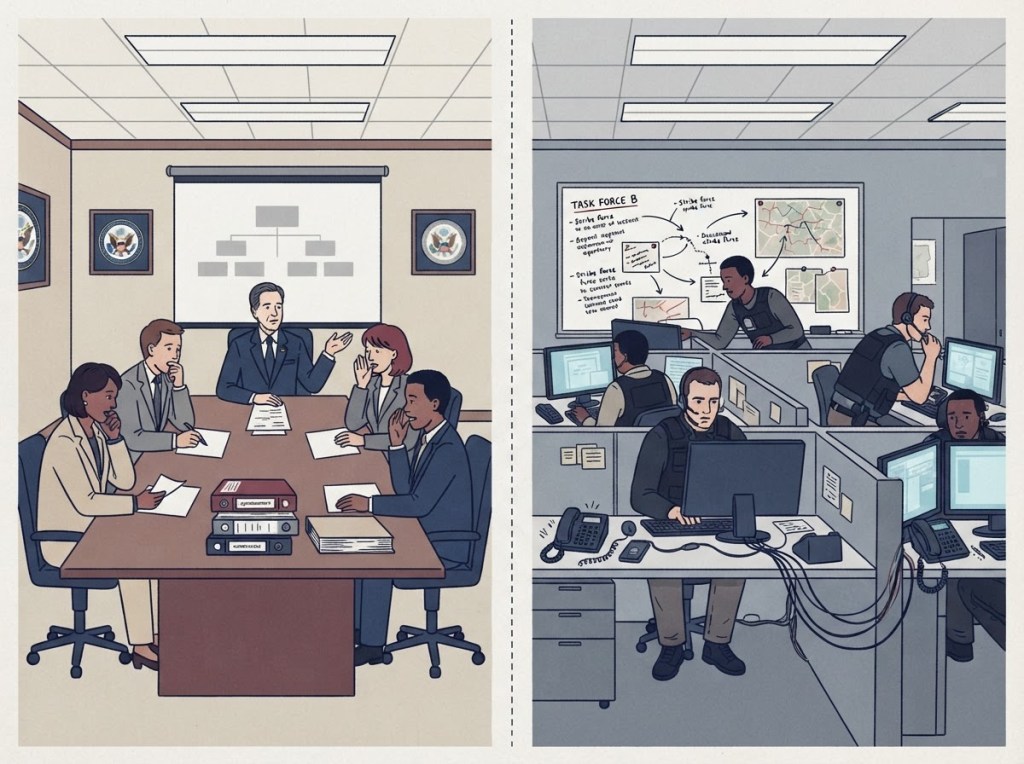
The House is set to vote Wednesday on a bill that orders the President to create a federal task force against overseas scam compounds. The Justice Department already has one. The bill never mentions it.
The Dismantle Foreign Scam Syndicates Act (H.R. 5490) is on the suspension calendar, which means limited debate and a two-thirds vote. It cleared the Foreign Affairs Committee 48 to 0. This is about what the floor text actually does.
What the Bill Orders
Within 30 days of enactment, the President must set up an interagency Task Force. The Secretary of State chairs it. Members are State, Justice (including the FBI), Homeland Security (including the Secret Service and Homeland Security Investigations), and Treasury.
The SEC, FTC, and FCC may join. Within 240 days, the Task Force must deliver a government-wide strategy to Congress.
Every member agency must share all relevant data. It must also share all information about its plans on scam-related matters, before and after final agency decisions are made. That is a broad demand to make of independent agencies, even if joining is optional for them.
Sanctions are discretionary. The President “may” impose them, with a national security waiver on 15 days’ notice. The Task Force ends five years after enactment.
What Already Exists
In November 2025, the U.S. Attorney’s Office for D.C. launched a Scam Center Strike Force. It combines that office with the Criminal Division, the FBI, and the Secret Service, and it partners with State, Treasury’s sanctions office, and Commerce. FBI agents were embedded with Thai police in Bangkok from the start.
By April, DOJ announcements reported by Cointelegraph put its restrained cryptocurrency above $700 million. The same coverage notes a State Department reward of up to $10 million tied to one Burma compound.
The Strike Force director told Congress in March it had grown to more than 150 personnel. She also said it would be more effective if it could immediately take down websites.
The House bill does not mention the Strike Force. DOJ and the FBI sit on the new Task Force as members, but the text does not say who directs whom. It also amends no criminal law, so the tool the director said she lacks is not in it. That reading is mine, drawn from the bill text and her reported testimony.
Supporters have a fair point. At a March hearing, Sen. Maggie Hassan said New Hampshire officers she contacted had not heard of the Strike Force. The bill orders quarterly consultation with state and local law enforcement, which addresses exactly that gap.
No New Money
The bill authorizes no new spending. Section 10 directs the Secretary of State to use amounts already authorized under the Foreign Assistance Act’s international narcotics and law enforcement provision. The victim-support programs in Section 8 are tied back to that same section.
CBO estimates implementation would cost under $500,000 a year and $1 million over 2026 through 2030. Some bill trackers still describe a $30 million-a-year authorization. That language was in earlier versions. The floor text has none.
The new Task Force and the victim programs will compete for the same existing pot. The bill does not say how much of it goes to either.
The Fine Print Moved
Several changes since the bill was introduced are worth noting. The introduced bill sunset the Task Force after seven years. The committee cut that to five.
The reporting schedule did not shrink to match. The first report is due 360 days after the strategy, with annual reports for five years after that. By my arithmetic, assuming everything is delivered on time, at least one required report falls after the Task Force has been dissolved.
The committee-approved version told the Task Force to develop partnerships with banks, social media platforms, dating apps, telecom carriers, crypto exchanges, and others. The floor text says only to consult private-sector actors.
Two additions arrived between committee and floor. One bars sanctions on imports of goods. The other authorizes State to give NGOs and research institutions access to satellite imagery to document abuses at scam compounds, with a report on who got access due in 180 days. The text names no money for it.
A Task Force for a Strike Force
None of this makes the bill bad. Coordination is a real problem, and a statute gives the effort a permanence the Strike Force, which has no statute of its own, lacks.
But the bill orders a coordination body for work that has been under way for a year. It staffs the body from agencies already doing that work, and pays for it out of money Congress gave State for something else.

