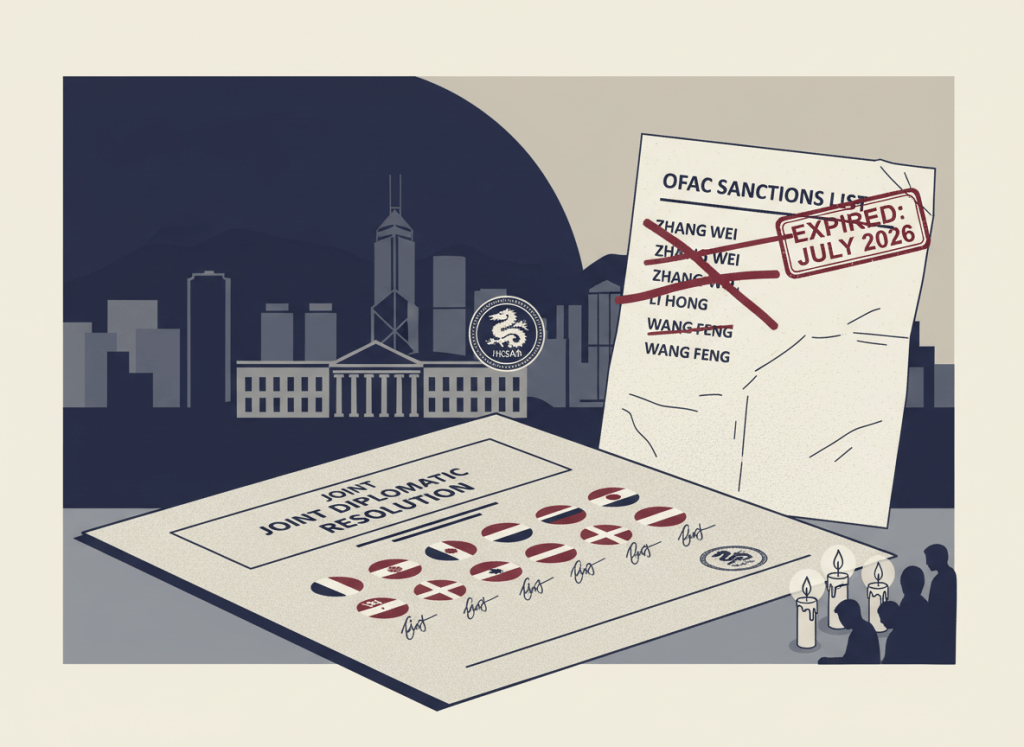
Ten governments have condemned the imprisonment of Joshua Wong and the prosecution of Hong Kong democracy leaders. But a July change to U.S. sanctions authorities raises questions about what Washington can, and will, do beyond issuing statements.
WASHINGTON, Nov. 9, 2026 — The United States joined nine other governments Friday in condemning Hong Kong’s latest national security prosecutions, including a new 10-year prison sentence for democracy activist Joshua Wong. The coordinated diplomatic statement arrived less than four months after a major U.S. sanctions authority targeting Hong Kong officials expired, prompting a separate question about the federal government’s response to the territory’s continuing political prosecutions.
The November 6 joint statement, issued by the United States, Australia, Canada, France, Germany, Italy, Japan, the Netherlands, New Zealand, and the United Kingdom, criticized the use of Hong Kong’s National Security Law against political expression and participation.
The governments called for an end to prosecutions they characterized as unjust and urged Chinese and Hong Kong authorities to honor the rights and freedoms guaranteed under the 1984 Sino-British Joint Declaration.
The statement, however, announced no new sanctions, enforcement measures, or other concrete penalties.
Meanwhile, records published by the Treasury Department’s Office of Foreign Assets Control (OFAC) show that the national emergency underpinning Executive Order 13936, a central component of Washington’s Hong Kong sanctions framework since 2020, expired on July 14, 2026.
The expiration resulted in the removal of certain individuals from Treasury’s principal sanctions list, although other sanctions imposed under congressional statutes remain in force.
Together, the developments present an accountability question extending beyond the latest diplomatic condemnation: What enforcement tools remain available to Washington, and how are federal officials using them in response to Hong Kong’s national security prosecutions?
Another Decade Behind Bars
Wong, one of Hong Kong’s internationally recognized democracy activists, was sentenced November 5 after pleading guilty to conspiracy to collude with foreign countries or external elements to endanger national security.
According to reports of the proceedings, High Court Judge William Tam concluded that Wong and fellow activist Nathan Law had encouraged foreign governments to impose sanctions and other measures against Chinese and Hong Kong officials.
The judge adopted a 13-year starting point before reducing the sentence to 10 years to account for Wong’s guilty plea and mitigating circumstances.
Wong was already serving a separate prison sentence and had been approaching its completion. The new sentence substantially extends his incarceration.
Hong Kong authorities have defended the prosecution as a lawful response to conduct threatening national security. Officials argued that Wong and his associates had actively sought foreign sanctions and other measures against China and Hong Kong. The government also rejected criticism from the U.S. Consulate General, describing it as political interference.
The distinction between the competing positions is central to the controversy. Hong Kong authorities maintain that the prosecution punished conduct intended to undermine national security. Western governments and human rights advocates contend that the National Security Law has been used to criminalize political expression and international advocacy.
The case is particularly consequential because the conduct described by prosecutors included efforts to persuade foreign governments to adopt precisely the kind of sanctions that Washington has maintained against certain Hong Kong officials.
The Prosecution of Hong Kong’s Historical Memory
The November 6 joint statement also referenced the convictions of leaders of the Hong Kong Alliance in Support of Patriotic Democratic Movements of China.
For decades, the organization helped arrange Hong Kong’s annual candlelight vigils commemorating the victims of the Chinese government’s June 1989 crackdown on protesters in Beijing’s Tiananmen Square.
The gatherings became a prominent feature of Hong Kong’s political culture, reflecting freedoms that distinguished the territory from mainland China following the 1997 transfer of sovereignty from Britain.
The Alliance dissolved in 2021 amid mounting national security investigations.
Its former leaders subsequently faced prosecutions over the organization’s political activities and advocacy. The cases have drawn international attention because they concern the legal boundaries of political organizing, criticism of China’s governing system, and public remembrance of historical events.
Hong Kong authorities maintain that national security legislation addresses threats to state security rather than legitimate political disagreement. Critics argue that the prosecutions illustrate how the law has narrowed the space for peaceful political participation.
The ten-government statement placed Wong’s sentencing and the Alliance convictions within the same broader pattern.
For Washington, however, that assessment intersects with an existing body of federal law designed specifically to respond to changes in Hong Kong’s autonomy and political freedoms.
A Sanctions Authority Expires
On July 14, 2020, President Donald Trump issued Executive Order 13936, declaring a national emergency concerning Hong Kong and establishing sanctions authorities following Beijing’s imposition of the National Security Law.
The order formed part of a broader federal response to changes in Hong Kong’s autonomy and its relationship with mainland China.
Six years later, the emergency declaration expired.
In a July 17, 2026 notice, OFAC announced changes to its Hong Kong-related sanctions program resulting from the expiration.
Individuals whose property had been blocked solely under the executive order’s emergency economic powers authority were removed from the Specially Designated Nationals and Blocked Persons List.
For those individuals, the expiration ended the blocking restrictions imposed under that authority.
But the expiration did not eliminate the entire Hong Kong sanctions framework.
OFAC explicitly stated that the Hong Kong Human Rights and Democracy Act of 2019 and the Hong Kong Autonomy Act of 2020 remain in effect.
Individuals subject to continuing sanctions under the Hong Kong Autonomy Act were transferred to Treasury’s Non-SDN Menu-Based Sanctions List. OFAC explained that previously blocked assets covered by those continuing statutory restrictions remain blocked, subject to the applicable legal provisions.
The distinction is important. Removal from one sanctions list does not necessarily mean that every restriction against an individual has disappeared. Conversely, the continuation of statutory authorities does not automatically preserve restrictions that depended exclusively on an expired emergency declaration.
Treasury’s published program guidance confirms both the expiration and the continued operation of the congressional statutes.
The July changes therefore altered the legal basis and scope of some existing restrictions while preserving others.
What remains less clear from the public statements is how the administration intends to employ its remaining authorities in response to the latest national security prosecutions.
Congress Already Established an Oversight Framework
Washington’s response to Hong Kong is not governed exclusively by executive discretion.
Congress has enacted several laws addressing Hong Kong’s autonomy, human rights conditions, and treatment under U.S. policy.
The United States-Hong Kong Policy Act provides a framework for evaluating Hong Kong’s status and requires periodic reporting and certification concerning its autonomy.
The Hong Kong Human Rights and Democracy Act strengthened congressional oversight of developments affecting the territory’s freedoms.
The Hong Kong Autonomy Act established additional sanctions mechanisms addressing individuals involved in undermining Hong Kong’s autonomy and certain foreign financial institutions conducting significant transactions with them.
These laws remain relevant regardless of whether a particular presidential emergency declaration continues.
They also create an important distinction between the government’s public diplomatic position and its statutory responsibilities.
A statement condemning prosecutions is one form of foreign policy. Determining whether particular conduct meets statutory criteria for sanctions, documenting those determinations, and reporting to Congress are separate administrative functions.
The November 6 statement does not establish whether the State Department or Treasury has undertaken any new sanctions review related to Wong’s sentence or the Alliance cases.
Nor does the July expiration establish that the federal government has abandoned its Hong Kong policy.
Those are questions requiring clarification from the responsible agencies.
The Difference Between Condemnation and Enforcement
The chronology is striking.
In July, the emergency declaration supporting one component of U.S. sanctions against Hong Kong expired.
In the following months, Hong Kong continued prosecuting prominent figures associated with its democracy movement.
On November 5, Wong received another decade in prison. The following day, ten governments publicly condemned the prosecutions.
The sequence does not demonstrate that the expiration of U.S. sanctions authorities influenced Hong Kong’s judicial proceedings. No such causal relationship is established by the available records.
It does, however, place Washington’s diplomatic criticism alongside a documented change in its enforcement framework.
The distinction matters because sanctions policy operates through specific legal authorities, individual designations, financial restrictions, and administrative decisions. Those mechanisms are not interchangeable with diplomatic statements.
For Congress and the public, the relevant questions are therefore practical.
How many individuals lost sanctions restrictions following the July expiration? Which officials remain subject to statutory sanctions? Have federal agencies reviewed the latest prosecutions for potential action under the surviving authorities? And how will the developments affect the next assessment of Hong Kong’s autonomy?
Treasury’s July notice provides a starting point for examining the changes, but it does not answer all of those questions.
The State Department’s November statement offers a clear diplomatic position, but no accompanying explanation of additional enforcement action.
A Test of Federal Accountability
Hong Kong’s national security prosecutions present difficult questions involving sovereignty, political rights, international obligations, and the authority of governments to regulate conduct they consider threatening to national security.
The United States and its diplomatic partners have publicly challenged Hong Kong’s application of those laws. Hong Kong’s government rejects that criticism and insists that its courts are enforcing legitimate national security protections.
For Washington, the disagreement also involves a domestic accountability issue.
Congress has established laws governing the federal response to developments in Hong Kong. Treasury has documented changes to the sanctions framework. State has now joined an international condemnation of further prosecutions.
Whether those developments lead to additional administrative determinations, sanctions designations, or other actions remains an open question.
For now, the federal record establishes two things: Washington has condemned the latest prison sentences, and a significant component of its earlier sanctions framework is no longer in force.
The question is what the government intends to do with the authorities that remain.
Bureaucracy Times plans to seek clarification from the State and Treasury departments concerning the July 2026 sanctions changes, the continuing statutory authorities, and the federal response to the latest Hong Kong national security prosecutions.

