The House votes Wednesday on a bill that would let Congress ask the Congressional Budget Office to estimate preventive health savings 30 years out. By design, those estimates could not be used for anything that counts.
The Preventive Health Savings Act (H.R. 4464) is on the suspension calendar, which means limited debate and a two-thirds vote. Its sponsors are a bipartisan set: Reps. Obernolte and Carter of Georgia, both Republicans, and Reps. DeGette and Peters, both Democrats.
What the Bill Does
The text sets up a four-person gate. CBO acts only on a request from the chair and ranking member of a Budget Committee and the chair and ranking member of the committee of primary jurisdiction, all in the same chamber.
On request, the CBO Director determines whether a proposed law would produce net reductions in outlays through preventive health care. If so, CBO must describe and estimate those reductions in its projection, and it may extend the projection beyond the usual time periods.
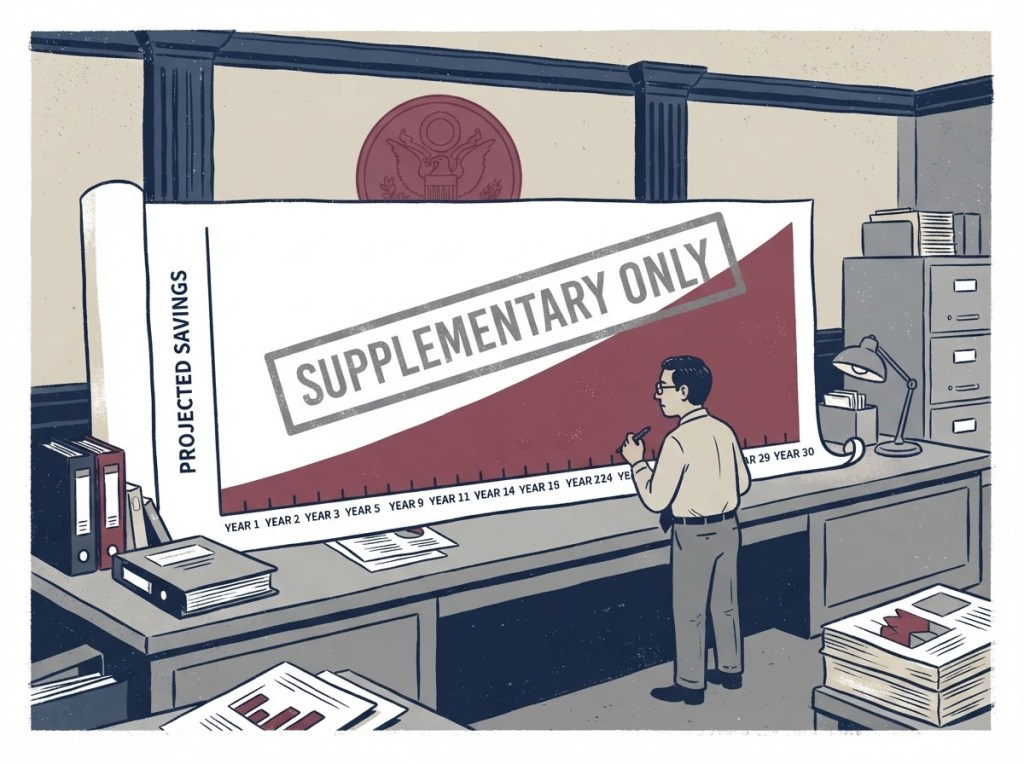
The window covers two consecutive 10-year periods that start 10 years out, which works out to roughly years 11 through 30. Any such estimate is “supplementary” and cannot be used to determine compliance with the Budget Act or any other budget enforcement control.
The bill also defines preventive health care. An intervention must be shown effective by “credible and publicly available evidence” from epidemiological models, clinical trials, observational studies in humans, longitudinal studies, or meta-analysis.
What CBO Already Does
CBO’s October 20 cost estimate says current practice covers a lot of this ground. It says CBO’s estimates typically span 10 years for direct spending and revenues, and that it also assesses whether legislation would raise net direct spending and deficits over an additional 40 years.
CBO also says it already provides budgetary effects beyond the 10-year period when committees request it and flag it as a priority. It expects no significant increase in workload and puts the cost at under $500,000 over 2027 through 2031.
The same document describes the bill as covering estimates over a 30-year period, provided by CBO “if it determined” a bill would produce savings. In other words, the bill’s main additions are a formal request mechanism, a one-way trigger, and an evidence standard for what counts as prevention.
A One-Way Estimate
The trigger is the interesting part. As written, the Director looks for “net reductions” in outlays. Nothing in the text asks CBO to report long-run costs from cutting preventive care.
That is my reading of the text, and it matches a critique in Health Affairs of the bill’s prior version. The author notes CBO could estimate long-range savings from expanding preventive care but not the long-range costs of restricting it.
There is a skeptic’s case too. An American Action Forum analyst told Roll Call in 2024 that Congress should not assume preventive care always saves money, and that some members may be expecting savings that are not there.
Supporters have their own answer. A 10-year window can miss payoffs that arrive later, and the bill adds information without changing any enforcement rule. A Hill commentary supporting the earlier version framed it as supplementary context that shows the limits of official scorekeeping.
A Bill With a Long Memory
This is not a new idea. A version was introduced in 2012 by Reps. Burgess and Christensen, and reintroduced in 2019.
In March 2024 the House took up H.R. 766, a nearly identical bill, under suspension. Health Affairs describes it as passing by voice vote. It did not become law, and the same text is back this Congress.
There is money in the background. A news summary of lobbying disclosures says the Healthcare Leadership Council reported $200,000 in first-quarter lobbying that covered H.R. 4464 and pharmacist-services legislation. That figure covers both issues, so it says little about this bill alone.
The House Budget Committee ordered the bill reported on September 16, according to CBO’s estimate. It now moves under rules that allow no amendments.
Information, Not Authority
Nothing here is sinister. A bipartisan House has repeatedly liked the idea of looking further down the road.
But the design is worth noticing. The estimates would be available only to the people who ask for them, would be produced only when they show savings, and could not be used to enforce anything. A number built to make a bill look good, and barred from deciding whether it passes, is a strange kind of tool.
The same family of rules, savings that exist in the real world but not in the official ledger, shows up in the fight over health care fraud funding. We will look at that separately.

