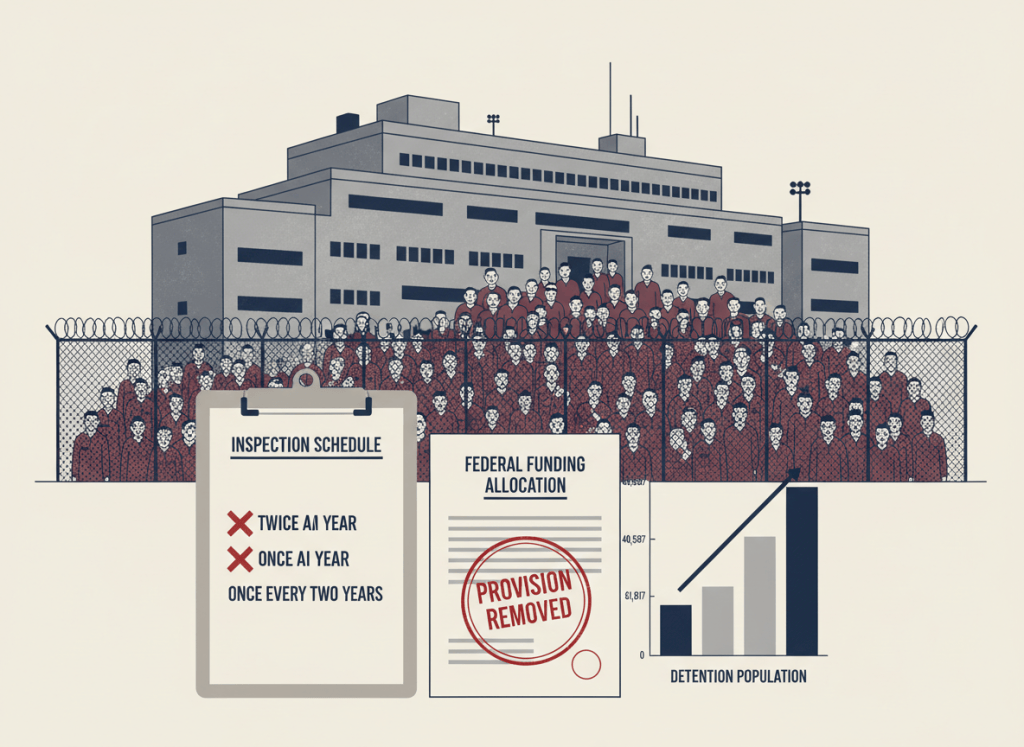
A federal rule that could cut off money to failing immigration detention contracts is gone, according to a new Government Accountability Office report.
ICE officials told GAO in August that the rule no longer applies. The report buries that fact in two footnotes.
Since fiscal year 2019, appropriations law barred DHS from continuing a detention contract if the facility’s two most recent performance evaluations rated it below “adequate.” Congress renewed the language through fiscal 2025. The fiscal 2026 DHS appropriations act left it out.
The timing matters. ICE has also changed how often it inspects.
Before fiscal 2025, the ICE Office of Detention Oversight inspected facilities with 10 or more detainees twice a year. Now it inspects dedicated facilities annually and shared facilities every two years. Smaller facilities inspect themselves.
By that math, it would take at least two years for a dedicated facility to collect two ratings. For a shared facility, it could take four.
A March 2025 ICE memo laid out the reasoning. It said the new approach would reduce the burden on service providers and improve ICE’s ability to obtain detention space, especially from state and local partners. GAO found the memo cites no evidence on how the changes affect oversight.
Meanwhile, ICE added more than 40 detention facilities from April 2025 to April 2026. Average daily population rose from 40,587 to 61,817.
ODO inspections fell from 194 in fiscal 2024 to 102 in fiscal 2025. The Office of the Immigration Detention Ombudsman stopped inspecting in January 2026 after receiving no appropriation.
DHS agreed with GAO’s two recommendations and asked that they be closed as implemented. GAO declined, saying ICE has not shown it assessed how the changes work together.
DHS Defends Detention Standards but Leaves Oversight Questions Unanswered
In a statement provided to Bureaucracy Times on November 9, 2026, a Department of Homeland Security spokesperson defended ICE detention conditions and the department’s inspection practices.
“ICE is committed to transparency and accountability and regularly conducts inspections to ensure the well-being of individuals in its care.”
DHS spokesperson, November 9, 2026
DHS also said ICE facilities are regularly audited and inspected by external agencies. That assertion does not resolve GAO’s narrower finding: ICE reduced the frequency of its own detention oversight inspections, while GAO said the agency had not provided evidence assessing the combined effect of its oversight changes.
“ICE is regularly audited and inspected by external agencies to ensure that all ICE facilities comply with performance-based national detention standards.”
DHS spokesperson, November 9, 2026
The spokesperson further asserted that detainees receive medical, dental and mental health intake screening within 12 hours of arriving at each facility, a full health assessment within 14 days, access to medical appointments and round-the-clock emergency care, and meals certified by dietitians. DHS also claimed ICE detention standards exceed those of most U.S. prisons. The statement supplied no comparative methodology or inspection records supporting that claim.
The department did not directly provide the requested OIDO and Civil Rights and Civil Liberties inspection figures, staffing information, or documentation supporting its position on closure of GAO recommendations. Its account of detention services is an attributable agency position, not a response to the report’s central question about the effectiveness of inspection oversight.
Bureaucracy Times has sought answers from ICE and DHS. Beyond the specific oversight data requested from DHS, three questions remain unanswered:
- Who removed the two-rating provision from the fiscal 2026 bill, and why?
- What evidence supported the March 2025 inspection framework?
- How many facilities would have triggered the old funding cutoff under the prior inspection schedule?
Source: GAO-27-109299, “Immigration Detention: Changes In Inspections of ICE Facilities Raise Questions About Oversight,” November 5, 2026.

