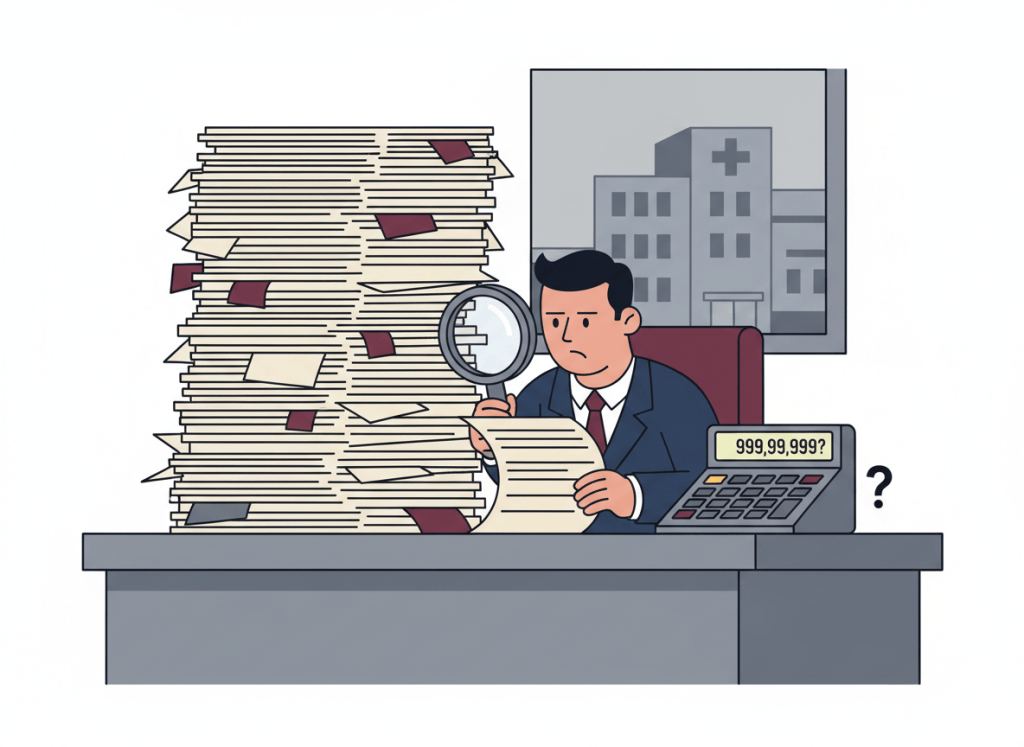
Federal auditors uncovered major calculation errors in COVID-19 relief payments, including a $137 million mistake involving a financial figure that had already been corrected. The agency responsible for recovering the money says further reviews depend on available resources.
The federal government spent billions keeping America’s health care providers afloat during the COVID-19 pandemic. Six years later, the Department of Health and Human Services is still sorting out whether some of those providers received more money than they should have, whether others received too little, and how much of the difference taxpayers can expect to see again.
An October 29 audit by the HHS Office of Inspector General identified approximately $658 million in potential overpayments under Phase 3 of the Provider Relief Fund, a federal assistance program administered by the Health Resources and Services Administration (HRSA).
The auditors also identified approximately $132 million in potential underpayments, meaning the government’s payment calculations produced errors in both directions.
But the audit’s most consequential finding may concern what happens next.
In its response to the inspector general, HRSA indicated that it would review supporting documentation for the remaining providers and pursue repayment where appropriate, subject to available resources.
The government has identified hundreds of millions of dollars in potentially excessive payments. Whether those amounts become confirmed debts, and whether the government recovers them, remains an open question.
A $137 Million Mistake Hiding in Plain Sight
Congress appropriated approximately $178 billion for the Provider Relief Fund to help health care providers absorb pandemic-related expenses and lost revenues.
Phase 3 alone distributed approximately $19.3 billion, using financial information submitted by providers to calculate additional relief payments.
HRSA received more than 100,000 applications. Approximately 95 percent were processed without manual examination of their supporting documentation. The remaining applications received additional scrutiny, but accounted for approximately $14.7 billion, or 73 percent, of the money distributed.
That distinction is important. HRSA concentrated its manual reviews on applications representing most of the funding, yet significant errors remained.
One example illustrates the problem.
An acute-care hospital submitted financial information containing an incorrect quarterly figure. During the review process, the contractor identified the problem and corrected the amount to $888,417,812.
Somewhere between that correction and the final payment calculation, however, the figure became $88,417,812.
The difference was $800 million.
According to the inspector general, the resulting calculation produced a potential overpayment of $137,637,092 to a single provider.
The episode raises questions extending beyond an ordinary data-entry mistake. The error had been identified during the review process. The corrected figure was available. Nevertheless, the payment calculation relied on a substantially different number.
It is not yet clear precisely where the corrected information was lost, which organization controlled that processing step, or what quality-assurance procedures were supposed to prevent the mistake.
The government’s safeguards appear to have identified the problem without ensuring that the correction survived the process.
The Errors Went Both Ways
Across its statistical and nonstatistical samples, the inspector general identified approximately $657.9 million in potential overpayments and $132.4 million in potential underpayments.
Those figures do not represent a nationwide projection, nor does the overpayment figure establish that every questioned dollar constitutes a legally recoverable debt. Additional review is required to determine the amounts actually owed.
The underpayments nevertheless reveal another dimension of the problem.
Some health care providers may have received less emergency assistance than HRSA’s own methodology entitled them to receive.
The inspector general recommended that HRSA review the questioned overpayments and seek recovery of amounts determined to have been improperly distributed. It did not recommend comparable additional disbursements to address the underpayments.
That difference has practical consequences.
Congress rescinded unobligated Provider Relief Fund balances in 2023, and HRSA has since ended the program’s payment activities. The agency now concentrates on compliance, reporting, and program integrity.
Whether HRSA retains any lawful mechanism to correct historical underpayments remains unresolved.
The result is an unusual accountability question: The federal government may pursue providers that received too much, while providers that received too little face uncertainty about whether their payments can ever be corrected.
Nearly $1 Billion Became $658 Million
The final audit figure was substantially lower than the amount originally identified.
According to the report’s appendix, the inspector general’s June 30, 2026 draft initially identified approximately $983 million in potential overpayments.
During the agency’s response process, HRSA supplied documentation showing that two providers had already returned approximately $324 million.
After reviewing that documentation and making additional adjustments, the inspector general reduced the final potential overpayment finding to approximately $658 million.
The distinction matters.
The $324 million was not newly recovered because of the final audit. The inspector general verified that those repayments had occurred before the audit began.
That leaves another question unanswered: How much of the remaining amount has been reviewed, confirmed as improper, or recovered since the records examined by auditors were assembled?
The published report does not provide a current recovery accounting.
Recovery Authority Exists. Resources Are Another Question.
HRSA is not without tools to recover improper payments.
Its published repayment and debt-collection procedures establish mechanisms for reviewing questioned payments, determining debts, issuing formal notices, and allowing recipients to dispute findings.
Unresolved federal debts may ultimately be referred for collection through established government procedures, including Treasury collection mechanisms.
Those procedures do not establish that the $658 million identified in the audit has reached the debt-collection stage. The questioned payments must first be examined and substantiated.
But they do establish that federal recovery mechanisms exist.
That makes HRSA’s response to the inspector general particularly significant.
Rather than committing to a specific completion schedule, the agency indicated that further reviews and recovery efforts would proceed pending available resources.
The audit does not establish whether HRSA currently lacks sufficient staff, funding, or technical capacity to complete those reviews. Nor does it establish that the agency has failed to take additional action since submitting its response.
It does, however, leave the public without a clear timetable for determining how much of the questioned money should be recovered.
For an agency administering a program involving billions of federal dollars, that is a consequential omission.
The Contractor Question
The audit also points toward a broader examination of the government’s reliance on private contractors to administer emergency relief.
HRSA’s contemporaneous Phase 3 payment methodology described procedures for examining reported revenues, losses, previous relief payments, and applications flagged for additional review.
Those procedures contemplated identifying unusual financial information and correcting problematic submissions.
The $137.6 million hospital example suggests that identifying an error was not necessarily sufficient to prevent it from affecting a final payment.
Separately, HRSA materials from September 2021 identify UnitedHealth Group as a technology and administrative participant in the broader Provider Relief Fund program.
The company provided technology and expertise supporting the collection of provider information used in funding decisions, while HHS and HRSA retained responsibility for program administration and funding decisions.
Those records do not establish that UnitedHealth Group performed the particular Phase 3 calculations or manual reviews criticized in the audit.
Identifying the responsible contractor, the applicable contract requirements, and the government’s oversight procedures will require additional documentation.
The distinction is important because a payment-processing failure can involve multiple stages, from applicant submissions and contractor review to agency approval and disbursement.
Determining where the safeguards failed is necessary before assigning responsibility for the specific error.
A Separate Congressional Concern
The audit also examined a group of Planned Parenthood providers at congressional request.
The inspector general reviewed 15 applications in that nonstatistical sample and did not identify false or misleading information submitted to obtain access to Provider Relief Fund payments.
Nevertheless, seven providers in the sample received incorrectly calculated payments. Auditors identified approximately $2.3 million in potential overpayments and $1.1 million in potential underpayments.
The findings distinguish between fraudulent or misleading applications and administrative payment-calculation errors.
In this instance, the audit did not establish that the providers obtained relief through false representations. It identified calculation problems affecting their payments, consistent with the broader weaknesses examined in the report.
November 9 Update: Watchdog Has No Recovery Accounting
Reporting update, November 9, 2026: In a written response to Bureaucracy Times received at 1:32 p.m. Eastern, HHS OIG Public Affairs Specialist Morsal Mohamad said the watchdog has not received subsequent information from HRSA about repayment determinations, actual recoveries, or implementation of the audit recommendations.
“At this time, OIG has not received information from HRSA regarding repayment determinations, recoveries, or the implementation status of the recommendations,” Mohamad wrote. OIG said it would continue monitoring HRSA’s progress through its audit-resolution process.
The response does not mean HRSA has made no determinations or recovered no funds. It means OIG has received no information confirming those actions. The approximately $324 million in repayments documented during the audit were made before the audit began and should not be confused with subsequent recoveries of the remaining questioned payments.
Mohamad also confirmed that, because the Provider Relief Fund program has concluded, OIG has no current plans for additional audit work on the payment-calculation controls, including the treatment of corrected financial figures during manual review. OIG said it may reconsider future work if emerging risks or priorities warrant it.
On the $137.6 million hospital overpayment, Mohamad said the audit did not publicly identify specific contractor responsibilities for the calculations or processing steps, and that additional contractor-specific details are not publicly available. This does not establish which contractor made the error or whether a contractor was at fault.
Asked whether projects A-02-23-01014 and A-02-23-01025 would examine related weaknesses, OIG declined to discuss the scope, findings, or publication timing of ongoing audits. Their relationship to this specific error therefore remains unconfirmed.
HRSA, rather than OIG, is now the principal source for a current accounting of repayment decisions, recoveries, corrective actions, and any remaining review backlog. Bureaucracy Times submitted a separate inquiry on November 6 and received an HHS response on November 12, discussed below.
November 12 Update: HHS Confirms Review, but No Recovery Figures
Reporting update, November 12, 2026: In a written response to Bureaucracy Times, the Department of Health and Human Services said the Health Resources and Services Administration and its contractors are reviewing supporting documentation related to the OIG’s findings.
HHS emphasized that HRSA had neither concurred nor disagreed with the inspector general’s recommendations. Instead, the agency described actions it intended to take, including determining whether the recommendations are consistent with HRSA policy and seeking repayment where appropriate.
The department did not provide figures identifying how much of the approximately $657.9 million in potential overpayments had been reviewed, confirmed, demanded for repayment, or recovered. Nor did it identify the contractors involved, provide an anticipated completion date, or address questions concerning approximately $132.4 million in potential underpayments.
The distinction is significant. The inspector general identified potential payment errors, but the department’s response does not establish how much of that money has been determined to be recoverable, much less returned to the government.
The Audit Is Not the End of the Investigation
The October report is part of a broader inspector general examination of the Provider Relief Fund’s general distributions.
According to the HHS OIG work plan, two related audit projects, A-02-23-01014 and A-02-23-01025, remain active.
Their eventual findings may provide additional information about the program, but OIG has not confirmed that either project examines the specific calculation failure described here.
For now, the completed audit establishes that substantial calculation errors occurred within the examined Phase 3 payments, including mistakes that survived additional review procedures.
It does not establish the full nationwide extent of such errors or the amount that ultimately will be recovered.
Bureaucracy Times asked HHS for clarification on the status of the questioned payments, recovery resources, the contractors responsible for Phase 3 calculations, and options available to underpaid providers. The November 12 response did not resolve those questions.
In its November 9 response, HHS OIG said it had received no subsequent information from HRSA on repayment decisions, recoveries, or recommendation implementation, and had no current plans for additional audit work on these payment controls.
The larger issue is not whether distributing emergency assistance during a national crisis presented extraordinary administrative challenges. It did.
The issue is whether the federal government can now account for the consequences of those challenges.
Six years after the pandemic began, the inspector general has identified hundreds of millions of dollars in potentially excessive payments, along with substantial underpayments to other providers.
HRSA has established procedures for recovering improper payments. What remains uncertain is how much of the money identified by auditors will ultimately be confirmed as improperly paid, how much can be recovered, and when the government expects to finish the job.
The emergency may be over. The accounting, apparently, is not.

