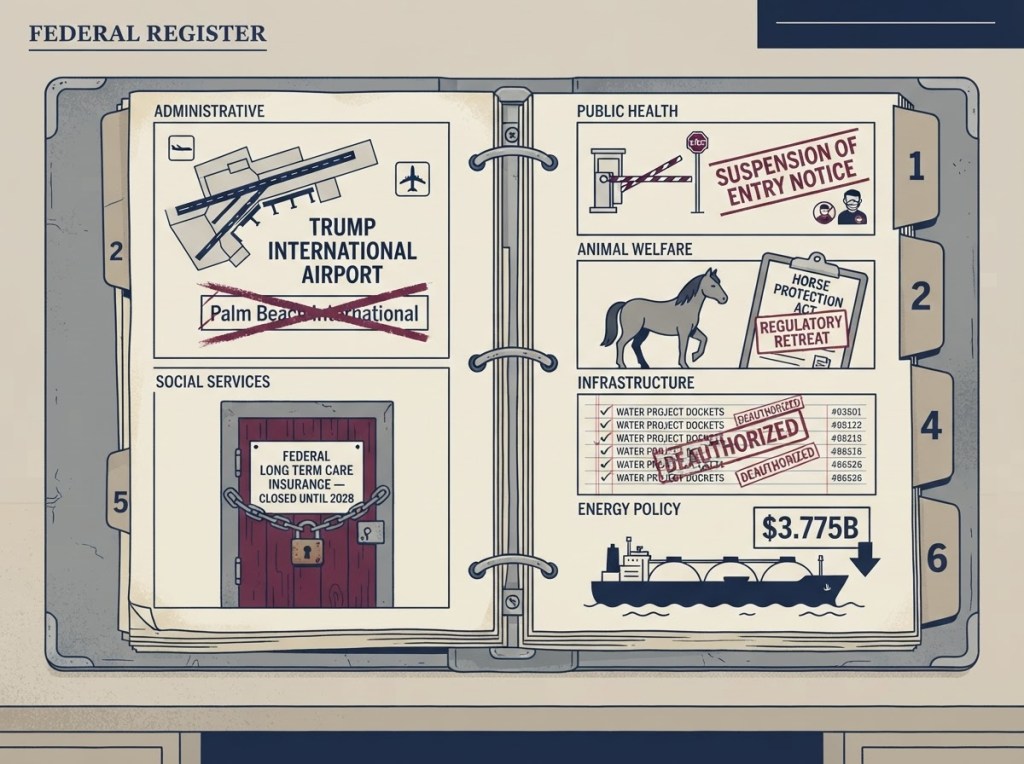
The most striking document in today’s Federal Register is not a policy change on its face. It is a Federal Aviation Administration airspace proposal that happens to reveal, almost as an aside, that Palm Beach International Airport now goes by a different name in federal paperwork.
- Federal Aviation Administration: The FAA proposed redrawing the Class C airspace around what the notice calls “President Donald J. Trump International Airport” in West Palm Beach, Florida, a facility pilots and the public have long known as Palm Beach International. The agency frames this strictly as a safety matter, saying new boundaries and altitudes are meant to separate arriving and departing traffic and reduce the risk of a midair collision. Nothing in the docket explains or dates the renaming itself; this rulemaking is simply the first place it surfaces in the public record. The proposal takes comments through January 12, 2027, which gives pilots and airspace users a formal channel to flag safety problems with the redrawn boundaries, though not a venue to contest the new name on the charts. Read the proposed rule.
- Centers for Disease Control and Prevention: The CDC published an order continuing its suspension of the right to bring certain people into the United States from countries where a quarantinable communicable disease is present, acting under Sections 362 and 365 of the Public Health Service Act. The order took effect November 10 and expires December 10, a short leash that lets the CDC director extend, amend or drop it without starting the process over. Because the order can be revised at the director’s discretion any time before it lapses, each renewal like this one is also the public’s clearest window into whether the list of covered countries or conditions has quietly shifted since the last version. Read the order.
- Animal and Plant Health Inspection Service (USDA): APHIS proposed unwinding its own May 2024 overhaul of Horse Protection Act enforcement, after a court vacated part of that rule and the agency chose to withdraw the remainder rather than keep defending it. The replacement proposal would rewrite how inspectors are certified to check show horses for soring, strengthen the appeals process before a horse can be disqualified, and limit a soring finding to the specific class where it was detected instead of the whole event. An agency reversing a rule it adopted barely two years ago is itself worth noting, and APHIS casts the retreat as a due-process correction rather than a change of enforcement philosophy. Comments are open through December 14, 2026, the window for horse industry groups and welfare advocates to weigh in before the rollback is finalized. Read the proposed rule.
- Office of Personnel Management: OPM extended, for another 24 months, its freeze on new applications to the Federal Long Term Care Insurance Program, the plan that lets federal employees and retirees buy long-term care coverage as a group benefit. The suspension now runs from December 2024 through December 2028, a four-year gap that has outlasted whatever was “temporary” about its original framing. This is a notice rather than a rule, so there is no public comment period attached, which means the only way the public will learn whether or when enrollment reopens is through OPM’s own future notices in this same register. Read the notice.
- Army Corps of Engineers: The Corps published its final list of water resources projects being stripped of congressional authorization, the last step in a process that began with a proposed list in May and now heads to the House Transportation and Senate Environment committees. Deauthorization is largely housekeeping: it formally closes the books on projects approved years or decades ago that were never built and have no active funding. But it is not without consequence, since any community that still wanted one of those projects revived would need Congress to authorize it from scratch rather than simply fund it. Read the notice.
- Export-Import Bank: EXIM disclosed that it is weighing a $3.775 billion loan or guarantee application to help finance roughly $2.25 billion in U.S. equipment and services for an LNG export expansion in Papua New Guinea, adding about 4 million metric tons a year of capacity aimed at Asia-Pacific buyers. The bank’s notice explains that the gap between the full financing amount and the smaller U.S.-content figure is financing costs, a disclosure EXIM has to make precisely because most of the deal’s value is not American-made goods. The notice does not name the project sponsor or borrower, and it sets a comment window of just 14 days from publication, reflecting that this is only a preliminary notice of intent to analyze the deal rather than a financing decision. Read the notice.
Today’s issue ran 118 documents across pages 73137–73426 of Volume 91. Excluded as routine: a large batch of SEC self-regulatory-organization fee and rule filings, FERC combined notices of filings, FEMA flood hazard determinations, agency information-collection (OMB/PRA) notices, antidumping and countervailing duty review notices, foreign-trade zone filings, and advisory committee and closed-meeting notices from the Forest Service, NIH and other agencies.

