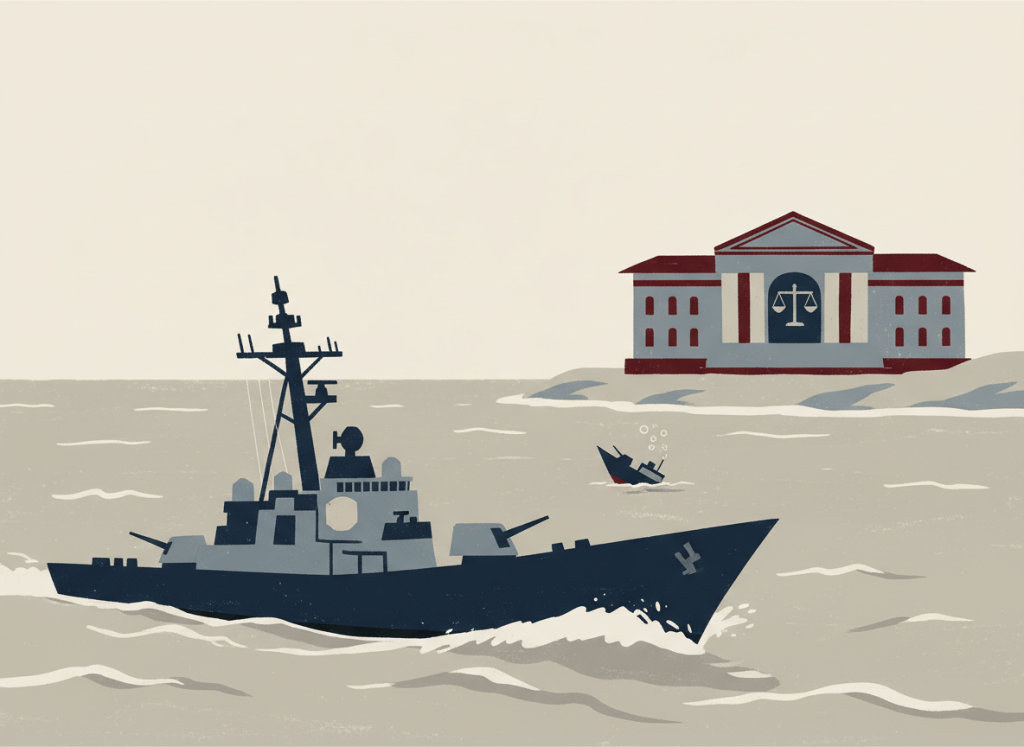
The U.S. military’s quarterly report to Congress on Operation Southern Spear describes crews removed from suspected trafficking vessels, transferred to Ecuadorian authorities, and vessels sunk after they were cleared. It does not describe what evidence was preserved before those vessels went down. In one case, an Ecuadorian judge later released 28 crew members without charges after finding prosecutors had not shown evidence that they had committed a crime.
The Lead Inspector General’s report covers July through September 2026, when U.S. forces resumed lethal strikes on suspected drug boats and conducted a series of nonlethal interdictions of floating refueling stations in the Eastern Pacific. SOUTHCOM said intelligence linked those refueling vessels to Los Choneros, an Ecuadorian criminal organization. Crews were removed and transferred to Ecuador, and the vessels were sunk. The September 2 release and the September 3 release describe those procedures.
The crews of the Conquista II and OM2 arrived in Manta on September 4. The next day, a judge ordered 28 crew members released without charges, finding prosecutors had not shown evidence they had committed a crime, according to Human Rights Watch, which reviewed the hearing record. The court outcome did not determine whether the vessels had any connection to trafficking. But it raises a practical question: what evidence did the U.S. provide to Ecuador, and could prosecutors use it after the vessels were sunk?
That question is sharper because the report does not give a vessel-by-vessel account of the cargo seized. It describes the interdictions as actions against floating refueling stations and says crews were transferred, but it does not identify the quantities or types of cargo recovered, any drugs seized, or the evidence shared with Ecuador. The report also says information gathered from federal agencies generally was not independently verified or audited.
The report’s basic count is unclear as well. Its summary says U.S. forces interdicted nine vessels. The detailed section reports eight interdictions. Endnote 19 cites nine SOUTHCOM press releases, including one dated September 9. The report does not explain whether these figures count operations or individual boats. SOUTHCOM’s September 5 release describes a “multi-vessel” station but does not state how many boats were involved.
The report separately records four lethal strikes during the quarter. SOUTHCOM said the August 23 strike killed two people, the August 25 strike killed four, the September 9 strike killed three, and the September 19 strike killed four. The Lead IG report totals those deaths as 13 killed or presumed dead. The public releases assert that intelligence confirmed the boats’ active involvement in trafficking, but do not identify those killed or disclose the evidence behind that determination. See August 23, August 25, September 9, and September 19.
The report says the Coast Guard conducted no search-and-rescue operations following those strikes. It notes that most occurred within foreign search-and-rescue regions, where the relevant country’s rescue coordination center directs search planning. It does not say whether those centers were notified, whether they launched searches, or whether anyone was recovered.
“The U.S. Coast Guard relies on notification from U.S. Southern Command to initiate search and rescue operations for strike survivors. The U.S. Coast Guard was not notified of any strike survivors between July-September 2026.”
U.S. Coast Guard spokesperson, statement provided to Bureaucracy Times, November 9, 2026
The Coast Guard’s November 9 statement identifies SOUTHCOM as the source of survivor notifications on which the service relies. It does not establish that no one survived the strikes or explain whether foreign rescue coordination centers were notified. It also does not address the separate nonlethal interdictions in which crews were transferred to Ecuadorian authorities.
The Lead IG agencies had evaluations underway on the intelligence process and the military’s targeting cycle. Those reviews could help answer how targets were identified and whether the revised guidance was followed. The public report does not say whether they will examine what evidence was collected before interdicted vessels were sunk or what was passed to Ecuador.
For now, the record contains two different forms of accountability. The military says intelligence identified the vessels as part of a trafficking network. Ecuadorian courts, in at least one case, found prosecutors had not shown evidence against the crew members they brought before a judge. The public record does not yet show what evidence connects those accounts.
Bureaucracy Times sent questions to SOUTHCOM, the Department of War Inspector General, the U.S. Coast Guard, and Ecuador’s Fiscalía on November 4. Responses were requested by November 9.

