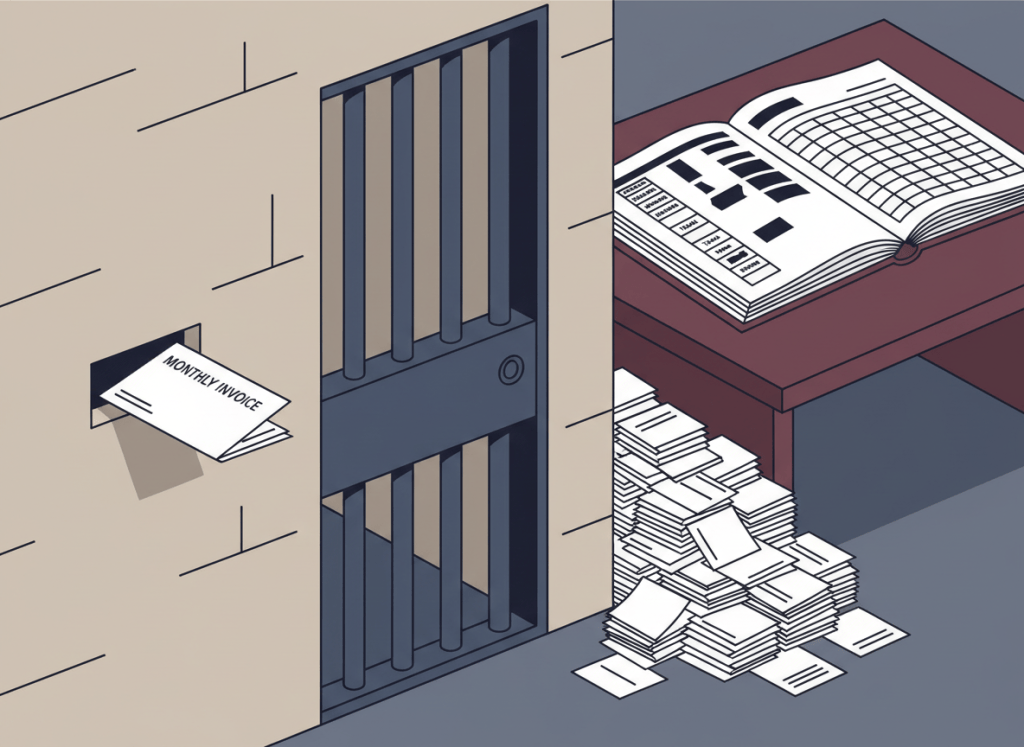
There is a particular species of government waste that never makes the evening news. It involves no fraudster, no smoking gun, no perp walk. It involves a spreadsheet, a monthly invoice cycle, and a state agency that knew exactly what the law required and simply could not make its own computers do it. The latest specimen comes courtesy of the U.S. Department of Health and Human Services Office of Inspector General (OIG), which published an audit in October 2026 finding that Louisiana made unallowable Medicaid managed care capitation payments on behalf of incarcerated enrollees — and the tab starts at $3.7 million.
Federal law is not subtle on this point. People incarcerated in prisons are enrolled in Medicaid, but the federal government generally won’t reimburse the state for their care unless they’re inpatients in a medical institution. Everyone else — the prison handles. Under federal regulation (42 CFR §§ 435.1009 and 435.1010), states are expected to suspend, not terminate, Medicaid coverage during incarceration, and lift the suspension upon release so people don’t re-enter society uninsured.
Louisiana had a process for this. On paper, it was meticulous.
The System That Knew Too Late
Here’s how the machinery was supposed to work, according to the audit (OAS-25-04-100): The Louisiana Department of Public Safety & Corrections (LDPS&C) sends the Louisiana Department of Health a weekly list of incarcerated individuals. The state’s eligibility system, LaMEDS, matches the list against Medicaid enrollment and suspends managed care enrollment automatically, cutting off the monthly capitation payments — the fixed per-person fees the state pays to managed care organizations (MCOs) regardless of whether the enrollee sees a doctor.
In practice, the first domino wobbled. LDPS&C runs on what the OIG dryly describes as an “antiquated information system,” and its incarceration data was frequently incomplete — arriving months after an admission, and in some cases up to five years late. Five years. Somewhere in Louisiana, a man served his sentence, got out, possibly got a job, and the system was still paying his managed care organization as though he were behind bars.
The second domino wasn’t much sturdier. LaMEDS, implemented in 2012, couldn’t automatically update managed care enrollment when incarceration status changed if it overlapped with prior enrollment activity — those cases required a human analyst to intervene manually. And the third-party enrollment broker, Maximus, could only act if it received timely data from LDPS&C in the first place. Garbage in, capitation out.
The Numbers
The OIG matched prison data against federal T-MSIS enrollment records and identified 3,639 incarcerated Medicaid enrollees for whom the state paid $18.3 million in capitations during the audit period, October 1, 2022 through September 30, 2024. From a stratified random sample of 100, auditors found that 46 — nearly half — had unallowable payments totaling $143,459 ($102,822 federal share).
Projected across the full population, the OIG estimates Louisiana made unallowable payments of at least $3.7 million ($3,742,284, with a federal share of $2,690,745 — the amount OIG recommends Louisiana refund). The point estimate is higher: $4.9 million, and the statistically plausible ceiling reaches $6 million.Lower limit (refund recommended)Point estimateUpper limit$0$1,000,000$2,000,000$3,000,000$4,000,000$5,000,000$6,000,000Estimated unallowable payments (USD)Estimated Unallowable Payments, LouisianaOIG statistical estimate ranges, Oct 2022–Sep 2024 (90% confidence)
For most victims of this accounting drift — 35 of the 46 sampled enrollees — the bleeding was capped at six months. But eleven enrollees accumulated more than six months of payments for care they legally couldn’t receive, and six of them ran past eighteen months. None of the unallowable payments had been recovered from the MCOs at the time of the audit.
Louisiana’s Defense: Fair, and Telling
To its credit, Louisiana’s response, filed September 8, 2026 and reproduced in the report’s appendix, is not the usual shrug. Medicaid Executive Director Seth Gold wrote that the state “concurs” with the refund recommendation and is “working internally” to return the federal share. More importantly, the state notes that starting in July 2024 — before the audit concluded — it began a monthly manual cross-check of incarceration data from LDPS&C against Appriss data, a nationwide incarceration database run by an Equifax subsidiary. During the final months of the audit period, the OIG found no new unallowable payments.
That is genuinely good news, with two asterisks. First, “monthly manual cross-check” is how states describe fixes when the actual fix — an automated interface between corrections data and eligibility systems — still hasn’t been built. Second, the manual workaround exists precisely because the underlying data pipeline, run by a corrections department on a legacy system, remains the weak link. The state has bolted a sump pump onto a leaking hull.
Not a Louisiana Story — A Federal One
The most revealing part of this report isn’t about Louisiana at all. It’s the citation trail. The OIG’s opening section references a prior audit of the same phenomenon in Ohio, two earlier probes by the Louisiana Legislative Auditor (in 2014 and 2018, meaning Louisiana has known about this failure mode for over a decade), and a December 2025 OIG audit of Illinois, which found at least $9.5 million in unallowable capitation payments, $8.3 million federal. The OIG announced a formal national audit series on the issue in July 2024, and it is still working through the states.
The series has already bagged New York, too: a September 2026 OIG report found unallowable capitation payments totaling $7.55 million ($6.16 million federal) there — notable in that New York failed on the payments for every one of the 1,375 enrollees examined, not a sample.Illinois (Dec 2025)Louisiana (Oct 2026)New York (Sep 2026)$0$2,000,000$4,000,000$6,000,000$8,000,000Federal share to be refunded (USD)Federal Share Owed, by State AuditRecent OIG audits in the national series on incarcerated Medicaid enrollees
The pattern across all three: state Medicaid agencies buy enrollment information systems, corrections departments run incompatible or aging records systems, the handoff between them depends on timeliness nobody enforces, and money flows monthly to MCOs in the gap. Nobody steals anything. The plumbing just leaks.
The Uncounted Cost
There’s a quieter casualty here than the federal treasury: continuity of care. Louisiana — like most states — deliberately suspends rather than terminates Medicaid coverage during incarceration, so that coverage resumes the moment someone walks out the gates. The Justice-Involved Pre-Release Enrollment Program Manual exists precisely to ease that transition.
But a system that takes months or years to register an admission is the same system that has to register a release. The OIG found delays at both ends. For a parolee whose enrollment suspension lagged or whose re-enrollment stumbled, the promises of the re-entry paperwork are only as good as the data feed underneath them.
Where This Leaves Us
Louisiana will refund $2.69 million, the audit’s numbers will settle into a footnote, and the July 2024 cross-check will keep the worst of it at bay. Congress, meanwhile, has begun nudging the underlying rules — the Consolidated Appropriations Act, 2024 bars states from terminating Medicaid eligibility for incarceration outright and, as of January 1, 2025, permits limited federal reimbursement for certain pre-release services for juveniles.
None of that touches the actual culprit: an interface between two legacy databases that the OIG has now caught failing in Ohio, Illinois, New York, and Louisiana. When the same bug appears in four states spanning the red-blue map and four very different administrations, “isolated lapse” stops being a plausible explanation and “systemic architecture” becomes the diagnosis.
The OIG will keep auditing states alphabetically or by lottery; the leak will keep dripping until someone mandates — and funds — a working pipe between jail booking systems and Medicaid eligibility rolls. Until then, somewhere in America, a managed care organization is invoicing this month’s capitation payment for a man the warden met three years ago.
Sources & further reading:
- HHS OIG, Louisiana Made Unallowable Managed Care Capitation Payments on Behalf of Incarcerated Medicaid Enrollees (OAS-25-04-100), October 2026 — full report (PDF)
- HHS OIG, Medicaid Managed Care Capitation Payments on Behalf of Incarcerated Enrollees — national audit series page (SRS-A-25-024)
- HHS OIG, Illinois Made Unallowable Managed Care Capitation Payments… (A-05-24-00019), December 2025 — report page
- HHS OIG, New York Made Unallowable Managed Care Capitation Payments… (OAS-25-02-074), September 2026 — report page
- Ohio Auditor of State, Ohio Department of Medicaid Improper Capitation Payments, December 2021; Louisiana Legislative Auditor, Medicaid Participant Fees Paid for Incarcerated Individuals, July 2014, and Identification of Incarcerated Medicaid Recipients, October 2018 (cited in OAS-25-04-100)
Methodology note: OIG’s estimate of at least $3.7 million is a conservative lower bound drawn from a stratified random sample of 100 enrollees, calculated at the lower limit of a two-sided 90-percent confidence interval — a method designed to understate, not overstate, the true total.

