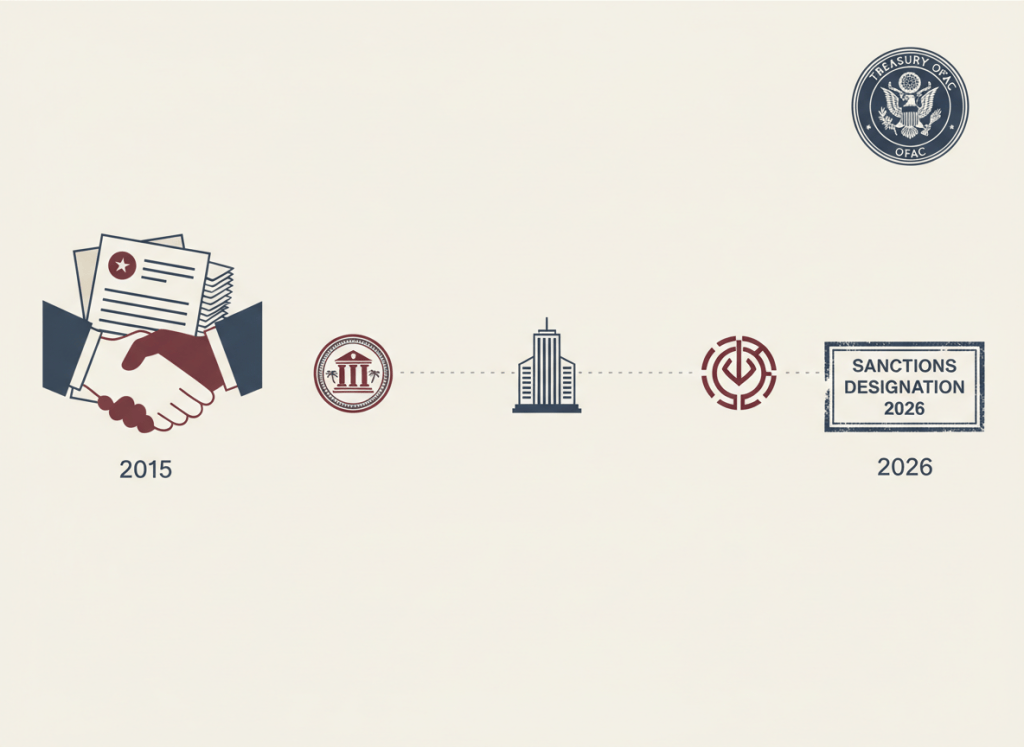
SEC filings document a U.S.–Cuba banking arrangement established in 2015 and still disclosed in 2021. The Trump administration now says the Cuban bank provided services to a sanctioned Iranian institution beginning no later than 2022, but has not publicly explained the transactions or its enforcement timeline.
WASHINGTON, October 19, 2026 — When Secretary of State Marco Rubio announced new sanctions against a Cuban state-owned bank on October 15, the administration presented the action as another effort to dismantle financial relationships between Havana and Tehran.
The target was Banco Internacional de Comercio S.A., better known as BICSA, a Cuban financial institution that the State Department says has provided services to Iran’s Karafarin Bank since at least 2022. The United States sanctioned Karafarin in 2020.
What the announcement did not mention was that BICSA had once maintained a correspondent banking relationship with an American bank, established during the Obama administration’s diplomatic normalization with Cuba and subsequently disclosed for years in federal securities filings.
A review by Bureaucracy Times of historical filings with the Securities and Exchange Commission found that Stonegate Bank established a correspondent relationship with BICSA in July 2015. When Home BancShares acquired Stonegate in 2017, it inherited that relationship, which the company continued to identify in its annual reports through at least 2021.
The filings do not establish that the American banking relationship remained operational when BICSA began providing services to Karafarin. Nor is there evidence in the records examined that Stonegate, Home BancShares or its subsidiary Centennial Bank facilitated Iranian transactions.
Nevertheless, the historical arrangement provides a previously documented dimension to the administration’s latest sanctions action, while raising questions about the evolution of BICSA’s international banking relationships and the government’s enforcement chronology.
A Banking Relationship Born of Diplomatic Normalization
In 2015, the Obama administration’s restoration of diplomatic relations with Cuba created limited opportunities for American financial institutions to establish banking arrangements that had been restricted for decades.
Stonegate Bank, a Florida-based institution, became one of the American banks participating in that opening.
According to a 2017 SEC filing containing Stonegate’s financial disclosures, the bank announced in May 2015 that it would provide banking services to Cuba’s diplomatic mission in Washington under authorization from the Treasury Department’s Office of Foreign Assets Control.
Two months later, Stonegate announced a correspondent banking relationship with BICSA intended to facilitate cross-border transactions involving Cuba.
Correspondent banking allows financial institutions to provide services to other banks, often facilitating international payments where direct access to a country’s financial system is limited.
Such arrangements are common in international finance, but they also introduce compliance obligations because the institution providing correspondent services may have limited visibility into the customers and underlying transactions of the foreign bank.
Stonegate recognized those risks.
Its disclosures described the additional monitoring and compliance requirements associated with maintaining a relationship with a Cuban financial institution, including the possibility of heightened exposure under federal anti-money-laundering regulations.
Those warnings were not accusations that BICSA had engaged in misconduct. They were descriptions of risks inherent in cross-border correspondent banking.
In 2017, Home BancShares acquired Stonegate and integrated it into Centennial Bank, bringing the Cuban relationships into a larger American banking organization.
The relationships remained visible in subsequent corporate disclosures.
The Risk Disclosures That Continued Through 2021
Home BancShares’ 2019 annual report identified the company’s relationship with BICSA as a source of potential compliance costs and regulatory exposure.
The report explained that correspondent banking arrangements involving Cuban institutions could create additional obligations under the Bank Secrecy Act and federal anti-money-laundering requirements.
The company also acknowledged that inadequate compliance with the conditions of its OFAC authorization could expose it to regulatory action.
The disclosure was unusually specific about the risks associated with foreign correspondent accounts, including the possibility that customers of foreign institutions might not be fully transparent to American banks.
By 2021, Home BancShares was still identifying the BICSA relationship in its annual filings.
Its 2021 Form 10-K stated that the company maintained banking relationships with Cuba’s diplomatic missions and BICSA, again warning about the regulatory obligations associated with those arrangements.
The filing provides an important historical marker, but it also establishes the limits of what can be concluded from the available documents.
An annual risk disclosure does not establish the number, value or frequency of transactions processed through a correspondent relationship during the reporting period.
Nor does it establish that the relationship remained active after the filing.
The precise termination date, if any, has not been determined from the records examined.
That unresolved date matters because the government’s newly disclosed timeline for BICSA’s relationship with Iran begins the following year.
An Iranian Relationship Dating Back to at Least 2022
On October 15, 2026, the State Department announced sanctions against BICSA, stating that the Cuban bank had provided services to Iran’s Karafarin Bank since at least 2022.
Karafarin was among the Iranian financial institutions sanctioned by Treasury in October 2020 under Executive Order 13902, which authorizes sanctions against specified sectors of Iran’s economy, including its financial sector.
The October 2026 announcement did not identify the nature of the services BICSA provided.
It did not disclose transaction amounts, currencies, counterparties, payment purposes or the identities of any intermediaries.
Nor did it specify whether the activity involved correspondent accounts, trade financing, currency transfers or another form of banking service.
Those omissions leave an important distinction unresolved.
Providing services to a bank already subject to American sanctions may create sanctions exposure, but the public announcement does not establish that BICSA participated in a specific terrorism-financing transaction or that American financial institutions facilitated the relationship.
The State Department designated BICSA under Executive Order 14404, a Cuba-specific authority issued in May 2026, for operating in or having operated in the financial-services sector of the Cuban economy.
The administration cited BICSA’s relationship with Karafarin as part of its justification, but the formal designation authority was separate from the Iran sanctions order under which Karafarin had been listed.
This distinction matters because the government’s public allegations and the legal grounds for the designation are not identical.
The administration has not publicly established when American authorities first identified the BICSA–Karafarin relationship, whether the activity was previously investigated, or what specifically prompted the October 2026 designation.
The phrase “since at least 2022” establishes a minimum duration for the banking relationship. It does not establish when the United States learned of it.
Three Cuban Banks Targeted in a Matter of Months
The BICSA designation was not an isolated action against Cuba’s financial sector.
During 2026, the administration also designated Banco Financiero Internacional and Banco Exterior de Cuba under the same Cuba-related sanctions authority.
Together, the three designations demonstrate a broader application of Washington’s new sanctions framework against Cuban banking institutions.
The measures coincide with the administration’s implementation of additional Cuba sanctions regulations and restrictions affecting financial transactions involving the island.
The cumulative economic consequences remain difficult to quantify.
The public records examined do not establish the three banks’ combined share of Cuban international payments, their current correspondent banking networks, or the number of businesses and financial institutions affected by the designations.
Without those figures, it would be premature to conclude that the sanctions have disabled a particular percentage of Cuba’s international banking capacity.
What can be established is that Washington has targeted multiple institutions involved in Cuba’s financial system within a relatively short period.
The latest designation also brings the Cuban banking campaign into the administration’s broader effort to restrict Iran’s international financial relationships.
Operation Economic Outcast
BICSA’s designation was announced alongside a larger Treasury Department operation targeting Iranian financial networks.
In its October 15 announcement, Treasury described Operation Economic Outcast as an effort to disrupt financial institutions and intermediaries allegedly helping Iran access foreign currency, conduct international transactions and evade existing restrictions.
The operation included measures against an Iraqi bank and other financial entities accused of facilitating Iranian access to international payment networks.
Treasury described offshore financial arrangements and intermediaries that allegedly moved substantial sums through companies and currency-exchange operations across multiple jurisdictions.
The department explicitly acknowledged that the BICSA designation was coordinated with the broader operation.
However, its announcement did not establish that BICSA participated in the specific transaction networks or financial arrangements attributed to the other designated institutions.
That distinction is important.
The coordinated timing establishes a policy connection between the actions. It does not, by itself, establish a common transaction network linking every designated institution.
A more complete picture would require transaction records, correspondent account information, enforcement documentation or additional disclosures from the agencies involved.
A Cuban Banking Restructuring Adds Historical Context
BICSA’s international role predates both the 2015 diplomatic opening and the current sanctions dispute.
Established in 1993, the bank has long operated within Cuba’s state-controlled financial system.
Cuban regulatory records from 2007 document a restructuring involving BICSA and Grupo Nueva Banca S.A., including the transfer of certain functions, assets and liabilities.
The restructuring expanded BICSA’s authorized activities and reinforced its institutional role in financial operations.
Those records help establish BICSA’s development as an international banking institution, but they do not independently establish its complete ownership structure in October 2026.
The current ownership chain, any subsidiaries, and the bank’s contemporary correspondent relationships remain subjects for further examination.
Those details are relevant because sanctions can extend beyond the specifically named institution to entities meeting applicable ownership thresholds.
The November Deadline
The sanctions also create an immediate compliance question for foreign financial institutions that may have existing relationships with BICSA.
In Frequently Asked Question 1276, Treasury’s Office of Foreign Assets Control states that the U.S. government does not intend to target foreign persons, including foreign financial institutions, under Executive Order 14404 for transactions ordinarily necessary to wind down qualifying BICSA relationships through November 14, 2026.
The guidance does not provide blanket permission for American persons to engage in otherwise prohibited transactions.
Instead, it establishes a limited period during which qualifying foreign counterparties may disengage from the sanctioned institution without being targeted under that particular executive order for those wind-down activities.
OFAC also cautions that certain transfers involving sanctioned assets may still create sanctions exposure.
The deadline introduces another unanswered question: how many foreign financial institutions have relationships requiring termination or restructuring, and what effect will those changes have on legitimate commercial payments involving Cuba?
Treasury has not publicly provided an estimate of the affected institutions or transaction volumes in the guidance examined.
What Washington Has Not Explained
The October 15 designation establishes that the United States considers BICSA’s relationship with Karafarin significant enough to cite publicly in a sanctions announcement.
The historical SEC filings establish that BICSA also maintained a formally documented correspondent relationship with an American bank beginning in 2015, one that continued appearing in corporate disclosures through 2021.
Those two sets of records describe different periods and different banking relationships.
They do not establish that the American institution participated in, knew of or facilitated BICSA’s subsequent dealings with Karafarin.
But considered together, they raise several legitimate questions for federal officials and the institutions involved.
When did the American correspondent relationship actually end? What regulatory authorizations governed its operation, and were those authorizations subsequently modified or withdrawn?
When did Treasury or State first identify BICSA’s relationship with Karafarin? What services did BICSA provide, and did those services involve any financial intermediaries subject to American jurisdiction?
Finally, what specific development led the administration to designate BICSA in October 2026, rather than at an earlier point in the relationship identified by State?
These questions are not evidence of regulatory failure. They are gaps in the public explanation of a sanctions decision affecting an institution with a documented history of international banking relationships.
Cuban officials have rejected the designation. President Miguel Díaz-Canel characterized the sanctions as part of Washington’s broader economic campaign against the island, while Foreign Minister Bruno Rodríguez defended the legitimacy of BICSA’s activities.
The administration, meanwhile, has characterized the action as part of its effort to isolate financial institutions supporting Iran and other governments it considers hostile.
Both positions are clear. The underlying transaction evidence remains largely undisclosed.
For now, the public record establishes an unusual financial chronology: a Cuban bank entered a correspondent relationship with an American institution in 2015, remained identified in that institution’s securities disclosures through 2021, and subsequently provided services to an Iranian bank already under U.S. sanctions, according to the State Department.
What happened between those events, and what federal authorities knew as the relationships evolved, remains unanswered.
The government has announced the sanction. The financial history behind it is still being reconstructed.
Reporting note: This article is based on publicly available State Department and Treasury announcements, OFAC guidance, SEC filings, and historical Cuban regulatory records. The reviewed materials do not establish wrongdoing by Stonegate Bank, Centennial Bank or Home BancShares in connection with BICSA’s later Iranian banking relationship. The status of the historical U.S. correspondent arrangement after 2021 remains unverified. Agency and institutional responses to the outstanding questions have not yet been obtained.

