When the satellites go dark, pilots are told to fall back on the old ground stations, radio beacons that have been quietly pointing at the sky since the 1950s. On September 29, the Department of Transportation’s Inspector General published an audit of how the FAA decides how carefully the replacements must be built. The short version is that the agency’s own safety panel leaned one way, the program office went the other, and then the program was shelved anyway.
A Safety Rating Is Supposed to Be Arithmetic
Every new navigation aid the FAA buys gets a Design Assurance Level, a letter from A (failure is catastrophic) to E (nobody notices) that dictates how rigorously the thing must be designed and built. In the 2024 FAA Reauthorization Act, Congress told the Inspector General to study what would happen if distance measuring equipment, VORs, and TACANs were moved from DAL B to the stricter DAL A. The audit never got to answer that question. The auditors learned before they started that the FAA planned to keep the equipment at B, so they agreed with House Transportation and Infrastructure Committee staff to examine how the FAA assigns these ratings at all, as the original audit announcement and the final report describe. The report does not say who in Congress wanted the stricter level, or why.
What they found is a rulebook borrowed from the wrong vehicle. The FAA has no detailed guidance for assigning levels to ground-based systems, so it leans on industry standards written for airborne equipment. That matters because a failing airplane is one airplane, while a failing ground station misleads every aircraft in range at once. The one FAA advisory circular covering smaller general aviation aircraft has gone nearly fifteen years without revision, and it tolerates catastrophic failure likelihoods a thousand times higher than the industry standard the agency’s own risk guidance points to. The first ground-based assignment of any kind, the report says, did not happen until 2015.
The Vote Went One Way and the Signature Went Another
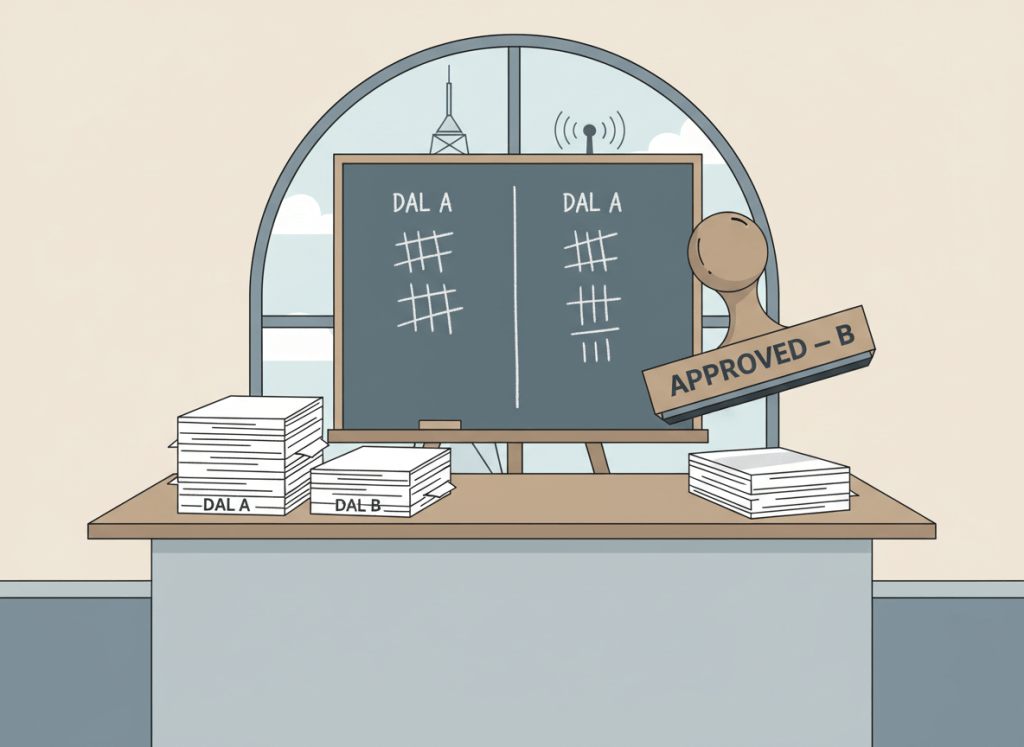
Here is the sequence the report lays out. Between March 2021 and August 2022, the operational safety assessment and the first preliminary hazard analysis for the program produced a DAL A, because the worst credible outcome was catastrophic. From August to December 2022, some program officials and panel participants objected, which the report attributes to unclear policy on how existing safeguards, such as controller alerts or terrain warnings on better equipped aircraft, may be counted when rating a hazard. Panelists split on whether such safeguards count at all unless they are available every single time. In May 2023, the hazard analysis held at DAL A anyway.
Then the program management office, citing those objections and acting under the direction of its own management, reconvened the panel and presented an event tree, a statistical diagram that by the office’s account justified a DAL B. Subject matter experts worried that the math did not meet the FAA’s own definition of likelihood and wrongly lowered the rating. Some panelists backed it and others did not. When the panel voted on adopting the change, the report says, more votes were cast to keep the original DAL A. The program office went with B regardless.
The FAA’s rules allow this. The report notes that the panel’s result is something the agency strives to follow, while final authority rests with the required signatories. The program office, Air Traffic Services, and the Office of Safety and Technical Training all signed. The safety office also attached a written dissent, arguing that the program office misapplied the industry standards and pointing to a credible scenario in which an aircraft flying in bad weather during a navigation aid malfunction, with no backup and no controller help, meets a catastrophic end. Its director approved the document and documented the opposition anyway. An Air Traffic Services executive offered the other side, that the original analysis ignored the rising risk of leaving aging equipment in service and was driven by general aviation operations, without credit for controller monitoring. It is a real argument, and the report does not say the panel found it persuasive.
Cheaper, Faster, and Never Priced
FAA policy says safety risk analysis is not to be used for budget, finance, or staffing considerations, and the agency accordingly never ran a cost comparison of DAL A against DAL B. Several officials told the auditors that safety should come first. Other officials said that in meetings and informal discussions, offices worried a DAL A would cost more, take longer, and narrow the field of vendors. This publication’s inference, resting on that passage of the report and the sequence above, is that cost and schedule were in the room when the rating came down. The reasoning is that the report records those worries alongside a decision history in which management ordered a second look at an analysis that had come out at A. That is a possibility the evidence permits, not a finding the report makes, and the officials interviewed insisted on the safety priority.
The irony arrives on schedule. The DAL B approval came in December 2024. In March 2025, citing funding concerns and shifting priorities, the FAA suspended the program. It gave the auditors no estimate of when the work might resume and has no long term strategic plan for it. The FAA’s own April 2026 briefing to the GPS advisory committee is blunt about where that leaves things. Most of these systems are more than thirty years old and becoming unsustainable. Contracts to replace VORs and TACANs are not available. Full-scale development of a new VOR is not affordable right now, for a fleet of more than 700. A 2025 market survey found two vendors with viable products, each meeting the FAA’s VOR specification to a varying degree, and the strategy under development lists cannibalizing parts among its options. The program that retires the minimum VOR network is itself being closed out in 2026 because of funding constraints and agency prioritization.
Nor is the satellite side immune. The same briefing records a loss of precision approach WAAS service across the continental United States and Alaska beginning January 19, which it ties to ionospheric impacts. The backup is old, the primary has bad days, and the argument about how carefully to build the successor ended with nothing being built.
Who Referees the Referee
The Inspector General made two recommendations, to write DAL guidance specific to ground-based aids and to clarify the safety manuals on how existing safeguards are counted. The FAA concurred with both and promised to finish by September 30, 2027, a year from now, which is brisk by the standards of an agency that needed more than four years to settle a single rating.
The fix is being built inside a house that is also being rearranged. On January 27, the FAA announced the largest reorganization in its history, including a new Aviation Safety Management System Organization that centralizes safety work previously spread across five lines of business. Separately, on July 1 the Inspector General opened a different audit, of the Air Traffic Organization’s safety management system and safety culture, at the request of the Transportation Secretary and following an NTSB recommendation. The NTSB had found that gaps in that system and deficiencies in that culture contributed to the January 29, 2025 midair collision near Reagan Washington National Airport.
This publication’s inference is that the navigation aid dispute belongs in that second audit’s inbox. The reasoning is that the DAL panels ran under the Air Traffic Organization’s safety management manual and its risk guidance for acquisitions, the same machinery the new audit will examine, and the 2022 disagreement over how to count safeguards is a documented case of that machinery producing a split it could not resolve on its own terms. The Inspector General has not said it will look at the case.
The documents that would settle the matter are the hazard analysis addendum, the event tree, and the safety office’s written dissent, and none of them appears to be public. There is one thread worth pulling. In 2021 the FAA told industry through a procurement notice that it would explain how it derived the assurance levels and share the program’s operational safety assessment with vendors on request, which means vendors could have asked for copies and may still hold them. That is an inference from a notice, not a claim about what any vendor has, and the notice does not say what level the assessment assigned.
A safety rating is meant to be the output of a process. Here a majority of the panel voted for one rating, the program office signed the other, and the safety office filed a dissent for the record, after which the whole enterprise was set aside for lack of money. The beacons, meanwhile, go on pointing at the sky, one more budget cycle at a time.

