The VA Office of Inspector General inspected the Albany Healthcare System for three days in September 2025, sat on its findings for a year, and published a report on September 25, 2026, that reads like a facility trying very hard to be fine. Leadership is engaged. Morale is mostly intact. The lobby is clean and the coffee is presumably adequate. Beneath that, veterans went a full year with barely more than half their urgent test results delivered on time, staff were mixing bleach in a room with no eyewash station, and dead insects were found inside a locked medication dispensing unit. All four of these things are true at once, because that is how institutional dysfunction actually works; it does not announce itself, it just sits quietly under the lobby furniture.
Fifty Five Percent Isn’t a Grade, It’s a Coin Flip Weighted Against the Patient
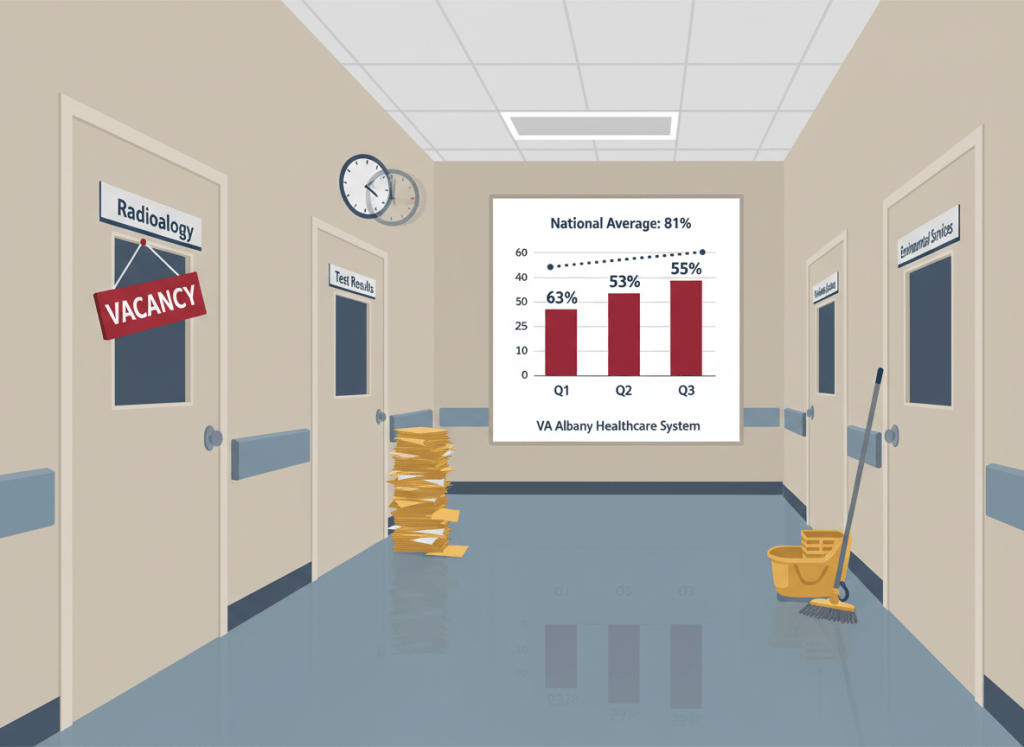
VHA Directive 1088(1) requires facilities to notify patients of urgent, noncritical test results within seven days. Albany’s compliance rate for the first three quarters of fiscal year 2025 was 63 percent, 53 percent, and 55 percent. The national VHA average across those same quarters was 81 percent, 81 percent, and 82 percent. Albany was not merely behind the curve; it was failing a coin flip weighted against the patient, three quarters running.
The OIG traced part of the collapse to a radiology vacancy crisis, which the Chief of Staff attributed directly to the 2025 return to in person work mandate. Radiologists left rather than come back to a desk, and some who were later granted an exemption declined to return anyway. The facility leaned on the National Teleradiology Program and neighboring VISN facilities to cover the gap while it tried, unsuccessfully for most of the year, to get a staffing contract awarded (that contract was still “pending award” as of June 2026, nearly a year after the inspection). Meanwhile the OIG found that the Chief of Staff and the Associate Director for Patient Care Services, who are specifically named in the directive as the officials responsible for monitoring this data, were not doing so; unit level leaders were reviewing it instead, which is the bureaucratic equivalent of delegating your own homework.
Here is the part worth sitting with. The Director’s response claims that by fiscal year 2026, compliance jumped from 52.38 percent to 90.48 percent, and that a related metric rose from 71.43 percent to 95.24 percent, both “surpassing VISN and VHA percentages.” The OIG accepted this and closed the recommendation before the report was even published. A facility that spent three consecutive quarters roughly 25 to 30 points below the national average apparently corrected itself so thoroughly, so fast, that it now beats the system it was failing. That is either an extraordinary turnaround driven by a gap analysis and a policy review, or it is a metric that got easier to hit once somebody started watching it closely enough to hit it. The OIG’s own methodology allows for both explanations and picked the flattering one.
Bleach Without an Eyewash Station, Insects Without an Exterminator
The Environment of Care findings are where the report stops being abstract. Inspectors found protected patient health information sitting unsecured at an emergency department nursing station and on carts in the dialysis unit hallway, a plain violation of VHA Directive 1605.01. They found dusty and soiled surfaces throughout the emergency department, debris and dead insects in a soiled utility closet, and more dead insects in a bin inside a locked medication dispensing unit, which is a sentence that should not exist in a hospital inspection report and yet does.
Dialysis unit staff, it turns out, had been mixing their own disinfectant wipes because the hemodialysis equipment requires a specific bleach concentration no premade product could match. They were doing this in a room without an eyewash station, a hazard the VISN’s own Annual Workplace Evaluation had already flagged in January 2025. Nine full time and one part time environmental services staff left between January 2024 and July 2025, a loss the environmental services chief attributed to VHA’s strategic hiring initiative, competitive pay elsewhere, and a hiring pipeline that takes three to six months, long enough for most applicants to simply lose interest and take another job. Supervisors ended up covering housekeeping shifts themselves while also training new hires, because the training instructor had retired and nobody replaced that role either.
Food and medication refrigerators across patient care units were found with dirty surfaces and gaskets. The nursing procedure for medication refrigerators states, without irony, that “nursing staff will ensure medication refrigerators are clean,” but nurse managers could not produce an actual cleaning schedule to show the OIG. A policy that says clean it without saying when, by whom, or how you’d know, is not a policy; it’s a wish.
The Robot in the Room Everyone Already Knew About
This report also discloses, in its methodology appendix, that the inspection team used Microsoft Copilot Chat to help review interview transcripts, documents, questionnaire responses, and physical observations, with staff confirming the output against source material afterward. It reads like a striking admission until you check the other recent VA OIG healthcare facility reports and find the exact same paragraph in them too. Government Executive and Nextgov/FCW both reported in September 2026 that this has been standard boilerplate language across every OIG hotline, healthcare facility, and mental health inspection report since March, with a VA OIG spokesperson insisting the tool never shares data with the department itself. So the disclosure in the Albany report isn’t a revelation about Albany; it’s a revelation about how quietly an inspector general’s office normalized AI assisted audits of the agency it’s supposed to be watching, with almost nobody outside two trade publications noticing until now.
Twenty Two Days for a Scan, Thirty Seven for a Rash, and Nobody Owns the Difference
The community care numbers round out the picture. Veterans referred out for imaging and radiology waited an average of 22 days; those referred for dermatology waited 37, against a federally mandated 7 day scheduling standard under the Consult Timeliness SOP. Community care referrals rose 19 percent in a single year, driven in part by the same provider losses hollowing out radiology and cardiology in house. And when something does go wrong in the community, the report notes, facility staff who file a Joint Patient Safety Reporting entry often never learn the outcome, because the third party administrators investigating those reports aren’t contractually obligated to tell them. The OIG has now made this same complaint about third party opacity in at least two prior reports, on VISN 16 and VISN 17, which means Albany isn’t an outlier so much as a data point in a pattern nobody with the authority to fix it seems inclined to address.
None of this required a hidden whistleblower or a leaked memo. It’s all sitting in a 24 page PDF the Inspector General published under its own letterhead, alongside a Director’s response that concurred with every recommendation and a compliance jump so clean it closes the book before the ink dries. The veterans waiting on a dermatology referral in Albany are, presumably, still waiting.
Sources: VA OIG, Healthcare Facility Inspection of the VA Albany Healthcare System in New York, Report No. 25-00256-276, September 25, 2026; Government Executive, “VA watchdog uses AI to help compile healthcare facility audits”; Nextgov/FCW, “VA watchdog uses AI to help compile healthcare facility audits”.

