When the U.S. Attorney’s Office for the Southern District of West Virginia announced earlier this month that Zachary Hess Dawson had pleaded guilty to stealing more than $354,000 in veterans benefits, the criminal case itself seemed relatively straightforward.
Dawson had admitted what he did.
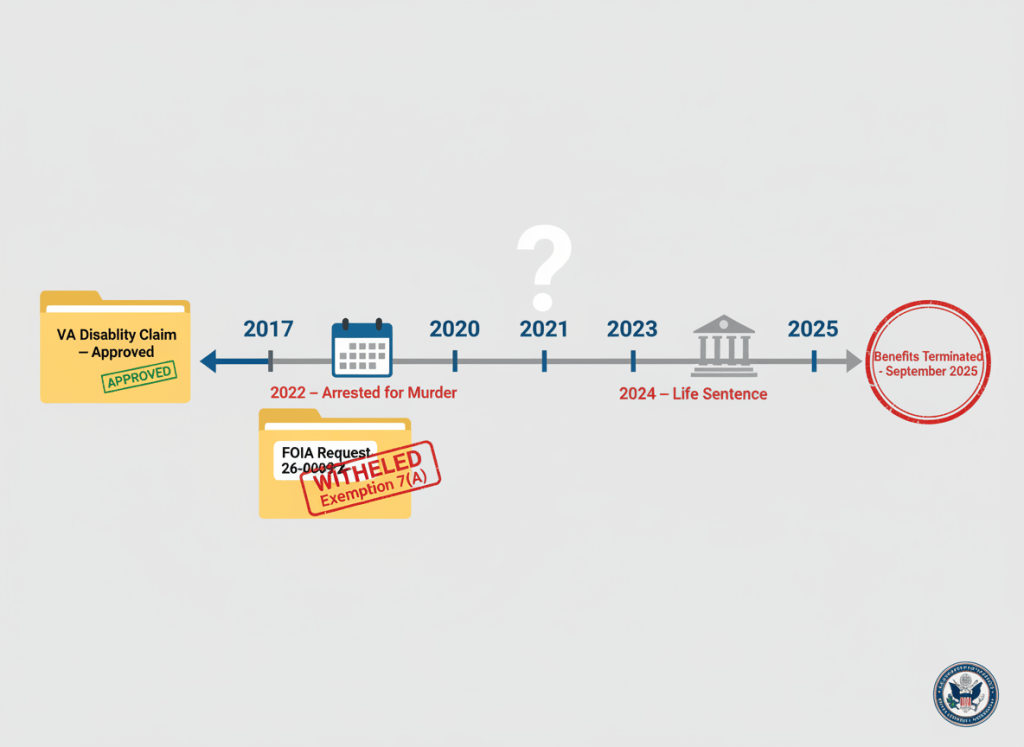
According to federal prosecutors, he falsely claimed that he suffered from post-traumatic stress disorder stemming from service with the U.S. Army in Afghanistan in 2009. Based on that claim, he received Department of Veterans Affairs benefits from approximately January 2017 through September 2025, ultimately collecting $354,813.98 to which the government says he was not entitled.
By the time the federal case became public, there was little mystery about the government’s allegation. Dawson had signed a plea agreement and admitted making false statements to VA and Veterans Benefits Administration officials to obtain the money.
The mystery was how it had worked for so long.
Eight years is a long time for the federal government to send money to someone based on a fraudulent disability claim. It is an even more curious stretch of time when the recipient spends part of it being prosecuted for murder.
That is where this investigation began.
Dawson’s VA fraud case did not unfold in isolation. On Thanksgiving Day in 2022, he killed his wife, then-30-year-old Destiny Dawson, at their home in Alderson, West Virginia. He was arrested and prosecuted in state court and, in November 2024, was sentenced to life in prison without the possibility of parole after pleading guilty to first-degree murder.
Yet according to the dates provided by federal prosecutors, Dawson’s fraudulent VA benefits did not stop when he was arrested. They apparently did not stop when he was incarcerated, either. They did not even stop when a state judge sentenced him to spend the rest of his life in prison.
The federal government says the fraudulent benefits continued until approximately Sept. 30, 2025 — roughly 10 months after his life sentence was imposed.
That chronology does not establish that Dawson’s murder case had anything to do with the eventual discovery of his VA fraud. There may be no connection at all.
But it presents a question that is difficult to ignore.
At some point between the approval of Dawson’s claim in 2017 and the federal prosecution that followed years later, somebody discovered that the premise underlying hundreds of thousands of dollars in veterans benefits was false. The public record explains the beginning of that story and, through the federal prosecution, much of its ending. What it does not explain is what happened in between.
That missing middle has become the focus of our investigation.
We want to know how Dawson’s claim was originally evaluated and approved, what information VA relied upon when making that decision, and whether the claim was subsequently reviewed during the nearly eight years that payments continued. We also want to know what finally caused the government to look again.
Most intriguing is the possibility raised by the timeline itself: whether Dawson’s arrest, incarceration or murder conviction somehow put his VA benefits under scrutiny.
We do not know that it did.
In fact, the continued payments after his arrest and subsequent life sentence complicate that theory considerably. If Dawson’s entry into the criminal justice system eventually caused someone to notice a problem with his VA claim, the obvious follow-up question is why that process apparently took years.
There are other possibilities. VA may have discovered the fraud through an internal review. Another agency may have passed information to the department. An investigator may have noticed a discrepancy. Someone familiar with Dawson may have reported him. The investigation could have originated from information completely unrelated to the murder case.
The public record does not currently tell us which, if any, of those explanations is correct.
So we started looking.
Reconstructing the Dawson Case
Our first inquiries went to the two federal entities closest to the prosecution: the U.S. Attorney’s Office for the Southern District of West Virginia and the VA Office of Inspector General.
The U.S. Attorney’s Office helped fill in portions of the record, including providing copies of Dawson’s federal criminal information and plea agreement. We subsequently went into the federal court system and reconstructed additional portions of the case through PACER.
Those records established the mechanics of the federal prosecution and provided a clearer chronology of how Dawson moved from state custody into federal court.
The criminal information was filed in July. Because Dawson was already incarcerated in West Virginia, federal prosecutors sought a writ of habeas corpus ad prosequendum to bring him before the U.S. District Court in Charleston. By September, Dawson had appeared in federal court and pleaded guilty to theft of public money.
The court records were useful, but they were principally records of prosecution. They documented what happened after investigators had already determined there was a crime worth prosecuting.
Our questions concerned what happened before that.
We therefore approached VA OIG, the agency whose investigators worked the fraud case.
In a media inquiry, we sought information about how the investigation originated and how the fraudulent claim had survived for so long. The inspector general’s office declined to discuss the open matter and directed requests for nonpublic investigative records into the Freedom of Information Act process.
Fair enough.
We filed one.
Trying the Records Door
On Sept. 22, Bureaucracy Times submitted a targeted FOIA request to VA OIG seeking records that might reconstruct the investigative history behind the Dawson prosecution.
The request was deliberately broader than a search for a single investigative report. We sought records concerning the origin and detection of the fraud, the investigative findings that ultimately resulted in a prosecution referral, VA or OIG knowledge of Dawson’s incarceration, the determination that his PTSD-related claim was fraudulent, and records concerning his benefits and payment history.
Those records could answer a deceptively simple question: What happened inside the government between the day VA began paying Dawson and the day somebody realized it should not have been?
VA OIG assigned the request tracking number 26-00092-FOIA.
Its answer arrived Sept. 25.
No records were released.
The inspector general invoked Exemption 7(A) of the Freedom of Information Act, which permits law-enforcement agencies to withhold records when their release could reasonably be expected to interfere with enforcement proceedings. Although Dawson has pleaded guilty, his criminal case remains pending because he has not yet been sentenced.
VA OIG therefore suggested that we return after the criminal case has concluded and submit another request.
There is an important limitation to what can be inferred from that response. The denial does not establish that every category of record we requested exists. It tells us only that VA OIG is withholding law-enforcement records while the Dawson prosecution remains active.
For the moment, we are not appealing that decision.
We are waiting for the prosecution to end.
What We Still Don’t Know
Dawson is scheduled to be sentenced Jan. 7, 2027. The federal theft charge carries a maximum penalty of 10 years in prison, although the practical significance of an additional prison term is diminished by the life-without-parole sentence he is already serving for murder.
For this investigation, the more important consequence of sentencing may come afterward.
Once the federal enforcement proceeding is actually concluded, we intend to return to VA OIG and seek the investigative records again. We will also continue watching the federal docket because sentencing memoranda and related filings may disclose additional details about the origin of the investigation, the calculation of the government’s loss or the circumstances that brought Dawson’s fraud to investigators’ attention.
The objective is not to prove that Dawson defrauded the VA. The federal government has already prosecuted that question, and Dawson has admitted it.
The object is to understand how he was able to do it.
Somewhere inside the government’s records should be the story of how a fraudulent claim became an approved claim, how that approval turned into years of federal payments, and how a system designed to administer disability benefits to veterans failed to identify the deception for nearly eight years.
There should also be an answer to the most basic question of all: What finally changed?
Perhaps the answer will lead back to Dawson’s murder case. His arrest and incarceration placed him squarely inside another government system years before the VA payments ended, and his eventual life sentence made his circumstances even more conspicuous. Perhaps information generated during that prosecution eventually reached the VA.
Or perhaps it had nothing to do with it.
That is precisely why we are not filling the gap with assumptions.
What we know is that the government says Dawson began receiving benefits based on fraudulent representations in January 2017. We know that he killed his wife in November 2022 and subsequently entered the state criminal justice system. We know that he was sentenced to life without parole in November 2024. And we know that, according to federal prosecutors, the fraudulent VA payments continued until approximately September 2025.
Then, somewhere along the line, the government figured it out.
The federal prosecution tells us what investigators found once they got there. It does not yet tell us how they got there, why it took so long, or whether anyone could have gotten there sooner.
For now, the records that may contain those answers remain behind Exemption 7(A), waiting for Dawson’s criminal case to reach its conclusion.
So this investigation is going into a holding pattern, but it is not being closed.
When the prosecution ends, we will go back for the records.
Because the unanswered question in the Dawson case is no longer whether the government paid a fraudulent claim.
It is how the government managed to keep paying it for eight years.

