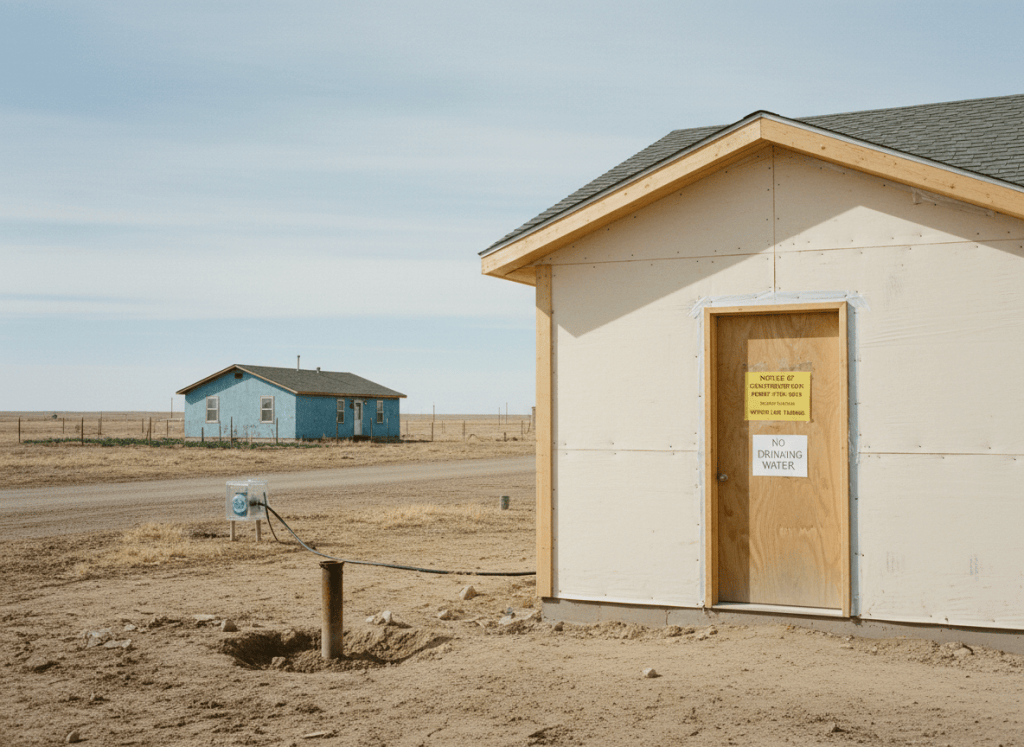
For more than forty years, an annual line buried in appropriations acts has told the Indian Health Service one thing plainly. It cannot spend its own money connecting water to a new home if that home was built with a Department of Housing and Urban Development grant. Not a workaround, not a special case; a blanket statutory wall between two federal agencies whose programs, if you squint at the org chart, look like they were designed to work together. A new Government Accountability Office report on tribal water infrastructure lays out exactly what four decades of that wall have produced, and the answer is homes with no running water, built on purpose, because the alternative was building fewer homes at all (Government Accountability Office, GAO-26-107178).
Choose Your Deprivation
HUD’s Indian Housing Block Grant program funds new home construction on tribal land, and normally the total cost of a new IHBG home is supposed to include the water and utility connections needed to live in it, according to HUD guidance (GAO-26-107178). That is the plan. The reality, as tribal housing authorities describe it to GAO, is a forced choice between two bad options, because IHBG funding has not kept pace with tribal housing need and, for decades, remained essentially flat in nominal terms while material and labor costs rose around it (GAO-26-107178). A tribal housing authority in California told GAO it would take one tribe nearly 350 years to build enough homes to meet its own housing need using only its annual IHBG allocation (GAO-26-107178). Three hundred and fifty years, using the money as currently allotted, to catch up on housing that people need now.
Given that math, tribes building homes with IHBG dollars have to pick a form of scarcity. Option one, build more homes and skip the water connection, accepting that families will move into a brand new house with no tap. Option two, include the water connection and build fewer homes, meaning some families who need housing get nothing while others get housing with plumbing. According to a senior HUD official, tribes reported that as recently as April 2026, HUD-funded homes were still being completed without water infrastructure (GAO-26-107178). One tribal housing authority in South Dakota told GAO plainly that building HUD-funded homes without running water is becoming the norm (GAO-26-107178). Not an emergency measure in a crisis year. The norm.
The Alaska Math Nobody Wants
In some parts of the country the math behind that choice is brutal enough to explain the whole pattern by itself. A HUD official told GAO that in Alaska, connecting a single new home to water can consume roughly 30 percent of that home’s entire construction budget (GAO-26-107178). Under a fixed development cost cap set by HUD regulation, an amount that must cover site work, utilities, and the home itself combined, a water connection eating nearly a third of the budget forces impossible tradeoffs (GAO-26-107178). GAO cites a HUD official describing exactly this kind of tradeoff in practice; a tribal housing authority in Alaska had to shrink a planned project from five homes down to four, specifically to cover the cost of connecting the remaining units to water and replacing a pumphouse the added water demand required (GAO-26-107178). One home, sacrificed to plumb the other four.
None of this is happening because HUD or IHS want families living without water. It is happening because a statutory prohibition, renewed year after year in appropriations riders since sometime in the 1980s, forbids IHS from spending its own water infrastructure money on any home built with HUD housing funds, full stop, regardless of need (GAO-26-107178). The prohibition does not ask whether the tribe can afford the water hookup out of pocket. It simply removes IHS, the one federal agency whose entire statutory purpose is building water infrastructure for Indian homes, from the table the moment HUD money is involved.
Nobody Knows What Happens If It Ends
Here is the strange part, and it is the part that makes this article different from the rest of the series. This is not a case where GAO found an obvious fix sitting on the shelf. GAO explicitly concludes that the effects of removing the prohibition are unclear (GAO-26-107178). HUD and IHS actually tried to find out; the two agencies ran joint formal tribal consultation from 2024 to 2025, specifically asking tribes what role, if any, IHS should play in connecting new HUD homes to water, and what removing the prohibition might change (GAO-26-107178). That consultation produced feedback, not certainty. Nobody, including the agencies whose money is at stake, can currently say with confidence what happens to program costs, agency workload, or existing water infrastructure prioritization if Congress simply deletes the line.
GAO’s actual recommendation reflects that uncertainty rather than pretending it away. Rather than telling Congress to remove the prohibition outright, GAO recommends that HUD and IHS jointly estimate the cost of providing water connections for newly built HUD-funded homes, aggregating IHS’s cost data with HUD’s home construction numbers, and report that estimate to Congress so lawmakers have real figures to work with (GAO-26-107178). It is a recommendation to do the homework before making the call, which is a modest ask given how long the underlying prohibition has already sat unexamined.
The Data Congress Already Has
The most quietly damning line in this section of the report is not about tribes or IHS at all; it is about the excuse HUD gave for resisting even this modest step. In its formal comments on the recommendation, HUD said it disagreed, stating that it lacked the authority to impose new reporting requirements on tribes beyond what statute and regulation already require (GAO-26-107178). GAO’s response is almost dismissive in its simplicity. Implementing the recommendation would not require HUD to collect a single new piece of information from any tribe, because HUD already collects and reports annually on the number of homes built with IHBG funding (GAO-26-107178). The data needed to answer Congress’s question already sits inside HUD’s own annual reporting. Someone would just have to combine it with IHS’s cost estimates and send it up the hill.
Health and Human Services, for its part, said IHS would work with HUD to find a methodology for combining the two datasets (GAO-26-107178). That leaves the question sitting exactly where it has sat for forty years, dependent on two agencies actually following through on a joint estimate that requires no new legislation, no new appropriation, and no new burden on a single tribe, just an agreement to share numbers each of them already has.

