The Department of Health and Human Services Office of Inspector General has a specific bureaucratic talent, which is finding the exact place where a state government stopped paying attention. This month it found one in Albany.
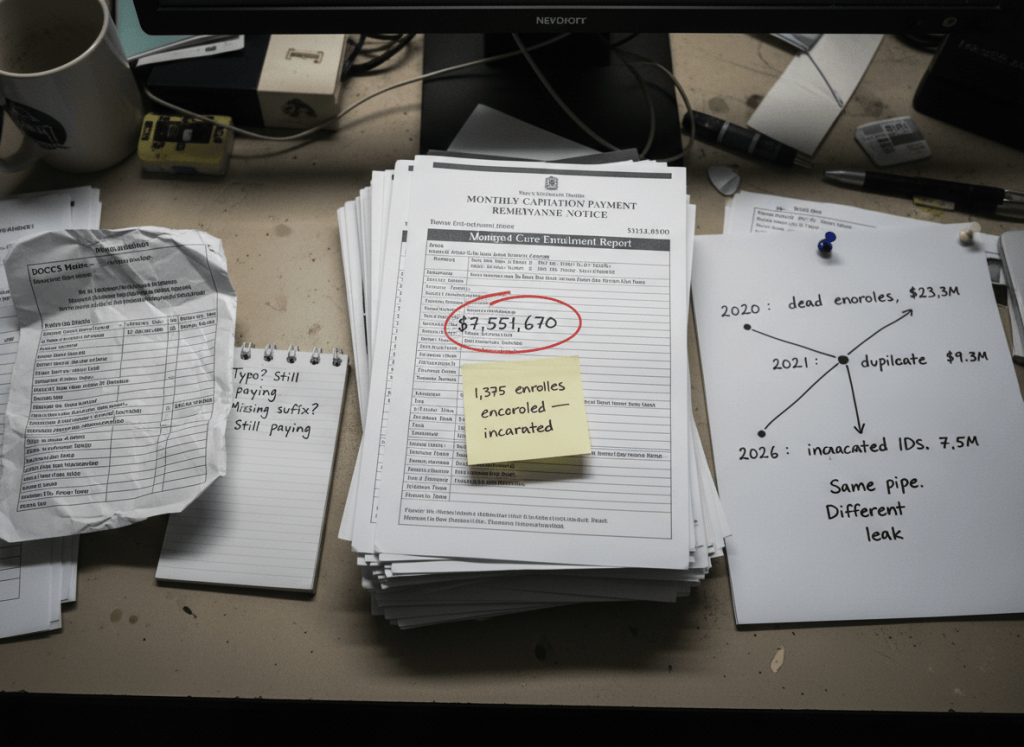
According to audit report OAS-25-02-074, New York’s Medicaid program made $7,551,670 in capitation payments, $6,164,734 of it the federal government’s share, to managed care organizations on behalf of 1,375 Medicaid enrollees who were, for the period in question, incarcerated in state prison.
Every one of them. Not a sample that suggested a wider problem, not a statistical extrapolation dressed up as certainty.
OIG reviewed all 1,375 incarcerated enrollees identified in the audit period and found unallowable payments attached to every single one. A capitation payment is a flat monthly fee the state pays an MCO per enrollee, regardless of whether that enrollee shows up for a checkup, a filling, or anything else, because the point of managed care is to buy access, not usage.
Which means the payment keeps generating on autopilot long after the person it was meant to cover has been removed from the population it was meant to serve, unless somebody tells the system to stop. Nobody told the system to stop.
The Machine That Forgot How to Check
Federal law is not ambiguous about this. An inmate of a public institution can stay enrolled in Medicaid, but the federal government will not pick up the tab for managed care coverage while that person is locked up, full stop, with the single exception of inpatient care in an actual medical institution.
New York’s own contracts with its MCOs say the same thing in plainer language, disenroll someone the moment the state learns they are in a Department of Corrections and Community Supervision facility, effective the first full month of incarceration.
The mechanism that was supposed to catch this is a monthly match between DOCCS prison rosters and the Welfare Management System, cross referencing Social Security numbers, dates of birth, and names. It broke twice.
First, New York built system overrides during the pandemic to preserve the continuous enrollment guarantee that came with an enhanced federal match, and those overrides apparently never learned that the incarceration exclusion was never part of the deal the continuous enrollment condition was suspending. The state kept people covered who were never supposed to be eligible for managed care reimbursement to begin with, pandemic rule or not.
Second, and more damning for how mundane it is, the matching algorithm choked on typos. A missing suffix. An extra space in a last name. A transposed digit in a birth date. These are not sophisticated fraud vectors. They are the kind of clerical noise every large database in America generates by the hour, and New York’s system treated a formatting inconsistency as grounds to keep cutting checks.
A State That Has Done This Dance Before
What makes the New York report distinct from its predecessors in this same audit series is not the dollar figure, which is modest by federal standards, but the fact that this specific state has been down this specific road with startling regularity.
In 2020, HHS-OIG found New York had made an estimated $23.3 million in capitation payments on behalf of Medicaid enrollees who were already dead, a population even less capable of using their benefits than an inmate.
In 2021, a separate audit found New York owed roughly $9.3 million after paying more than one MCO for the same beneficiary in the same month because its systems couldn’t recognize that two Medicaid ID numbers belonged to a single human being.
Three audits, three different failure modes, one common denominator: a state that pays managed care organizations by the head count and does not maintain a head count anyone can trust.
Dead enrollees, duplicated enrollees, incarcerated enrollees, it hardly matters which population falls through, because the underlying defect is the same unmonitored pipe between eligibility data and payment data.
New York’s own Office of the Medicaid Inspector General had already caught a version of this specific incarceration problem at a single managed care plan back in 2020, identifying more than $1.2 million in overpayments in an internal audit, which means the state’s own watchdog knew the pattern existed years before the federal one showed up with a spreadsheet covering the entire state.
Ohio’s state auditor found roughly $101 million in improper capitation payments tied to incarcerated enrollees when it reviewed every payment made over three fiscal years, a wider net than New York’s audit, and a bigger number as a result.
Illinois, audited under the same federal series as New York, sampled 100 incarcerated enrollees, found unallowable payments attached to 48 of them, and projected an estimated $9.5 million statewide. What separates New York’s report is the completeness of the miss. Illinois missed on roughly half its sample. New York missed on all of it.
Somebody Will Get Around to Asking for the Money
New York’s official response to the audit, filed by the Department of Health’s executive deputy commissioner, is a masterclass in saying quite a lot while committing to almost nothing. The state did not concur. It did not decline to concur.
It described, at length, what it has done and what it might do, which in bureaucratic correspondence functions as a kind of grammatical tense reserved for actions that may never conjugate into the past.
The state’s Office of the Medicaid Inspector General says it is analyzing the payments OIG identified to confirm the encounter data, after which it will pursue whatever the analysis supports, subject to the due process rights of the providers being asked to give the money back.
This is not stonewalling exactly. It is closer to a promise to eventually check the math on somebody else’s math.
On the systemic fix, New York’s answer is that the specific pandemic-era override problem should not recur, since the continuous enrollment mandate that necessitated it has expired, which is true and also beside the point, since the demographic mismatch problem that let typos slip incarcerated people past the filter has nothing to do with COVID rules and everything to do with a matching algorithm that has apparently never been asked to tolerate a hyphen. The state says it is exploring a manual review process for near misses. Exploring, in this context, is doing a great deal of work.
OIG’s response, tucked at the end of the report, amounts to a shrug dressed in institutional language: we acknowledge the steps taken and planned, we still found the money missing, our recommendations stand. Which is the entire relationship between a federal inspector general and a state Medicaid agency in miniature.
One side documents the leak with forensic precision. The other side describes, in the conditional mood, its intention to look for the bucket.
Sources: HHS Office of Inspector General, New York Made Unallowable Managed Care Capitation Payments on Behalf of Incarcerated Medicaid Enrollees (OAS-25-02-074, 2026); HHS OIG, New York State Medicaid Capitation Payments After Beneficiaries’ Deaths (2020).

