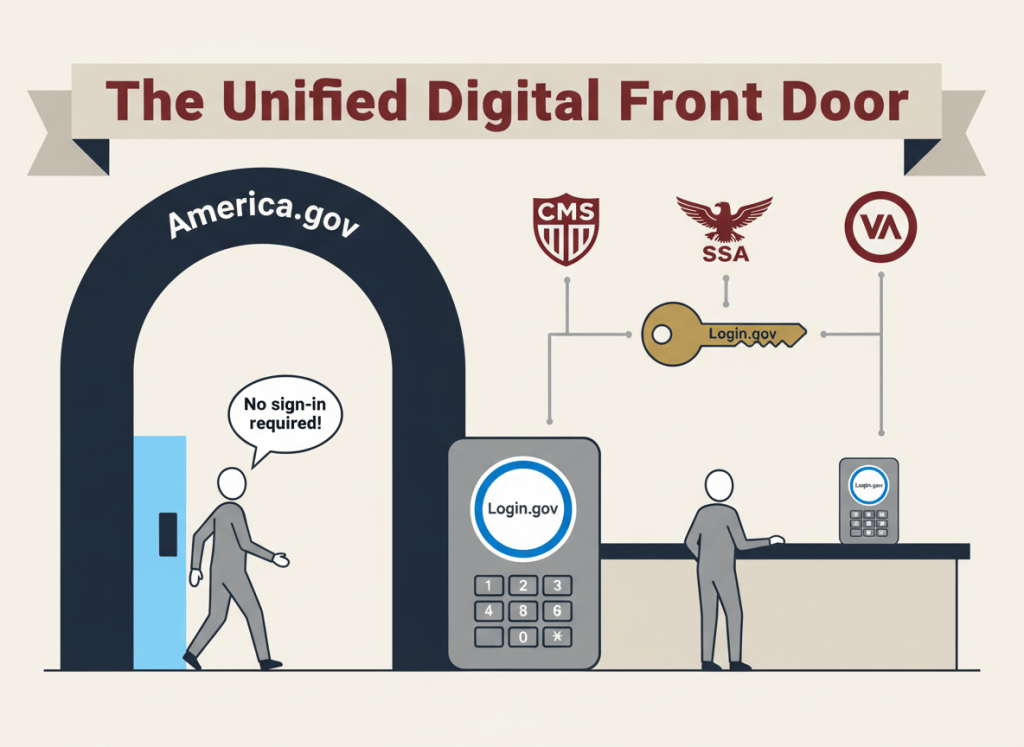
The Federal Register for Friday, October 2, 2026 runs from page 62635 to page 63132, and its most revealing item is a few pages of executive order about a website. Executive Order 14432, signed September 29 and printed at 91 FR 63121, directs the creation of America.gov as “the unified digital front door to the Federal Government,” with Login.gov installed as the lock.
The Front Door Has a Keypad
The administration has sold the portal as frictionless. At the launch, Joe Gebbia, Chief Design Officer of the National Design Studio, said users are not required to log in and that the platform does not track them, according to Federal News Network. The site’s privacy page, per Nextgov, says it uses no web tracking and saves no conversations. All of that may be true of the question box you can type into today.
The order describes a different animal. Its purpose section calls America.gov a point of entry “through which an individual may sign in.” Section 4(b) tells GSA to integrate Login.gov, “including using Login.gov as the authentication service for America.gov.” Section 5(b)(iii) orders every agency to complete Login.gov integration under OMB Memorandum M-26-18, which Federal News Network describes as the memo mandating Login.gov for most federal websites. At the launch, CMS Administrator Mehmet Oz presented a plan for Americans to verify their identities through Login.gov and pass that information to CMS, the Social Security Administration and Veterans Affairs, Nextgov reports.
So the White House is not fibbing when it says you needn’t sign in. It is describing the lobby. The order describes the building. An anonymous portal that answers trivia and demands credentials once it handles your Medicare enrollment is a sensible design, but it is a different pitch from the one in the launch remarks, where the no-login language lives, while the sign-in language sits in the order’s first paragraph.
An inference follows, and it is labeled as one. It rests on Section 2(c) of the order and on the Login.gov mandate above. Section 2(c) promises that unified access will not create “a centralized Federal system of records concerning the American people.” Sections 4 and 5, however, route authentication for covered services (those with more than 100,000 annual users, excluding IRS tax filing, the Department of War and the Intelligence Community) through one shared identity service. My reasoning is that a records system and an identity layer are different things, and the order disclaims the first while mandating the second. Records may stay in agency custody, yet a single credential would open all of them, and the order says nothing about what logs that credential leaves behind. That deserves an answer before OMB’s 90-day implementation memo arrives, not after.
A Rose by Any Other Acronym
The same issue prints Executive Order 14434 (91 FR 63129), which instructs the executive branch to say “Super Intelligence” and “SI” in place of “Artificial Intelligence” and “AI,” and promises the government “will not acknowledge” the old terms in applicable settings. The science adviser has 60 days to propose legislative language defining the new term. Until then, the order defines it as exactly what the statute already calls artificial intelligence, under 15 U.S.C. 9401(3). A new name for the old thing is the cheapest policy available, and it arrives alongside Section 2(e) of the America.gov order, which promises that “super intelligence” used with the portal will be accurate, reliable and transparent.
Executive Order 14433 (91 FR 63125) declares war on ticks and mosquitoes, favoring non-chemical measures such as sterile insect techniques, and notes that invasive mosquitoes have become dominant in places including the District of Columbia. The District’s mosquitoes, to be fair, have never pretended to be anything other than parasites.
Emergencies, Ceilings and Waivers
Presidential Determination 2026-24 (91 FR 63119) sets refugee admissions for fiscal 2027 at up to 17,500, to be allocated primarily among Afrikaners from South Africa under Executive Order 14204. A notice at 91 FR 63131 continues the national emergency regarding Syria that Executive Order 13894 declared in 2019.
At 91 FR 62739, DHS invokes section 102 of IIRIRA to waive legal requirements for new barriers and roads in the El Paso Sector. The notice cites more than 1,248,000 apprehensions between fiscal 2021 and August 30, 2026, and in the same passage credits DHS with delivering “the most secure border in history.” The statute does the reconciling, since it lets the Secretary waive every legal requirement he or she deems necessary for expeditious construction.
The Machinery of Self-Management
The SEC amended its quorum rule so that a lone commissioner constitutes a quorum for any matter from which every other sitting commissioner is disqualified (91 FR 62654). The Commission called it internal organization, skipped notice and comment, and made it effective today. A quorum of one is less a quorum than a monologue with a seal on it.
Elsewhere, the Federal Reserve finalized a rule that averages the maximum common equity tier 1 declines from the prior two stress tests to calm the stress capital buffer, and moves its effective date to January 1 (91 FR 62636). A transparency rule on stress test models and a notice of 2027 model changes ran alongside it. The NRC is discontinuing certain regulatory authority within Indiana under a new agreement with the state (91 FR 62635). CMS finalized the GLOBE Model, a mandatory Medicare payment model that tests an alternative way of calculating Part B drug inflation rebates, effective November 30, 2026 (91 FR 62936). Treasury and the IRS issued a final rule and a companion proposal implementing the section 25F scholarship tax credit for tax years ending after December 31, 2026 (91 FR 62655 and 62818).
The paperwork rounds out the day. OFPP, DoD, GSA and NASA want OMB to extend approval of the FAR Part 11 information collection, now cleared through January 31, 2027, for three more years (91 FR 62733). VA is revising its residency verification form for veterans and survivors, estimating 14,593 respondents a year at five minutes each (91 FR 62816). Neither will trend. Both are the sort of notice where the machinery shows its gears.
One order says you may sign in, and the next pages say what the government will call the thing that signs you in. Watch the OMB memo.

