A veteran checks into a psychiatric ward in San Antonio expecting one of two things: he is being watched because someone with a badge decided he might hurt himself, or he is being watched because the government simply films everything and asks permission later. According to a Veterans Affairs Office of Inspector General report released September 14, the second version is closer to the truth, and it took federal inspectors walking the halls of the Audie L. Murphy Memorial Veterans’ Hospital to discover that nobody had bothered to tell the patients either way.
The inspection covered the acute inpatient mental health unit at the South Texas Veterans Health Care System, conducted on site over three days in January 2026. Investigators found a unit that met some of its most serious obligations, suicide risk screening and safety planning among them, while quietly failing at nearly everything adjacent to those obligations: the physical space patients recover in, the paperwork protecting their legal rights, and the cameras recording their worst days without their knowledge.
Thirty Three Beds That Weren’t There
Ask South Texas Veterans Health Care System how many psychiatric beds it operates and the paperwork says 33. Ask the OIG, who counted, and the answer is 25. One of the unit’s three wings has been closed for roughly five years for construction that has yet to finish. Two more beds sat empty because of water leaking into their bathrooms. The eight phantom beds existed only in a bed availability letter that facility leaders had simply not gotten around to updating, a lapse that runs directly counter to a national directive requiring “current, complete, and accurate” reporting so the Veterans Integrated Service Network knows what it is actually working with.
This is not an abstract bookkeeping problem. When bed counts are wrong, veterans get diverted to community hospitals instead of admitted to the VA, and the facility acknowledged as much. Mental health leaders told inspectors they expect seven additional beds once construction wraps, with a completion estimate of December 2027, a date that recurs throughout this report with the reliability of a scheduled bus that never arrives.
The physical unit itself fares no better on inspection. Bedrooms are dimly lit, painted an institutional off white, furnished with nothing but a bed, and fitted with blinds that cannot be adjusted, a safety feature that doubles as a permanent excuse to keep out natural light. The common area used for dining has a wall phone with no privacy and no artwork, no warm paint, nothing resembling the “hopeful and healing environment” that VA’s own design guide calls for. The facility’s own Associate Chief of Staff for Mental Health described the unit as “very old and institutionalized,” which is one way to characterize a taxpayer funded psychiatric ward that cannot manage ambient lighting.
The Ligature Points That Have Waited Six Years
If the paint colors are cosmetic, the next finding is not. The unit has sinks, toilets, and anchor points identified as hanging hazards, the exact kind of environmental risk the Mental Health Environment of Care Checklist exists to catch and correct within six months. Instead, the facility has been granted appeal after appeal, for six consecutive years, to keep these hazards in place while a “risk mitigation plan” consisting largely of nursing staff performing 15 minute observation checks stood in for an actual fix. There was no documentation that these checks were even happening consistently until the OIG asked for one, at which point staff produced a tracking sheet on the spot. The unit’s chief nurse told inspectors the workaround placed an ongoing burden on her staff, which is a polite way of saying the facility outsourced a construction failure to the nervous system of its nursing corps.
A contract to fix the toilets, sinks, and dispensers existed at one point. It was terminated because the contractor lacked the materials to finish the job. As of the inspection, there was no completion date at all. By May 2026, facility leaders had landed on the now familiar December 2027, a full two years after the OIG walked the unit and found the hazards still standing. Two of the six standing appeals were not even resubmitted within the required window, a paperwork lapse on top of a construction lapse on top of a safety hazard that predates most of the current staff’s tenure.
Cameras Rolling, Signs Missing
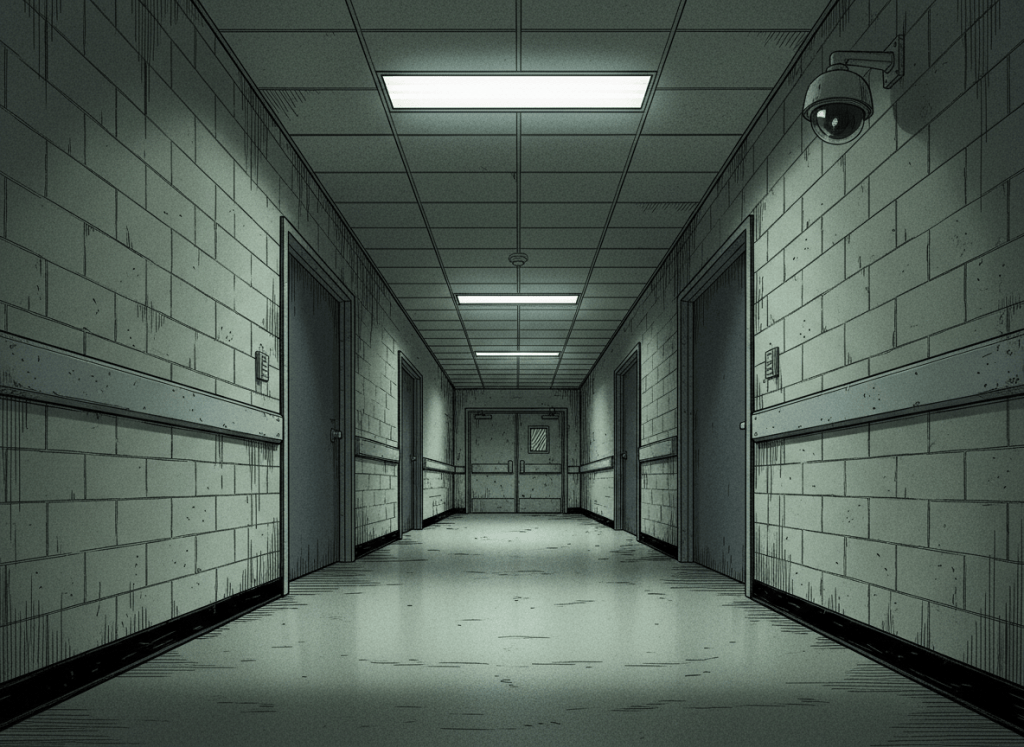
Buried in the section on “recovery oriented principles,” not suicide prevention, sits the finding most likely to unsettle anyone who has spent time on a locked ward: VA police were monitoring and recording veterans on camera in common areas, in direct violation of the agency’s own privacy directive. That directive permits live monitoring for safety purposes but explicitly prohibits recording, restricts access to authorized healthcare staff, and requires posted signage telling patients they are being watched. The unit had no signage, no standard operating procedure governing camera use, and video access that extended beyond clinical staff to VA police, who were the ones doing the recording.
It is worth being precise about what the report does and does not establish. The OIG places this finding under general unit operations, not under its Suicide Prevention or Safety sections, and the specific mechanism the facility relies on for monitoring veterans identified as suicide risks is the manual 15 minute check described above, tied to physical hazards rather than to camera footage. Whether the recording was ever intended, formally or informally, as a suicide watch tool is a question the report leaves open, and one bureaucracy.news would like South Texas Veterans Health Care System to answer directly. What the report does establish, clearly, is that the violation here is not that surveillance existed on a psychiatric unit, which any veteran who has been on one would tell you to expect, but that it existed without a sign, without a policy, and without confining access to the people actually providing care. A posted notice at the front door would have made the surveillance itself unremarkable. Its absence, combined with unauthorized recording, is what turned routine security into a documented civil liberties failure.
The Paperwork Veterans Never Get to Read
The unit’s clinical shortcuts round out the picture. Only 36 percent of reviewed medical records showed a prescriber had discussed the risks and benefits of a new psychiatric medication with the veteran before giving it to them, well short of the required standard. Discharge instructions, the document meant to get a veteran to his next appointment, listed follow up locations in plain, understandable language only 13 percent of the time; the rest buried the information in medical abbreviations a discharged patient in crisis has no reason to decode. Facility policy on involuntary commitment existed but never bothered to align itself with Texas state law, leaving staff to rely on informal huddles to track who was there voluntarily and who was not, a gap the OIG flagged as capable of contributing to unlawful hospitalization. That disconnect is not a technicality; it risks turning short-term evaluation holds into de facto detentions without the hearings, notices, and clinical certifications state law requires. For veterans on the unit, the difference between a compliant policy and the one in place can be the line between a lawful admission and a confinement that would not withstand legal scrutiny.
The Health Service Area Director and the Medical Center Director concurred with all thirteen recommendations and produced action plans stretching into 2027, which is the bureaucratic equivalent of a pinky promise with a calendar invite attached. The signage recommendation is already closed. The construction, the treatment planning SOPs, and the involuntary commitment procedures are not, and December 2027 remains, for now, less a deadline than a mantra.
 Bureaucracy Times