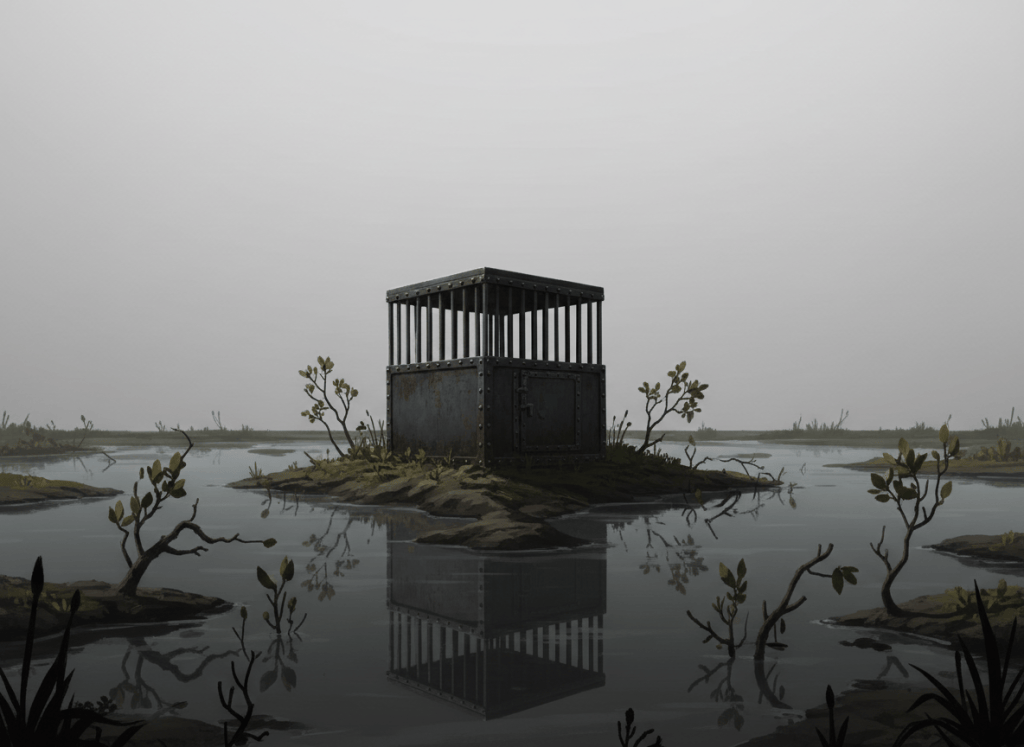
Somewhere in the Everglades, between July 2025 and January 2026, the federal government discovered a new use for the word “calming.” Staff at the Florida Soft-Sided Facility, the detention center better known by its unofficial and rather more honest nickname, “Alligator Alcatraz,” used it to describe an outdoor metal box measuring roughly eighteen square feet. Detainees were placed inside these enclosures 79 times over that six month span, for anywhere from six minutes to nearly two hours, with an average stay just short of one hour. The Department of Homeland Security’s Office of Inspector General visited on January 21, 2026, looked at the boxes, and concluded that whatever they were, they were not calming. It called the practice “unprecedented” among every detention facility it has ever inspected, and recommended that ICE stop using them immediately, for any reason, for any length of time. That recommendation, like the other nine in the report, was later closed administratively, not because anyone fixed anything, but because the facility stopped existing before anyone had to.
A Rose by Any Other Name
Bureaucracies are gifted at inventing language that makes the unbearable sound optional. Facility leadership told OIG investigators that these enclosures were “calming areas,” spaces detainees could request voluntarily when they needed a moment away from the crowd. It is a lovely piece of institutional poetry, evoking something between a meditation room and a quiet corner at a daycare. It also does not survive contact with the physical evidence. Inspectors observed locking mechanisms on the enclosures, the kind of hardware one does not generally install on a space people are free to leave whenever they like. Staff insisted time inside was closely monitored and that nobody was locked in. The report does not resolve this contradiction so much as let it sit there, both claims on the record, the locks photographed and cataloged regardless.
The euphemism matters because it is doing real work. Call something a cage and you invite scrutiny; call it a calming area and you invite a shrug. The Florida Soft-Sided Facility’s paperwork consistently chose the shrug. The eighteen square feet of floor space is not, and neither are the dimensions behind that figure: roughly four feet three inches by four feet three inches, a footprint smaller than a standard walk-in closet, standing outdoors in South Florida, a state not known for gentle weather. One does not need to adjudicate every allegation about heat or sun exposure to notice that the structure itself was never going to be mistaken for a wellness amenity by anyone who had actually stood inside one.
It is worth pausing on who gets to name a thing. The detainees inside these boxes did not choose the phrase “calming area.” Facility staff did, and facility staff are also the ones who logged the duration of each stay, who decided which incidents warranted the enclosure, and who described its purpose to inspectors after the fact. Every euphemism in this story was manufactured by the same party being asked to explain itself. That is not a conspiracy. It is simply how institutional language works when nobody outside the institution is in the room to object.
The Twenty-Six Minutes
OIG’s report distinguishes itself from the more sensational outside allegations that had already been circulating, that detainees were baked in these boxes under direct sun for punishment, denied food and water, left to the mosquitoes. The inspector general says plainly that it could neither confirm nor refute those claims, and that none of the detainees it interviewed reported experiencing them. This is the sort of finding that gets quoted by whichever side finds it convenient and ignored by the other. It deserves neither treatment. It is simply what a limited, one day inspection can and cannot establish.
But buried in the same report is a single entry that does more work than any of the outside allegations combined: facility documentation showing a detainee held in one of these enclosures for 26 minutes after failing to comply with a lawful command. Twenty-six minutes is not a rounding error. It is a logged, documented, administratively recorded use of an eighteen square foot metal box as a disciplinary tool, written down by the facility’s own staff in the facility’s own paperwork. ICE told inspectors the enclosures served several purposes: discipline, crisis intervention, housing reassignment, conflict de-escalation. Set against a background of “calming areas” offered on request, discipline is not a small addition to that list. It is the whole list tipping over.
What a Federal Watchdog Will and Will Not Say
There is a particular value to a finding like “unprecedented among detention facilities OIG has inspected,” and it has nothing to do with adjectives. OIG inspects a great many ICE facilities, under multiple administrations, across a range of political climates in which the agency’s practices have been generous with euphemism and stingy with disclosure. When an independent oversight body with that breadth of comparison says it has never seen this before, that is not rhetorical flourish. That is a baseline being broken in real time, documented by the one entity in this story with no evident interest in making Alligator Alcatraz look better or worse than it was.
And yet the practical consequence of that finding was almost nothing. The recommendation to discontinue the enclosures immediately arrived in a report published after the facility had already ceased operations in June 2026. ICE never had to comply, because there was nothing left to comply with. The recommendation was closed the way a case file is closed when the defendant dies before trial: administratively, finally, and without anyone having answered for the underlying conduct. The eighteen square foot boxes were never dismantled by order. They simply stopped being used because the facility around them stopped being used, a distinction that matters enormously to accountability and not at all to anyone who spent an hour inside one of them.
What remains is a documentary record: photographs of locking mechanisms, a timestamp log running from six minutes fifty three seconds to one hour fifty nine minutes eighteen seconds, and one entry, 26 minutes long, that quietly answers the question the calming area euphemism was built to avoid. The federal government inspected its own creation, wrote down what it found, called it unprecedented, and then let the whole matter close itself. That is not oversight failing to notice a problem. That is oversight noticing a problem in exact, granular detail and discovering it had no lever left to pull.
Source: DHS Office of Inspector General, Unannounced Inspection of ICE’s Florida Soft-Sided Facility (“Alligator Alcatraz”) in Ochopee, Florida, OIG-26-22, September 11, 2026.
 Bureaucracy Times