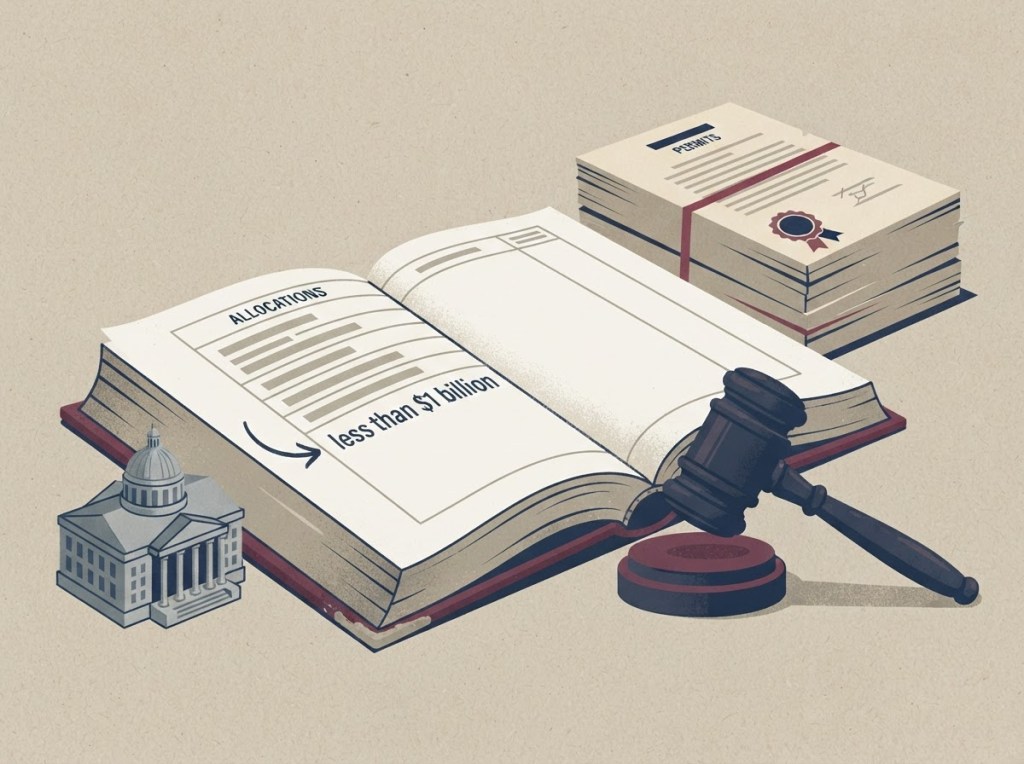
The Senate passed a sweeping permitting overhaul with a preliminary CBO score of less than $1 billion — but the estimate doesn’t mention the Judgment Fund, which could be on the hook the first time a developer wins a lawsuit.
A Preliminary Number Goes to Work
On the night of November 19, the Senate passed the Bipartisan American Affordability and Jobs Act, 62 to 33. The nearly 500-page rewrite of the country’s environmental review laws now heads to the House.
It travels with one piece of fiscal reassurance. A Congressional Budget Office letter dated November 13 says enacting the bill would add less than $1 billion to the deficit over 2027 through 2036.
The bill is not new, and neither is the scramble. Sens. Shelley Moore Capito, Mike Lee, Sheldon Whitehouse and Martin Heinrich introduced it in late September, and the Senate used the House’s H.R. 2347 as the vehicle. Support narrowed as the debate went on, from 73-25 on the first procedural vote on November 9 to 65-31 on final cloture and 62-33 on passage.
The CBO letter was addressed to the Senate Budget Committee’s chairman, Ron Johnson, and its ranking member, Jeff Merkley, with the four sponsors copied. It is the only estimate we found for the substitute the Senate took up.
The letter is also, by its own description, preliminary. It assumes enactment by the end of this calendar year, and it is a conventional estimate rather than a dynamic one.
“Preliminary” does a great deal of work in Washington. Mostly it works by never having to be taken back.
What the Arithmetic Includes
CBO’s reasoning is tidy. Faster permitting speeds up federally funded projects, which pulls spending into the ten-year window that would otherwise land after 2036, and the letter points to unspent Infrastructure Investment and Jobs Act balances as an example.
One detail deserves a footnote of its own. CBO says some of the accelerated spending would come from funding originally designated as an emergency requirement, which is a polite way of saying the money was supposed to be for something urgent.
Against that, CBO expects more bonus bids, rents and royalties from energy and mineral production on federal land and in federal waters. Those count as offsets. On net, the letter says, the extra infrastructure spending outruns the extra collections.
The only line item with a precise figure belongs to the bill’s third division. The Joint Committee on Taxation estimates that broadening the tax exclusion for survivors of sexual misconduct would cost $84 million in revenue over the period.
That division is the leftover shell. H.R. 2347 began as the Survivor Justice Tax Prevention Act, and the Senate emptied it out to carry the permitting package. The rest of the bill gets a ceiling instead of a number.
The letter is candid about what it did not do. It could not determine whether the bill’s mandates on states, localities and private parties exceed the statutory thresholds. It says the dynamic effects are not fully captured, and that CBO could do a dynamic assessment if asked, though it would need more time.
We found no updated or dynamic estimate published since. The Senate took six days.
The Account Nobody Has to Appropriate
Title IV of the bill is called “Project Certainty,” a name that does not bear close inspection. Section 1401 restricts agencies from revoking or altering permits that have already been issued, and lets permit holders sue when they do. Section 1402 creates a separate cause of action for developers of listed project types who say they were denied or delayed through disparate treatment.
The Clean Air Task Force, an advocacy group that has been dissecting the bill, describes the remedies as including reinstatement, attorneys’ fees, delay costs and damages. The damages are paid from the Judgment Fund.
The Judgment Fund is a permanent, indefinite appropriation under 31 U.S.C. § 1304. Congress does not vote on each withdrawal.
The Congressional Research Service, analyzing the bill as introduced, concluded that Sections 1401 and 1402 could substantially increase payments from the Fund relative to historical baseline averages.
Now return to the CBO letter. It does not mention the Judgment Fund. It does not mention Title IV. It does credit the bill with reducing the likelihood of litigation, which is one reason projects would move faster.
The silence has at least three readings. CBO may have estimated zero, estimated something too small to itemize, or judged the exposure too speculative to score. The letter does not say which, so we treat it as a gap rather than an error.
The Deterrent and the Precedent
The sponsors’ theory is a deterrent. If an administration knows that canceling a permitted project can cost the Treasury real money, the thinking goes, it will think twice.
CATF points out a wrinkle. The administration has already spent roughly $3.9 billion from this same fund to prevent development of a dozen offshore wind leases, according to the group, which cites New York Times reporting. It also notes that the President said, as the Senate voted to proceed on the bill, that he would not approve wind turbines because they are a “major loser.”
An administration willing to pay from the Fund to stop projects is not obviously deterred by a statute that makes it pay from the Fund when it loses. CATF adds a practical point: the suits would have to be brought by individual project sponsors, not by states or trade associations, which it says exposes each developer to political retaliation.
The deterrent either works, in which case nobody sues and nobody collects, or it does not, in which case somebody sues and the Treasury writes the check.
Here we are inferring, and we say so. A sub-$1 billion score that does not discuss the account appears to rest on the first outcome. Nothing in the letter tells us it considered the second.
The House Gets the Pen
The bill’s fiscal fate now depends on a chamber that has to vote again, because the Senate replaced the text of a bill the House already passed. Speaker Mike Johnson told POLITICO he would try suspension of the rules, which requires two-thirds and bars floor amendments, with a standard rule as the fallback.
Heatmap reports the vote could come the week after Thanksgiving. It also notes the lame-duck problem: two-thirds is measured against whoever shows up, and many defeated Republicans have stopped showing up. Johnson wrote colleagues demanding full attendance.
Suspension also means no amendments. Whatever Title IV does or does not say about the Judgment Fund, the House would take it as the Senate left it.
The letter says less than $1 billion. It does not say what happens the first time somebody wins.

