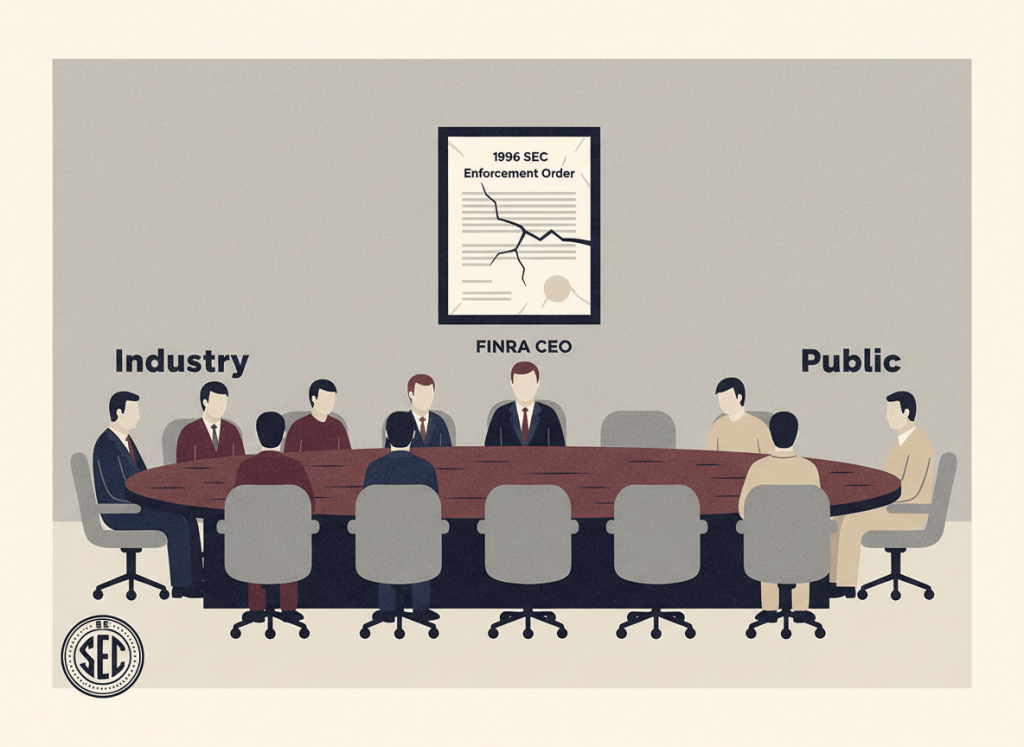
The securities industry’s principal self-regulator wants industry representatives to control its board, nearly three decades after federal regulators imposed safeguards against undue industry influence.
The Financial Industry Regulatory Authority is asking the Securities and Exchange Commission to approve a sweeping governance overhaul that would give securities industry representatives majority control of the organization responsible for regulating their firms.
The proposal, filed November 2 and noticed by the SEC November 10, would reverse a public-majority governance structure whose origins lie in a 1996 federal enforcement action against FINRA’s predecessor, the National Association of Securities Dealers.
That history makes the proposal considerably more consequential than an ordinary corporate governance adjustment.
In 1996, the SEC found that NASD had failed to adequately oversee the Nasdaq market and that market makers had exercised undue influence over its operations and regulatory affairs. The resulting enforcement order imposed 14 undertakings, including requirements for independent public and non-industry representation.
Thirty years later, FINRA argues that the circumstances justifying those safeguards have materially changed. The question now before federal regulators is whether those changes justify returning majority governance authority to representatives of the industry FINRA oversees.
A Reversal of Regulatory Safeguards
Under FINRA’s existing bylaws, public governors outnumber industry governors on its Board of Governors. The organization currently permits a board of 16 to 25 members, including its chief executive officer.
The proposed structure would reduce the board to between 13 and 20 members, with industry governors outnumbering public governors by one or two seats. Public representatives would constitute approximately 41.7 to 47.4 percent of the combined public and industry seats, depending on the board’s composition. FINRA’s chief executive officer would retain a separate seat.
The changes would also permit industry-majority representation on several important board committees, including those responsible for executive functions, finance, nominations, and regulatory policy. FINRA’s Audit Committee would remain majority public and continue to be chaired by a public governor.
The proposal would additionally extend consecutive board service from six to nine years and provide greater flexibility over committee appointments and membership.
FINRA argues that the changes would improve organizational efficiency, broaden participation by firms of different sizes and business models, and allow the board to draw more effectively on industry expertise. The organization also maintains that existing institutional safeguards, including independent adjudicatory functions, internal auditing, and SEC oversight, would continue to protect regulatory independence.
The 1996 Enforcement Action
The historical context is central to understanding the proposed changes.
On August 8, 1996, the SEC issued Release No. 34-37538, resolving an enforcement proceeding against NASD following findings involving Nasdaq market practices and failures of regulatory oversight.
The Commission found that NASD had inadequately investigated and enforced certain rules and that Nasdaq market makers had exercised undue influence over its regulatory activities. The resulting undertakings were designed, in part, to address the institutional conflicts exposed by those findings.
One undertaking required substantial independent public and non-industry representation in NASD governance. Another preserved an independent internal audit function reporting to an audit committee with a public and non-industry majority.
FINRA’s November 2026 filing acknowledges this history. The organization explains that NASD divested Nasdaq in 2006, eliminating the specific market-related conflicts that had helped prompt the original enforcement action.
FINRA also states that it is separately applying to the SEC for relief from the undertaking governing board and committee composition. That application is distinct from the proposed rule change now before the Commission.
FINRA is not proposing to eliminate the separate undertaking preserving the independence and public-majority composition of its Audit Committee. Nevertheless, the requested relief would alter a governance protection established following documented failures of securities industry self-regulation.
FINRA Explains Why It Believes the Safeguards Can Change
In a November 2 fact sheet explaining its governance proposal, FINRA argues that the regulatory environment has changed substantially since NASD adopted its majority-public board. It points particularly to NASD’s divestiture of Nasdaq, which FINRA says eliminated certain market-related conflicts that existed when the earlier safeguards were adopted.
FINRA also cites professional staff control over enforcement determinations, independent adjudicatory processes without member involvement, SEC-approved membership procedures, greater transparency, and expanded federal oversight. Its Audit and Risk Committee would retain a public majority and public chair, with responsibilities including oversight of independent audit and ombuds functions. These are the organization’s stated reasons for believing that an industry-majority board can coexist with regulatory independence; the fact sheet does not independently establish that the proposed arrangement would provide equivalent protection against industry influence.
The document also says FINRA’s current majority-public board approved the amendments and that member firms supported them in a vote concluded October 9. FINRA describes converting three appointed, segment-specific industry seats into at-large industry seats as a way to draw on a wider range of firm experience. The fact sheet does not identify a separate written consultation with investor-protection groups or resolve the legal status of the 1996 undertaking. FINRA’s separate application for relief from that undertaking therefore remains an important part of the SEC’s review.
FINRA further invokes the SEC’s dedicated examination program and GAO’s recurring reviews of SEC oversight. The existence of those oversight mechanisms is documented, but it should not be confused with a GAO endorsement of this particular governance change.
What Federal Oversight Has Established
FINRA points to continuing SEC oversight and independent review by the Government Accountability Office as additional safeguards.
A November 2024 GAO report, GAO-25-107723, examined the SEC’s oversight of FINRA, including conflicts of interest management and governance transparency.
GAO reported that the SEC initiated 21 program inspections of FINRA during fiscal years 2021 through 2023. Those inspections addressed eight of the ten oversight areas specified in the Dodd-Frank Act, with the remaining areas addressed through reviews outside that inspection cohort.
Nine inspections involved transparency of FINRA governance and activities, while seven addressed governance and conflicts of interest management. GAO also reported that the SEC had introduced outcome-based performance measures to evaluate aspects of its oversight.
However, the public report omitted certain findings and information that the SEC considered sensitive. The report documents an ongoing federal oversight structure. It does not establish that replacing FINRA’s public-majority board with an industry-majority board would preserve an equivalent degree of regulatory independence.
That distinction matters because the proposed changes would alter the organization’s internal distribution of authority, rather than merely changing the procedures through which existing authority is exercised.
Public Consultation and Regulatory Review
Another detail in FINRA’s filing deserves attention. In its statement concerning comments received before submission, FINRA reported that written comments were neither solicited nor received.
That statement does not establish that the organization conducted no consultations with stakeholders. It does mean the filing identifies no written comments obtained through a prefiling solicitation.
The SEC has now opened a formal public-comment process under File No. SR-FINRA-2026-024. The Commission must determine whether the proposed changes comply with applicable securities laws, including statutory requirements concerning fair representation, regulatory capacity, and investor protection.
Separately, the SEC must address FINRA’s request for relief from the relevant 1996 enforcement undertaking before the organization can implement changes inconsistent with that obligation. FINRA anticipates that the governance amendments, if approved, would become effective no later than its 2027 annual meeting.
What Happens Next
The SEC has made a public-comment form available for SR-FINRA-2026-024. The SEC docket provides the regulatory filing record. The notice was published in the Federal Register on November 13, 2026, with a 21-day comment period running to December 4, 2026.
Bureaucracy Times has submitted inquiries to FINRA and the SEC concerning the proposal’s origins, the separate request for relief from the 1996 enforcement undertaking, and the safeguards intended to preserve regulatory independence. Responses were requested by November 20, 2026. On November 19, FINRA media relations said it was still working on the inquiry and supplied its November 2 fact sheet. The fact sheet sets out FINRA’s public rationale but does not directly answer the outstanding questions about the 1996 undertaking.
The broader issue extends beyond the number of seats around a boardroom table. Nearly three decades ago, federal regulators concluded that industry influence had compromised the effectiveness of securities market oversight. Their response included structural measures designed to make regulatory governance more independent.
FINRA now argues that the conditions requiring those measures have changed. Whether those changes justify restoring majority authority to industry representatives is a question the SEC must answer before the proposed overhaul can take effect.

