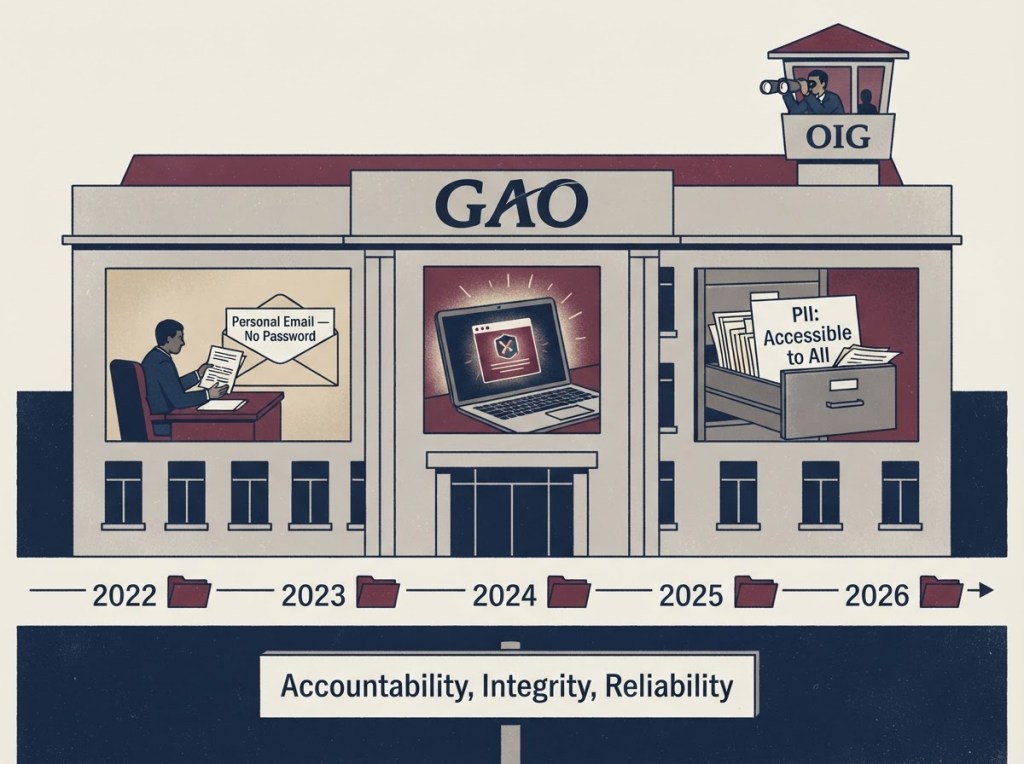
Inspector General investigations spanning several years reveal sensitive documents sent to personal email accounts, unauthorized software use, improperly accessible personnel information, and questionable employee timekeeping. The findings also raise unanswered questions about the agency’s technology oversight.
The Government Accountability Office is responsible for examining how federal agencies protect sensitive information, manage taxpayer resources, and comply with government policies. Its investigations and audits regularly identify weaknesses that agencies must correct.
But a review of several years of reports from GAO’s own Office of Inspector General reveals that the congressional watchdog has confronted recurring information-security and employee-accountability problems within its own operations.
The findings range from senior government employees sending sensitive documents to personal email accounts without password protection to the use of unauthorized online applications. In one investigation, the Inspector General found that personally identifiable information stored in GAO’s document-management system was accessible to employees who had no business need to view it.
Other investigations raised questions about employee timekeeping, including cases in which workers claimed to be performing their duties despite having no recorded network logins on numerous workdays.
GAO has taken disciplinary and corrective actions in several cases, including employee counseling, a suspension, additional training, and changes intended to strengthen information-security safeguards.
Nevertheless, the Inspector General’s reports reveal repeated instances of similar conduct over several years, raising questions about whether the agency’s preventive controls adequately addressed the underlying risks.
The latest findings appear in the Inspector General’s Fall 2026 Semiannual Report to Congress, which covers April 1 through September 30, 2026.
A Senior Employee, Sensitive Documents, and 40 Workdays
One of the most significant investigations disclosed in the Fall 2026 report involved a senior government employee who allegedly failed to safeguard sensitive information and whose time-and-attendance records also attracted scrutiny.
In case 23-0105, investigators found that the employee sent numerous documents containing sensitive information to a personal email account without password protection.
The Inspector General also determined that the employee had not logged into GAO’s network on at least 40 separate days when the employee claimed to be working.
On September 16, 2026, the OIG issued its report of investigation to GAO. As of September 30, the case remained open pending the agency’s response.
The public summary does not identify the employee, disclose the specific documents involved, or establish whether unauthorized individuals accessed the information. It also does not establish that the employee performed no work during the 40 days without recorded network logins.
Network activity can be relevant evidence in a timekeeping investigation, but the absence of a login is not necessarily conclusive proof that an employee failed to perform assigned duties.
The OIG’s findings therefore warrant scrutiny without being characterized as a final determination of payroll fraud or a confirmed compromise of classified information. The public record also does not establish whether GAO subsequently disciplined the employee or implemented additional corrective measures.
A Recurring Problem With Personal Email Accounts
The September 2026 case was not the first investigation involving sensitive government information transferred outside authorized channels.
In its Fall 2025 Semiannual Report, the Inspector General described four investigations involving senior government employees who sent sensitive documents between their GAO email accounts and personal email accounts without password protection. One employee also sent sensitive documents to email addresses belonging to other individuals.
The OIG issued its investigative reports on May 1, 2025. GAO counseled all four employees, and the Inspector General closed the cases during July and August 2025. The investigations were identified as cases 23-0058, 22-0308, 23-0083, and 23-0016.
Other investigations disclosed during the same reporting period involved similar conduct. In case 23-0137, another senior government employee sent sensitive documents to a personal email account without password protection. GAO counseled the employee, and the OIG closed the case in April 2025.
Case 23-0057 involved a senior employee who transferred sensitive information to a personal email account and used government email for outside rental-property business. GAO also responded with counseling.
Earlier reports identified additional senior-employee investigations involving similar transfers. The recurring nature of the conduct is significant, although the reports do not establish that every case involved a different employee or the same category of sensitive information. Nor do they establish that all incidents resulted in actual unauthorized disclosure.
Nevertheless, the repeated findings demonstrate that improper handling of sensitive information was not confined to a single investigation or reporting period.
Unauthorized Applications Introduced Another Risk
The Inspector General’s Spring 2026 report identified additional information-security concerns involving unauthorized online editing applications.
In case 22-0320, investigators found that a senior government employee uploaded sensitive information to an unauthorized online editing application, improperly installed the application on a government-provided computer, and emailed sensitive documents to a personal account without password protection.
The OIG issued its investigative report on January 27, 2026. GAO counseled the employee, and the Inspector General closed the case on March 31.
Another investigation, case 25-0248, involved sensitive information uploaded to an unauthorized editing application and documents sent to personal or third-party email accounts without password protection. GAO again reported counseling as its management response.
These incidents raise concerns extending beyond individual email practices. Uploading sensitive government information to an unauthorized external application may introduce additional questions about data retention, access permissions, third-party processing, and compliance with agency security requirements.
The public investigative summaries do not establish whether the information was subsequently accessed or retained by unauthorized parties. They also do not provide sufficient information to determine whether the applications involved shared technical vulnerabilities or whether the incidents were unrelated.
What the findings establish is that GAO personnel repeatedly used methods of handling sensitive information that investigators determined were inconsistent with agency requirements.
When Sensitive Information Was Accessible Inside GAO
Perhaps the most consequential finding in the earlier reports involved neither personal email nor unauthorized external software. It concerned GAO’s own document-management system.
In September 2022, the Inspector General received complaints that personally identifiable information was stored in the system without appropriate access restrictions.
The resulting investigations, identified as cases 22-0439 and G-23-0003, found that employees creating documents had inadvertently allowed access to all GAO employees because of the system’s default settings. That meant personnel without a business need to view the information could potentially access it.
The Inspector General also learned that GAO personnel responsible for information security had been informally notified of the problem but had not acted to address it.
This finding distinguishes the investigation from cases involving employees individually transferring documents outside authorized systems. The document-management investigation identified weaknesses in system configuration and in the response to an internally reported security concern.
The OIG notified GAO before completing its investigation so the agency could secure the affected information. On February 15, 2024, the Inspector General issued a management memorandum describing the findings.
GAO subsequently reported taking steps to secure the information and prevent recurrence. In April 2024, the agency also informed the OIG of plans for a new document-management system incorporating updated policies, security measures, and training. The Inspector General closed both investigations on August 13, 2024.
Those corrective actions are an important part of the record. The public summaries establish that GAO responded to the findings, rather than leaving the investigations unresolved. They do not, however, provide a comprehensive independent assessment of whether the replacement system ultimately eliminated the relevant access-control risks.
Employee Timekeeping Under Scrutiny
The Inspector General’s investigations also reveal recurring concerns about the accuracy of employee time-and-attendance records.
In a case disclosed in the Spring 2024 report, investigators found evidence that an employee falsely claimed more than 100 work hours and had not logged into GAO’s network on at least five days when claiming to work. The OIG issued its investigative report on June 12, 2023. The employee subsequently resigned, and the Inspector General closed case G-23-0101 in October 2023.
A separate investigation, case 25-0108, identified at least 48 days when an employee claimed to be working but did not log into GAO’s network. The OIG issued its report in March 2026. GAO subsequently imposed a 60-day suspension, and the Inspector General closed the case in September 2026.
The September 2026 investigation involving the senior employee who mishandled sensitive documents presents another example, with at least 40 claimed workdays lacking corresponding network logins.
These cases should not be treated as interchangeable. The earlier investigation explicitly identified falsely claimed hours. The later cases described discrepancies between claimed workdays and network activity, while their publicly reported dispositions and underlying evidence differed.
Nevertheless, the recurrence of timekeeping concerns across several reporting periods raises a broader management question: How does GAO independently verify employee time and attendance when network records suggest potential discrepancies?
The public summaries do not establish that the agency lacks effective verification procedures. They demonstrate that investigators repeatedly encountered circumstances requiring closer examination.
Counseling, Suspensions, and Corrective Measures
GAO’s documented responses varied according to the investigations. Several sensitive-information cases resulted in employee counseling. One timekeeping case resulted in a 60-day suspension, while another employee resigned after an investigative report identified falsely claimed hours.
The document-management investigation prompted steps to secure information, prevent recurrence, and develop improved system safeguards. Other Inspector General reporting describes additional actions involving security-clearance monitoring, personally identifiable information safeguards, and training for employees and contractors.
These responses complicate any suggestion that GAO ignored the findings or failed to take corrective action.
At the same time, the publicly available summaries generally do not explain why counseling was considered sufficient in individual sensitive-information cases, whether technical controls were strengthened after each incident, or how the effectiveness of broader corrective measures was evaluated.
Employee counseling may be appropriate in some circumstances. More serious misconduct may warrant stronger action. The summaries do not provide enough information to independently assess the proportionality of every management response.
The central issue is therefore not whether GAO should have imposed identical discipline in every case. It is whether the accumulation of similar findings led to durable improvements in the controls intended to prevent recurrence.
The Difference Between Individual Misconduct and Institutional Weakness
The Inspector General’s investigations reveal two overlapping categories of concern. The first involves individual conduct: employees transferred sensitive information to personal email accounts, used unauthorized applications, or generated timekeeping discrepancies that warranted investigation.
The second involves institutional controls. The document-management investigation demonstrated that default system permissions could expose personally identifiable information to employees without a business need. It also documented that information-security personnel had been alerted to the problem without taking action.
That finding raises a different question from whether an individual employee violated a rule. It concerns whether the agency’s technical safeguards and internal reporting processes operated effectively.
The distinction matters because employee counseling cannot, by itself, correct a system configuration problem. Conversely, improved technology cannot eliminate every instance of individual misconduct.
Effective accountability requires both appropriate personnel action and controls that reduce the likelihood of similar problems recurring. The Inspector General’s reports document examples of each type of response, but they do not yet provide a complete picture of the effectiveness of GAO’s overall corrective strategy.
Unanswered Questions About GAO’s Technology Strategy
The chronology of these investigations raises one additional question worth examining.
In September 2022, GAO’s Inspector General received complaints concerning improperly accessible personally identifiable information in the agency’s document-management system.
By February 2023, GAO’s original five-year information technology modernization plan was no longer actively being used, according to findings in a separate Inspector General audit.
That modernization plan had cost approximately $1 million to develop and outlined 61 initiatives with projected costs of roughly $29 million. The subsequent audit found that GAO had not adequately documented why it moved from the original five-year roadmap to a different modernization approach. Incoming technology leaders could not fully reconstruct the reasoning behind the strategic change.
The two sets of findings concern different oversight matters, and the public record does not establish that they were connected. Nevertheless, their chronology presents legitimate questions.
Did the information-security concerns identified during the earlier investigations influence GAO’s decision to change its modernization strategy? Were weaknesses involving document-management permissions, unauthorized applications, or sensitive-information handling among the risks considered by agency leadership? Did GAO’s technology officials discuss those concerns when reconsidering the original modernization roadmap? Or were the security investigations and the change in modernization strategy entirely unrelated developments?
The available public records do not answer those questions.
The February 2024 management memorandum concerning document-management security came after the modernization transition was already underway. It therefore cannot establish the reason for the earlier change. Likewise, the existence of investigative case numbers dating from 2022 and 2023 does not demonstrate when modernization decision-makers became aware of particular incidents.
The Inspector General’s technology audit identifies a gap in the documentation explaining the strategic transition. It does not identify information-security incidents as the cause.
That distinction is essential. The chronology provides grounds for inquiry, not a basis for alleging causation.
But the unanswered questions illustrate why preserving records of significant management decisions matters. When an agency cannot readily explain why a major technology strategy changed, it becomes more difficult to determine which operational risks, financial considerations, or security concerns influenced the decision.
Accountability Begins With the Watchdog
The Government Accountability Office performs an essential oversight function for Congress and the public. Its work regularly identifies waste, weak internal controls, inadequate documentation, and failures to safeguard government information across the federal bureaucracy.
The Inspector General’s investigations demonstrate that GAO itself is not immune to those problems. They also demonstrate the value of independent oversight within an institution whose primary responsibility is examining the performance of others.
GAO has taken documented corrective actions in response to several findings. Some investigations have been closed, while others remain unresolved in the latest available reporting.
The next accountability question is whether the agency’s corrective measures have addressed the recurring risks identified over several years. That question cannot be answered solely by counting closed investigations or disciplinary actions. It requires examining whether information-security safeguards, management oversight, and employee-accountability controls have become more effective.
For the congressional watchdog, the standard should be familiar. Accountability does not end when a problem is identified or an employee is counseled. It depends on whether the institution can demonstrate that the underlying weaknesses have been addressed.
Source note: This article draws principally from the Government Accountability Office Office of Inspector General’s semiannual reports to Congress, including the Spring 2024 report (OIG-24-2SP), Fall 2024 report (OIG-25-1SP), Spring 2025 report (OIG-25-2SP), Fall 2025 report (OIG-26-1SP), Spring 2026 report (OIG-26-2SP), and Fall 2026 report (OIG-27-1SP). Additional context comes from the OIG’s August 2026 information technology modernization audit, OIG-26-2. Investigative findings and management responses are attributed to the respective reports. The unresolved questions concerning technology modernization are presented as hypotheses, not established findings.

