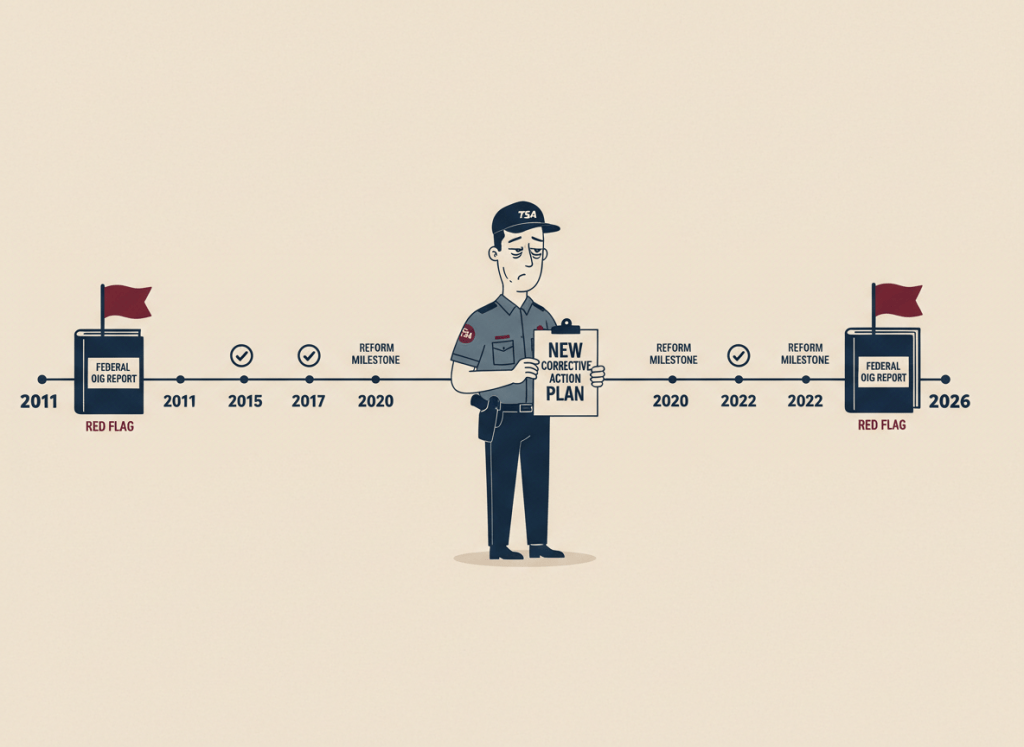
Federal investigators warned about airport-worker vetting failures in 2011. TSA subsequently introduced new screening procedures, enforcement guidance, and oversight systems. A November 2026 audit nevertheless found troubling similarities, raising questions about whether documented reforms have translated into reliable compliance.
In 2011, federal investigators warned that the Transportation Security Administration was not adequately ensuring that airport workers completed required security screening before receiving credentials granting access to restricted areas.
The problems included inaccurate applicant information, incomplete security threat assessments, and weaknesses in TSA’s oversight of airport badging offices.
Fifteen years later, another Department of Homeland Security inspector general investigation documented strikingly familiar deficiencies.
Airport operators issued security badges before required assessments were completed. Applicant information contained discrepancies. TSA inspectors did not consistently verify that violations had been corrected. Some airport operators faced no penalties for failing to comply with security requirements.
In one case, a worker retained an active airport security badge for 177 days despite TSA’s determination that the credential should not have been issued. Elsewhere, airport-operator noncompliance persisted for as long as 1,082 days.
The findings, published November 4, 2026, raise a question extending well beyond the latest audit: How did problems resembling those identified more than a decade earlier reappear after years of federal oversight, corrective-action plans, and agency reforms?
The answer is not that TSA spent 15 years doing nothing.
Government Accountability Office records show that the agency expanded criminal-background screening, developed an insider-threat strategy, updated enforcement guidance, and implemented improvements to its compliance-information systems.
Several of those corrective actions were independently verified by GAO.
But the latest inspector general findings reveal a distinction that government accountability systems do not always make clear. Implementing a recommendation is not necessarily the same as eliminating the underlying problem.
The Warning in 2011
In July 2011, DHS OIG published Report OIG-11-95, examining TSA’s oversight of airport operators responsible for issuing security credentials.
The investigation identified missing or inaccurate information associated with 95,961 individuals in airport-badging records. The deficiencies included problems involving identifying information and the documentation of security threat assessments.
The report also found that TSA’s inspection and oversight procedures were insufficient to ensure that airport operators consistently complied with applicable screening requirements.
These were not merely clerical concerns.
Airport-worker credentialing depends on accurate identifying information, completed security assessments, and reliable confirmation that an individual has been cleared before receiving access privileges.
Errors at those stages can undermine the safeguards intended to prevent unauthorized access to sensitive aviation facilities.
The findings received congressional attention.
During a May 16, 2012, House hearing examining airport security, DHS OIG officials discussed weaknesses in TSA’s oversight of airport-badging operations, including the need to verify that security assessments were completed before credentials were issued.
The inspector general’s findings placed TSA on notice that the integrity of the credentialing process required more than establishing screening rules. It required verifying that airport operators actually followed them.
TSA responded to the 2011 investigation with commitments to improve oversight and correct deficiencies.
The public record reviewed for this article does not establish that every problem identified in 2011 continued without interruption through 2026. Nor does it establish that the same airport operators, employees, or information systems were involved.
What it establishes is that federal auditors documented substantially similar categories of failure at both ends of a 15-year period.
Reforms Followed, and Some Were Verified
The intervening years brought meaningful changes to airport-worker screening.
Following heightened congressional concern about insider threats, TSA and other federal agencies expanded access to criminal-history information and strengthened recurrent screening requirements.
In 2015, GAO testimony on airport-worker screening described improvements in the criminal-history information available for vetting and the adoption of recurring fingerprint-based checks while more continuous monitoring capabilities were being developed.
The objective was straightforward. A worker who passed an initial background check could subsequently become disqualified, making ongoing monitoring important to maintaining the integrity of airport access credentials.
By 2017, GAO-17-662 documented additional TSA measures, including coordination with the FBI on its Rap Back program, updates to credentialing guidance, and efforts to strengthen airport access-control oversight.
These changes represented substantive improvements over an approach relying primarily on checks performed when workers initially applied for credentials.
TSA also addressed deficiencies in its broader insider-threat program.
In March 2020, GAO-20-275 found that TSA lacked an updated strategic plan and measurable performance goals for its Insider Threat Program.
The agency subsequently issued an Insider Threat Roadmap and developed mechanisms for tracking implementation and performance.
GAO eventually closed both recommendations as implemented after reviewing TSA’s corrective actions, including performance-tracking capabilities and reporting to agency leadership.
Those closures are significant.
They demonstrate that TSA took steps responsive to federal oversight and that independent reviewers verified implementation of the specified recommendations.
They do not, however, establish that every airport operator consistently complied with security requirements or that all operational weaknesses had been eliminated.
That distinction becomes especially important when examining what GAO found next.
A 2022 Warning About Enforcement and Oversight Systems
In September 2022, GAO published another investigation with direct implications for the latest inspector general findings.
GAO-22-105063, Aviation Security Programs: TSA Should Clarify Compliance Program Guidance and Address User Concerns with Its Data Systems, examined TSA’s aviation-security compliance activities, enforcement guidance, and information systems.
GAO found that TSA needed clearer guidance concerning when corrective-action plans were appropriate responses to security violations.
The report also identified difficulties associated with the agency’s Performance and Results Information System, known as PARIS, following a transition to a new platform in March 2021.
PARIS supports the documentation and management of aviation-security compliance activities.
The significance of the findings was institutional. TSA inspectors needed consistent enforcement guidance and dependable information systems to record violations, track corrective actions, and support management oversight.
Without those capabilities, an agency can identify noncompliance without consistently demonstrating that the underlying problem was resolved.
TSA responded to GAO’s recommendations.
In January 2023, the agency issued additional guidance addressing the use of corrective-action plans, followed by clarification meetings the next month.
It also undertook measures to address PARIS user concerns, including requirements-development activities, planning for system improvements, and lessons learned from technology transitions.
GAO subsequently closed all three recommendations from the 2022 investigation as implemented.
Once again, the record demonstrates corrective action rather than institutional indifference.
Yet the November 2026 inspector general investigation raises a difficult question about the practical results.
If TSA strengthened its enforcement guidance and compliance systems, why did auditors subsequently identify missing inspections, prolonged airport-operator noncompliance, and instances in which violations received no penalties?
The 2022 GAO report does not establish that PARIS problems caused the deficiencies identified in 2026. Nor does the available record establish that TSA’s 2023 guidance failed.
The reports examined overlapping institutional responsibilities but different evidence, periods, and specific questions.
Nevertheless, their combined findings make the effectiveness of TSA’s compliance oversight a legitimate subject for further scrutiny.
The Familiar Problems Found in 2026
The latest investigation, DHS OIG Report OIG-27-03, examined TSA’s vetting of airport workers and its oversight of airport operators responsible for issuing credentials.
Auditors compared 457 applicant records from five airports and identified discrepancies in information used for security threat assessments.
Some discrepancies involved the level of access requested for workers, including instances in which airport-operator records and TSA’s screening information did not agree.
Such inaccuracies create a risk that an applicant will receive an assessment based on incomplete or incorrect information.
The inspector general also examined records associated with 2,019,667 workers granted unescorted access to Security Identification Display Areas between October 2018 and February 2025.
The review found missing or incomplete Social Security numbers, although the publicly released report redacts the number of affected individuals.
More consequentially, auditors documented security credentials issued before TSA completed required threat assessments.
Some of those credentials remained active after TSA transmitted “Do Not Issue” notices.
A “Do Not Issue” notice does not necessarily mean that a worker has committed a crime or presents a confirmed terrorism threat. Such notices can result from unresolved identity, documentation, or eligibility requirements.
But issuing or retaining an active credential before those requirements are satisfied defeats the purpose of requiring clearance before access is authorized.
The inspector general’s most striking example involved a badge issued November 27, 2023.
TSA transmitted a “Do Not Issue” notice on December 13. Subsequent eligibility proceedings continued into March 2024, but the badge was not revoked until May 24.
The credential remained active for 177 days.
The report does not establish that the worker used the badge to enter a restricted area during that period. The documented failure is that the credential remained valid despite unresolved federal eligibility requirements.
The enforcement findings were similarly troubling.
Auditors reviewed 4,658 airport inspection records from fiscal years 2021 through 2024 and found that TSA did not consistently conduct required supplemental inspections.
Airport-operator noncompliance persisted for as long as 1,082 days.
TSA took seven enforcement actions against six airport operators, consisting of counseling, corrective-action plans, and warning notices.
In 19 instances involving 14 airport operators, TSA imposed no penalties. The inspector general could not determine the enforcement disposition of another case.
No fines, security-program revocations, or operational suspensions were imposed for the premature credential issuance examined in the audit.
The findings do not mean TSA conducted no inspections or took no enforcement action. They show that its oversight and enforcement were insufficient in the cases reviewed.
That distinction is essential when evaluating an agency responsible for a nationwide security system.
The Continuing-Vetting Problem
The November 2026 audit also identified weaknesses in verifying enrollment in the FBI’s Rap Back program.
Rap Back is designed to provide continuing criminal-history notifications after workers complete their initial background checks.
The system represents a significant development from the screening arrangements examined in earlier investigations.
But implementing a continuing-monitoring system creates a separate oversight obligation: ensuring that every worker subject to the requirement is actually enrolled.
Of 457 sampled workers, 451 were subject to Rap Back enrollment.
Auditors identified workers who were not enrolled and another 51 whose enrollment status could not be verified because they had left their employment and the relevant records were unavailable.
The number confirmed not enrolled is redacted.
These findings do not establish that the workers had disqualifying criminal histories.
They establish that TSA could not consistently verify compliance with a screening requirement intended to identify subsequent criminal-history developments.
That is a different deficiency from the earlier absence of comprehensive recurrent checks, but it demonstrates how new security systems can introduce new compliance challenges.
A program’s existence does not establish universal participation.
What Recommendation Closure Actually Means
Federal oversight reports frequently distinguish between recommendations that remain open and those considered closed.
A recommendation classified as closed and implemented generally means that the reviewing agency determined the responsible organization completed the action specified in that recommendation.
It does not necessarily mean every operational problem associated with the original finding has disappeared.
That limitation is particularly relevant to TSA’s record.
GAO verified the implementation of recommendations concerning strategic planning, enforcement guidance, and compliance-system improvements.
Those were meaningful accomplishments.
The 2026 inspector general nevertheless documented deficiencies involving airport-worker credentialing, inspection follow-through, and the verification of ongoing background monitoring.
Both sets of findings can be true.
The unresolved question is whether TSA’s performance measures, inspection procedures, and management controls were sufficiently designed to detect recurring violations and prevent them from persisting.
It is also unclear from the public records reviewed whether TSA’s post-2023 enforcement guidance was applied to the specific violations examined in the 2026 audit.
Some underlying conduct occurred before the revised guidance took effect. Other documented events occurred afterward.
Without a complete chronology of individual enforcement decisions, it would be premature to attribute the 2026 findings to the failure of any particular corrective measure.
The broader accountability question, however, remains.
When federal reviewers confirm that an agency has implemented corrective actions, what evidence demonstrates that those actions have improved actual compliance?
A New Round of Promises
TSA concurred with all four recommendations in the November 2026 inspector general report.
The agency committed to improving applicant-data quality, strengthening verification of badge revocations following “Do Not Issue” notices, improving inspection documentation and enforcement, and periodically confirming required Rap Back enrollment.
Two recommendations have target completion dates of December 31, 2026.
The remaining two are scheduled for completion by September 30, 2027.
In its October 6, 2026, management response, TSA described planned information-system enhancements and interim procedures intended to strengthen monitoring of airport-operator compliance.
The inspector general classified all four recommendations as open and resolved, indicating that TSA’s proposed corrective actions were considered responsive but had not yet been verified as implemented.
The process is familiar: auditors identify deficiencies, an agency agrees to corrective actions, and oversight officials monitor implementation.
The harder question is whether the eventual closure of those recommendations will be accompanied by evidence that the underlying failures have stopped recurring.
Fifteen Years Later, the Test Is Compliance
The historical record does not support a claim that TSA ignored every warning about airport-worker vetting or failed to improve its security programs.
It documents substantial reforms, including stronger criminal-background monitoring, updated insider-threat planning, clearer enforcement guidance, and improvements to compliance-information systems.
But it also documents recurring weaknesses in fundamental responsibilities: maintaining accurate applicant information, confirming security assessments before issuing credentials, inspecting airport operators, and verifying corrective action.
The 2011 and 2026 investigations used different samples, systems, and methodologies. Their findings cannot be combined into a single national failure rate or used to establish that identical deficiencies persisted continuously for 15 years.
What they demonstrate is that familiar categories of security failure remained sufficiently serious to attract federal audit findings long after the first warnings.
The November 2026 report leaves several important figures redacted, limiting the public’s ability to determine how widespread the latest problems were.
It also leaves TSA with another set of corrective-action deadlines.
For the agency responsible for protecting America’s aviation system, the next measure of success should not simply be whether it completes another plan, issues another directive, or closes another recommendation.
It should be whether airport operators consistently follow the rules, whether TSA detects violations promptly, and whether the agency can demonstrate that those violations have been corrected.
After 15 years of warnings and reforms, that is the accountability test that matters.
Reporting sources: DHS Office of Inspector General Reports OIG-11-95 (July 2011) and OIG-27-03 (November 2026); congressional testimony from May 16, 2012; GAO-15-704T (2015); GAO-17-662 (2017); GAO-20-275 (2020); and GAO-22-105063 (2022). The historical comparison reflects the publicly available reports and documented corrective actions. It does not establish uninterrupted noncompliance or a causal relationship between earlier system deficiencies and the specific violations identified in 2026.

