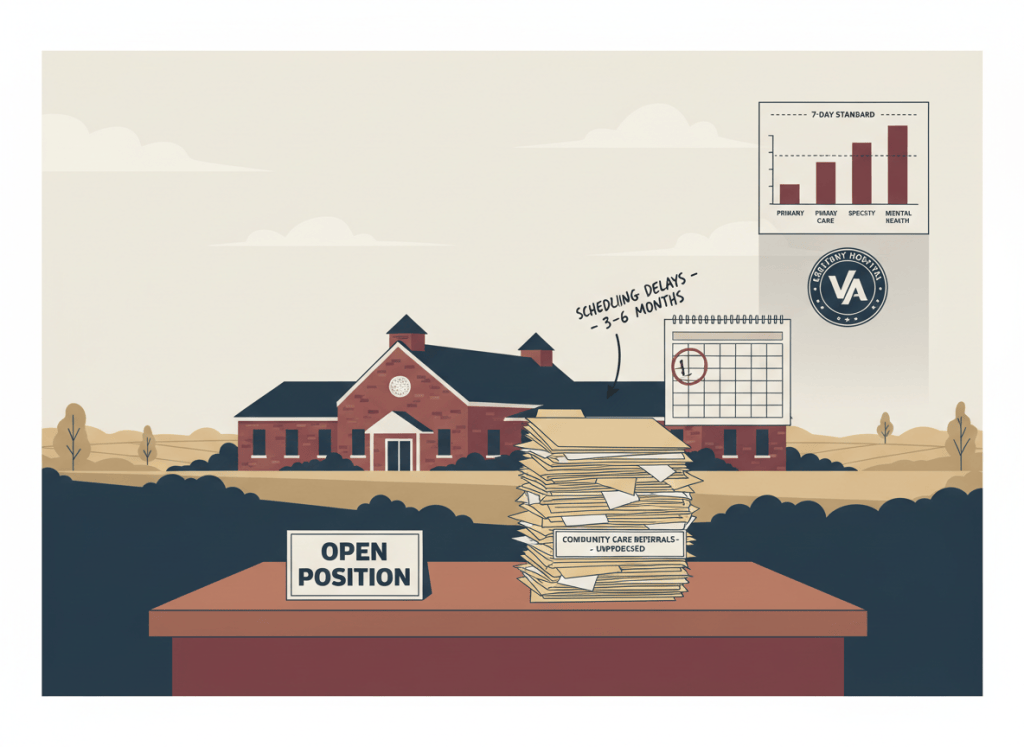
Federal workforce changes disrupted hiring and drove departures at the Marion VA Healthcare System, while community care scheduling remained slower than agency standards.
A federal hiring freeze, employee departures, return-to-office requirements, and probationary termination notices created staffing disruptions at a Department of Veterans Affairs healthcare system serving more than 42,000 veterans across three states, according to a newly released inspector general report.
The November 6 report from the VA Office of Inspector General documents how federal workforce initiatives complicated recruitment and retention at the VA Marion Healthcare System in Illinois. Facility leaders described losing experienced personnel, withdrawing employment offers, and struggling to replace workers as staffing pressures persisted into April 2026.
Meanwhile, inspectors found that community care scheduling remained slower than VA requirements, even as the healthcare system faced thousands of additional referrals to outside providers.
The findings offer a detailed account of how federal workforce decisions played out inside a regional veterans healthcare system. They also raise questions about whether policies intended to reshape the federal workforce adequately accounted for the operational demands of delivering medical care.
A Hiring Freeze With Consequences
The Marion healthcare system serves veterans across southern Illinois, southwestern Indiana, and northwestern Kentucky. During fiscal year 2025, it provided care to approximately 42,300 veterans and operated with a budget exceeding $363 million.
When inspectors visited April 21–23, 2026, facility executives described several federal workforce initiatives as disruptive events affecting operations.
Those included the deferred resignation program, Voluntary Early Retirement Authority, the federal hiring freeze that began January 20, 2025, return-to-office requirements, and probationary employee terminations.
According to facility executives, approximately 30 employees departed through deferred resignation and early retirement programs during 2025.
The departures were particularly consequential because hiring restrictions prevented leaders from promptly filling vacancies. Executives told inspectors that the remaining workforce absorbed additional responsibilities, reducing morale and operational efficiency.
The disruption extended to prospective employees.
Facility leaders reported withdrawing job offers after the hiring freeze began, including offers to applicants who had already relocated to the area or notified their existing employers that they intended to leave.
For a rural healthcare system already competing to attract medical professionals, the consequences extended beyond the immediate loss of employees. Recruitment itself became more difficult.
The OIG noted that VA had identified exemptions for positions critical to delivering veterans’ care. Nevertheless, Marion executives reported operational difficulties associated with the restrictions.
Return-to-Office Requirements Complicated Recruitment
Federal return-to-office requirements created additional challenges, particularly for medical and administrative positions that had previously operated remotely.
Facility executives told inspectors that some radiologists and medical support assistants left after being required to return to in-person work.
The facility director explained that telework arrangements are common for certain healthcare occupations, making Marion less competitive when recruiting against employers offering greater flexibility.
The consequences were especially apparent in community care, the program through which eligible veterans receive VA-funded treatment from outside healthcare providers.
At the time of the inspection, Marion had 15 community care vacancies, including eight advanced medical support assistants, four medical support assistants, and three registered nurses.
The chief of community care attributed recruitment difficulties partly to the elimination of virtual work arrangements. Applicants could obtain comparable positions elsewhere with remote or more flexible schedules, while others declined employment offers because of lengthy commutes.
Facility leaders responded by adjusting salaries to help retain existing medical support assistants.
The OIG’s findings do not establish that return-to-office requirements caused every vacancy. They do, however, document facility leaders’ assessment that the requirements reduced their ability to recruit and retain employees in an already difficult labor market.
Termination Notices and a Workforce Left Uncertain
The inspection also uncovered concerns about probationary employee terminations.
Facility executives told the OIG that some employees received termination notices from VA’s chief human capital officer citing underperformance, despite local leaders considering them strong performers.
According to the report, facility leadership had not received advance notice of the actions.
Some affected employees had already completed a year of probationary service, executives reported.
Although some eventually returned to employment, others found new jobs during the four to six weeks required to complete the return process.
The episode illustrates a recurring problem in large federal organizations: centralized personnel decisions can have consequences that extend beyond the offices issuing them.
At Marion, executives described a workforce unsettled by uncertainty over employment, staffing, and the facility’s ability to replace departing colleagues.
Leaders responded with town halls, anonymous employee feedback opportunities, additional supervisor meetings, and direct engagement with staff.
Those efforts reportedly helped employees feel heard, but did not eliminate their concerns.
Community Care Referrals Increased as Scheduling Lagged
The staffing challenges coincided with growing demands on Marion’s community care operation.
Inspectors found that referrals to outside providers increased by approximately 9,000 between fiscal years 2024 and 2025.
The chief of community care attributed the increase to the loss of specialty care providers within the VA healthcare system and limited physical space for treating patients.
At the same time, the facility was struggling to meet VA’s seven-day standard for scheduling community care appointments.
In fiscal year 2025, community care personnel took an average of 15 days to schedule appointments. That figure improved to 13 days during the first quarter of fiscal year 2026 and 11 days during the second quarter.
Although the improvement was meaningful, scheduling still took approximately four days longer than the agency’s standard.
The distinction between scheduling time and the actual date of medical treatment is important. The figures measure how long staff took to arrange appointments, not the total period veterans waited to see outside providers.
The chief of community care identified several contributing factors, including staffing vacancies, rising referral volumes, limited appointment availability, and the time needed to collect medical records requested by outside clinicians.
Specialty shortages were particularly troublesome in rheumatology, endocrinology, dermatology, and neurology.
To improve performance, facility leaders redistributed workloads, cross-trained employees, and introduced software allowing staff to schedule directly into participating community providers’ appointment systems.
Those changes helped reduce scheduling times, but had not brought the operation into compliance with the seven-day standard when inspectors conducted their review.
For veterans relying on specialty treatment, administrative delays represent another step between a referral and access to medical care.
Primary Care Faced Its Own Recruitment Challenges
The staffing problems were not limited to community care.
Inspectors identified five primary care vacancies, including two physician positions, one nurse practitioner, one physician assistant, and one advanced medical support assistant.
Primary care leaders described difficulties attracting physicians to the rural region, where private employers could offer more competitive compensation.
The facility attempted to improve recruitment through salary adjustments, education debt reduction benefits, and physician recruiters.
Those efforts produced limited success, prompting the healthcare system to hire nurse practitioners and physician assistants for some provider vacancies.
However, the OIG also documented an important distinction.
Despite physician recruitment difficulties, the chief of primary care reported appointment wait times below the 20-day community care eligibility threshold for both new and established primary care patients during fiscal year 2025 and the first half of fiscal year 2026.
That finding suggests Marion maintained primary care access within the cited threshold even as its workforce faced significant pressures.
Inspectors Also Identified Improvements
The report does not portray a healthcare system uniformly failing to serve veterans.
Inspectors documented several operational improvements, including a facility initiative that reportedly reduced sepsis cases by 6 percent as of April 2026.
Another effort addressed telephone transfers that left veterans waiting on hold. After employees received additional training, the facility recorded a 40 percent reduction in weekly calls remaining on hold longer than 15 minutes following a transfer.
The OIG also found that the facility maintained clean patient care areas and had corrected minor environmental deficiencies during the inspection.
These findings matter because they distinguish the healthcare system’s demonstrated efforts to improve services from the workforce and access problems described elsewhere in the report.
Patient Safety Procedures Still Needed Attention
Although staffing and access problems occupied substantial portions of the inspection, the OIG’s only two formal recommendations concerned communication of medical test results.
Inspectors found that Marion had an established process for communicating results to providers and patients, but had not updated its local policy or developed required written workflows identifying employee responsibilities.
The requirements stemmed from a Veterans Health Administration directive issued in July 2023 and amended in September 2024.
Facility leadership agreed to corrective action, with a target completion date of February 28, 2027.
The director’s response also cited a June 26, 2026, VHA directive pausing new policy development. Rather than revising the existing local policy immediately, officials proposed developing a standard operating procedure incorporating the missing requirements.
The OIG accepted the corrective-action plans and said it would monitor implementation.
The report did not identify patient injuries caused by the missing documentation.
The Accountability Question
The Marion inspection offers an unusually specific view of the operational effects of federal workforce policies at a veterans healthcare facility.
Approximately 30 employees departed through two voluntary workforce programs. Other workers reportedly left following return-to-office requirements. Employment offers were withdrawn, probationary terminations complicated staffing, and recruitment remained difficult.
At the same time, community care vacancies persisted, outside referrals increased, and scheduling times exceeded VA’s established standard.
These findings do not establish that federal workforce policies caused the community care delays. The OIG documented several other contributing factors, including rural recruitment challenges, shortages of outside specialists, and limited clinical space.
Nor did the inspector general issue formal recommendations addressing the workforce initiatives or community care scheduling performance.
Nevertheless, the report presents a question that extends beyond one healthcare system in southern Illinois.
When federal workforce policies are implemented across an agency responsible for delivering medical treatment to millions of veterans, how does the government determine whether those policies are affecting its capacity to provide timely care?
The Marion inspection provides evidence of operational disruption, but not a comprehensive accounting of its consequences for patients.
That distinction makes the unanswered questions important.
The VA’s obligation to manage its workforce efficiently does not exist separately from its responsibility to deliver healthcare. Both obligations must be measured against the experience of the veterans the system was created to serve.
And for those veterans, the practical test of any workforce policy is not how many positions disappear from an organizational chart. It is whether the healthcare system still has the people, resources, and capacity to deliver the care they have earned.
Source: U.S. Department of Veterans Affairs, Office of Inspector General, Healthcare Facility Inspection of the VA Marion Healthcare System in Illinois, Report 26-00049-163, November 6, 2026.

