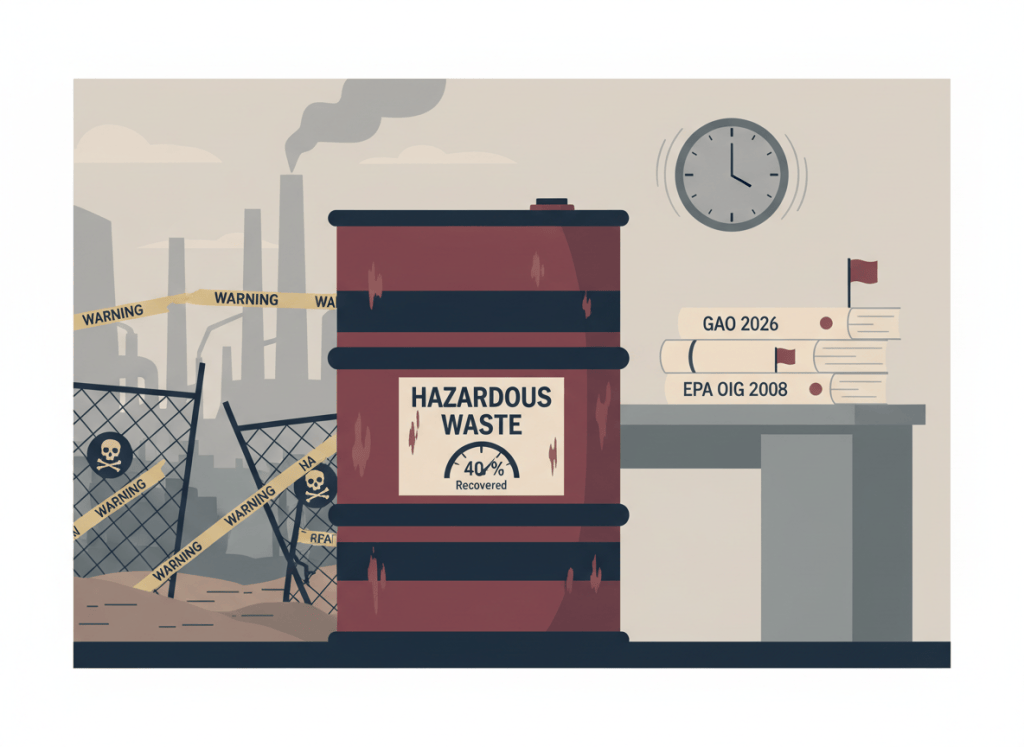
WASHINGTON, Nov. 9, 2026 — Nearly two decades after federal watchdogs warned that the Environmental Protection Agency needed better tools to recover hazardous waste cleanup costs from responsible polluters, the agency still has not established performance measures necessary to determine how effectively it collects that money.
A November 5 Government Accountability Office report found that EPA recovered approximately $7.7 billion of $19.2 billion in expenditures included in its cost-recovery analysis for nonfederal Superfund sites between fiscal years 1996 and 2024, a recovery rate of approximately 40 percent.
The approximately $11.5 billion difference does not necessarily represent legally collectible debt. Some responsible parties cannot be identified, no longer exist, lack the resources to pay, or have legal defenses. Recovery proceedings may also continue for years.
Nevertheless, GAO identified a fundamental management problem: EPA has not established agency-wide goals and performance measures to systematically determine how effectively it recovers cleanup costs, despite maintaining financial information that could support those assessments.
An Oversight Warning That Outlasted Nearly Two Decades
In March 2008, EPA’s Office of Inspector General issued EPA Can Recover More Federal Superfund Money (08-P-0116), identifying weaknesses in cost recovery. The Inspector General examined 58 sites and found EPA had not recovered as much as $129 million, approximately 44 percent of the costs reviewed — including between $30 million and $90 million that EPA had decided not to pursue. The report made three recommendations, including that EPA implement performance measures to track cost-recovery efficiency. EPA concurred with all three.
By September 2009, EPA’s own compendium of unimplemented recommendations recorded that the performance-measure recommendation had been removed from the unimplemented list — meaning EPA considered it addressed at the time. A separate recommendation on tracking unbilled costs and corrections remained open, with a completion date that had already passed.
Eighteen years after the original report, GAO found that effective agency-wide performance measures for cost recovery still did not exist. Whatever EPA put in place around 2009 was either insufficient or did not endure. EPA tracks whether officials act before statutes of limitations expire, but those timeliness checks do not show whether the agency is recovering an appropriate share of legally collectible costs.
EPA collects site-level expenditure and recovery data, GAO reported, but does not systematically compare federal spending with recovered or potentially recoverable amounts across nonfederal National Priorities List sites.
Billions Spent, Billions Unrecovered
Congress established Superfund under the Comprehensive Environmental Response, Compensation, and Liability Act of 1980 (CERCLA). EPA can compel responsible parties to conduct cleanups or seek reimbursement when it performs the work. When responsible parties cannot be found or cannot pay, federal resources can finance cleanup.
GAO found that EPA spent approximately $25.8 billion, adjusted to 2024 dollars, on various activities at nonfederal National Priorities List sites between fiscal years 1996 and 2024. Roughly half went to remedial activities. Its narrower cost-recovery comparison covered 1,622 sites and approximately $19.2 billion in expenditures and $7.7 billion in recoveries.
EPA identified at least one potentially responsible party at 1,491 of those sites. Identification does not establish liability for every dollar, and GAO called the recovery calculation a point-in-time estimate because cases remain ongoing.
The Investigators Who Identify Polluters Are Disappearing
EPA officials told GAO that experienced employees conducting responsible-party searches have departed over the last 10 to 15 years. Many were not replaced as regional offices prioritized technical personnel, including remedial project managers. Other employees now conduct searches alongside their regular duties.
EPA could not provide a reliable position-level count of staff devoted to these investigations. Identifying parties can require historical research, interviews, document reconstruction and analysis of industrial operations decades in the past. Companies may have dissolved and witnesses or records may be unavailable.
GAO did not establish that staffing losses caused a specific amount of unrecovered spending. The findings nonetheless raise questions about EPA’s investigative capacity.
A Georgia Cleanup Illustrates the Challenge
At a former wood-preserving facility in Georgia, where contaminants included pentachlorophenol and benzene, EPA spent more than $60 million addressing contaminated groundwater, soil and sediment, according to officials interviewed by GAO. It recovered just $556,004, less than 1 percent.
EPA cited litigation risks, evidentiary difficulties, liability defenses and limited responsibility attributable to certain parties. The case does not prove EPA abandoned collectible funds; it shows why assessing recovery performance across cases and regions matters.
Taxpayers, Industry Taxes, and the Cost of Contamination
GAO found that the Superfund Trust Fund received approximately $34 billion from fiscal years 2006 through 2024 in constant 2024 dollars. About 85 percent came from Treasury General Fund transfers after original Superfund taxes expired in 1995.
Congress reinstated certain industry-related taxes through legislation in 2021 and 2022. By fiscal year 2024, about $1.44 billion in reinstated tax revenue was available to EPA, more than twice the approximately $537 million in Superfund appropriations that year. GAO reported approximately $1.46 billion in tax revenue in fiscal 2025 and an expected $1.59 billion available in fiscal 2026.
Industry taxes fund the broader program; cost recovery seeks reimbursement from parties legally responsible for specific cleanups. One does not eliminate the need for the other.
Millions of Americans Live Near Superfund Sites
EPA population estimates cited by GAO indicate approximately 78 million people, roughly 23 percent of the country, live within three miles of a Superfund site. Contaminants found at these locations have been linked to serious health effects, although proximity does not by itself establish exposure or disease.
Superfund must prioritize reducing hazardous contamination and protecting public health. Effective cost recovery can also replenish program resources and reinforce the principle that legally responsible parties should bear appropriate costs.
EPA Agrees to New Accountability Measures
EPA agreed with all three GAO recommendations: establish cost-recovery effectiveness goals, systematically collect performance information, and use that information to evaluate progress and guide decisions.
EPA proposed a two-part Cost Recovery Accountability measure. An effective recovery rate would compare recovered costs with collectible past costs. A cost disposition rate would track the treatment of all past costs, including recovered, unrecoverable and not-yet-recoverable amounts.
The proposed framework addresses a limitation of simple spending-versus-recovery comparisons, but the GAO report does not establish that the framework is fully implemented or has delivered measurable improvements.
Congress Has Another Oversight Question
The GAO review was requested by Republican House Energy and Commerce Committee members, including Chairman Brett Guthrie and subcommittee leaders. Its findings span multiple administrations and raise a pointed question: EPA considered its 2008 performance-measure recommendation resolved by 2009. GAO found in 2026 that effective measures still did not exist. What happened in between?
The next measure of accountability will be whether EPA can demonstrate results rather than merely agree that better measurement is needed.
Primary Sources
GAO-27-107925 (November 5, 2026); EPA OIG, EPA Can Recover More Federal Superfund Money (08-P-0116, March 26, 2008); EPA CERCLA overview; EPA Superfund program.

