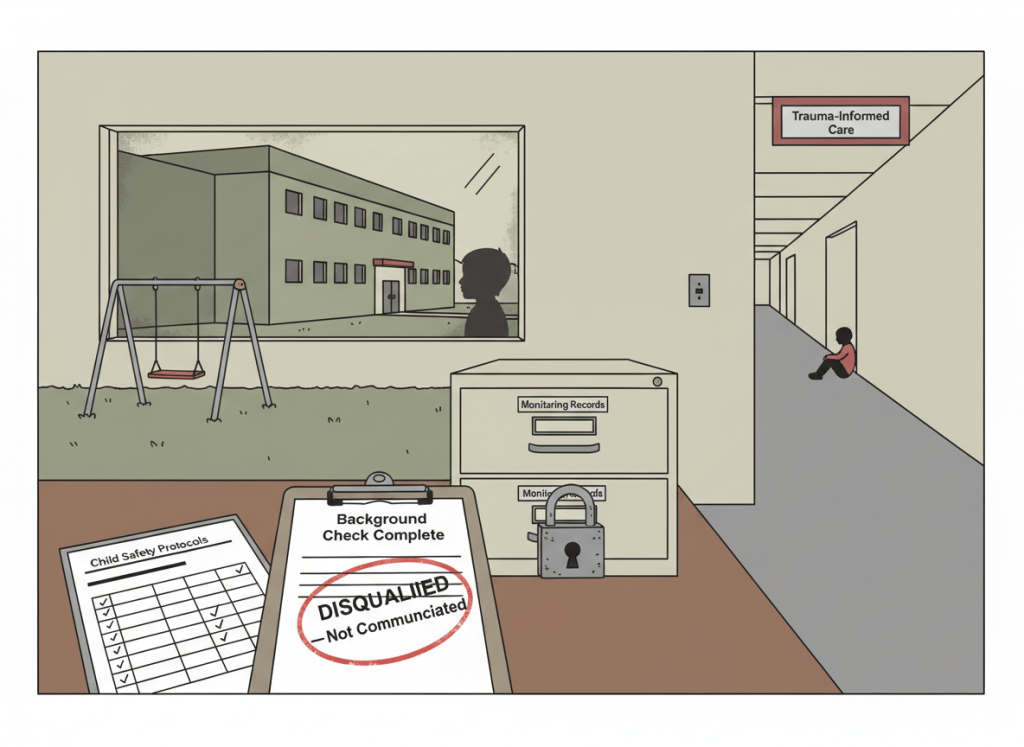
Federal auditors documented serious safety failures at residential treatment facilities, including disqualified employees, punitive treatment practices, and $416,009 in improper federal payments. Kentucky disputed two recommendations but failed to provide requested supporting records.
A child in Kentucky’s foster-care system found a syringe containing methamphetamine in an employee’s purse at a residential treatment facility, injected themselves with the drug, and was hospitalized after testing positive for methamphetamine.
The employee had a criminal history that should have disqualified them from working at the facility. Background-check results had identified the disqualifying conviction, but Kentucky officials had not notified the facility that the employee was ineligible for employment.
The incident was among the most disturbing findings in an October 2026 audit by the Department of Health and Human Services Office of Inspector General, which examined Kentucky’s oversight of Qualified Residential Treatment Programs, or QRTPs, serving children in foster care.
Federal auditors identified 235 instances of noncompliance involving children’s records and residential facilities. Every one of the 15 facilities examined had at least one compliance deficiency, and 25 of the 30 children’s records reviewed contained documentation problems.
The findings raise a question extending well beyond administrative compliance. Kentucky had licensing inspectors, background-check procedures, and an interagency oversight arrangement. Yet those safeguards failed to prevent or identify conditions that exposed vulnerable children to serious risks.
And when federal auditors challenged the state’s oversight, Kentucky disputed two recommendations without providing the supporting records auditors repeatedly requested.
A System Designed to Protect Vulnerable Children
Qualified Residential Treatment Programs operate under requirements established by the Family First Prevention Services Act of 2018, legislation intended to reduce unnecessary institutional placements of foster children while strengthening protections for those requiring residential treatment.
These facilities serve children whose emotional or behavioral needs may require structured treatment outside a family-based setting. Federal requirements include trauma-informed care, qualified clinical personnel, assessments establishing the necessity of residential placement, judicial review, and discharge planning.
States receive federal funding for qualifying foster-care expenditures through Title IV-E of the Social Security Act. Those payments come with conditions intended to ensure that children receive appropriate care and that facilities meet applicable standards.
Kentucky’s Cabinet for Health and Family Services, through its Department for Community Based Services, administers the relevant foster-care program and bears responsibility for ensuring compliance.
The federal audit examined placements from October 2023 through September 2024. Auditors also conducted unannounced visits to 15 of Kentucky’s 38 QRTP facilities between July and December 2025.
The facilities and children’s records were selected for review rather than drawn as a statistically representative sample. Consequently, the findings cannot be extrapolated to every QRTP in Kentucky.
Nevertheless, the deficiencies documented at the examined facilities were extensive.
Criminal Background Checks Failed to Keep Disqualified Workers Away From Children
Federal auditors found that Kentucky had not implemented the required fingerprint-based national criminal-background-check process for QRTP personnel and had not obtained a federal waiver authorizing its alternative approach.
Instead, the state relied on background checks obtained through Kentucky’s Administrative Office of the Courts.
At two facilities, background-check results revealed disqualifying convictions, yet the individuals were hired. Although the facilities received the results, the state failed to communicate explicit determinations that the individuals were ineligible for employment.
One employee was connected to the methamphetamine-syringe incident. Another was accused of verbally assaulting a child and resigned while an internal investigation was underway.
Auditors also found that seven facilities had failed to complete required out-of-state child-abuse registry checks for certain employees.
The distinction between obtaining a background check and acting on its findings is central to the investigation. A screening system provides little protection if disqualifying information does not prevent an individual from working with vulnerable children.
Kentucky already operates the Kentucky Applicant Registry and Employment Screening system, commonly known as KARES, which uses fingerprint-based criminal-history screening for covered employment settings.
Whether QRTP facilities were eligible or required to use KARES during the audited period remains unresolved. The existence of that infrastructure does, however, raise questions about how Kentucky implemented its screening requirements for residential foster-care facilities.
In its response to the audit, Kentucky reported completing fingerprint-based checks for employees at the 15 facilities examined.
The report does not establish whether equivalent screening had been completed at every other QRTP operating in the state.
Punitive Practices in Facilities Supposed to Provide Trauma-Informed Care
The audit also documented treatment practices that appeared fundamentally inconsistent with the therapeutic purpose of residential care.
At one facility, children were required to sit in a hallway facing away from other residents, prohibited from communicating with peers, and limited to hourly opportunities for bathroom and water breaks.
One child’s records showed that the restrictions were imposed during 61 of the child’s 150 placement days, approximately 41 percent of the placement.
Federal requirements emphasize trauma-informed treatment, particularly because children entering residential care may already have experienced significant instability, abuse, or neglect.
The auditors’ findings raise questions about whether the facility’s disciplinary practices were compatible with those requirements.
Kentucky subsequently provided a policy describing more supportive treatment methods. However, auditors reported that the state did not establish when the policy was developed or implemented.
Other deficiencies involved staff qualifications and facility safety.
At one facility, auditors identified a substance-abuse counselor providing services despite a professional license that had expired approximately eight months earlier. A state representative directed the facility to stop the employee from providing those services after the issue was discovered during the federal inspection.
Auditors also documented employees with expired driver’s licenses whose duties included transporting children, inadequate personnel and training records, sanitation problems, unsecured chemicals, and other physical safety hazards.
Of the 165 facility-level compliance findings, 104 involved personnel and training, 25 concerned physical conditions, 24 involved background checks, and 12 concerned policies and staffing.
These findings point to problems extending beyond isolated employee misconduct. They involve the basic systems facilities and regulators use to establish whether staff are qualified, buildings are safe, and treatment practices comply with applicable requirements.
The Inspections Continued. The Specialized Monitoring Did Not.
Perhaps the most consequential institutional finding concerns the state’s oversight arrangements.
Kentucky continued conducting annual licensing inspections through its regulatory structure. But according to federal auditors, routine onsite monitoring specifically addressing QRTP program requirements had not occurred since August 2023 when their inspections began in July 2025.
That distinction matters.
Ordinary licensing inspections can examine whether a facility meets general operational requirements. QRTP monitoring must also evaluate specialized federal obligations, including treatment practices, personnel qualifications, placement documentation, and other safeguards associated with federal foster-care funding.
Federal auditors found that the licensing inspections had not adequately identified significant deficiencies involving staff credentials, training, personnel records, and facility safety.
The report does not suggest that Kentucky stopped inspecting residential facilities altogether. Rather, it indicates that the oversight mechanisms still operating did not adequately address the specialized requirements applicable to these programs.
Kentucky disputed the recommendation that it establish routine onsite QRTP monitoring, maintaining that an intra-agency arrangement between the Department for Community Based Services and the Division of Regulated Child Care already provided a framework for coordinating oversight.
Federal auditors repeatedly requested the agreement and associated monitoring records.
According to the final report, Kentucky did not provide the requested documentation.
The absence of those records from the audit does not establish that the agreement never existed. It does, however, leave unresolved whether the state’s claimed monitoring arrangement was operating as described.
The result is an uncomfortable contradiction. Kentucky maintained that its oversight structure was sufficient, while federal auditors documented extensive deficiencies and an extended lapse in specialized program monitoring.
More Than $400,000 in Federal Payments Questioned
The audit also identified $571,306 in improper payments associated with placements that failed to satisfy applicable requirements. Of that amount, $416,009 represented the federal share.
Kentucky disputed part of the finding.
The state argued that the federal amount should be reduced by $80,730, citing expenditures previously repaid following a February 2026 state audit and payments allegedly charged to funding sources other than Title IV-E.
If accepted in full, that adjustment would reduce the questioned federal amount to $335,279.
However, federal auditors reported that Kentucky did not provide the financial documentation necessary to substantiate its proposed adjustment, despite repeated requests.
The audit therefore retained its recommendation that Kentucky refund the $416,009 federal share.
The final amount ultimately recoverable by the federal government remains a separate question from the auditors’ recommendation.
Although the financial findings are significant, they should not obscure the larger concern. Federal reimbursement requirements are one mechanism Congress uses to enforce standards governing the treatment and protection of children in foster care.
When those requirements are not satisfied, the problem involves more than whether a particular expenditure was properly documented.
Kentucky’s Corrective Actions Remain an Accountability Test
Kentucky agreed with recommendations addressing deficiencies in children’s records and personnel background checks, while disputing the recommendations concerning federal repayment and routine onsite monitoring.
The state described corrective measures, including completed fingerprint-based checks at the examined facilities and planned improvements to recordkeeping.
But several questions remain unanswered by the published audit.
It is not clear from the report whether routine specialized monitoring has resumed across all Kentucky QRTPs, whether every facility has implemented compliant background-check procedures, or whether the state has completed a comprehensive review of earlier licensing inspections.
Nor does the report establish whether the federal government has accepted Kentucky’s disputed financial reconciliation.
Bureaucracy Times submitted media inquiries on October 29 to the Kentucky Cabinet for Health and Family Services and the federal Administration for Children and Families.
The inquiries seek clarification regarding the background-check failures, corrective actions following the incidents involving employees with disqualifying convictions, the state’s monitoring agreement, the resumption of onsite program reviews, and the disputed federal payments.
Responses were requested by November 4.
The audit’s findings concern conditions documented during earlier periods and do not, by themselves, establish that every deficiency continues today.
What they do establish is that the state failed to ensure compliance with multiple safeguards intended to protect children receiving residential treatment.
Kentucky’s challenge now is not simply to demonstrate that new procedures have been written or that disputed payments can be reconciled.
It is to establish that the oversight mechanisms entrusted with protecting children are actually working.
For the children living in these facilities, that distinction is considerably more important than another completed compliance checklist.

