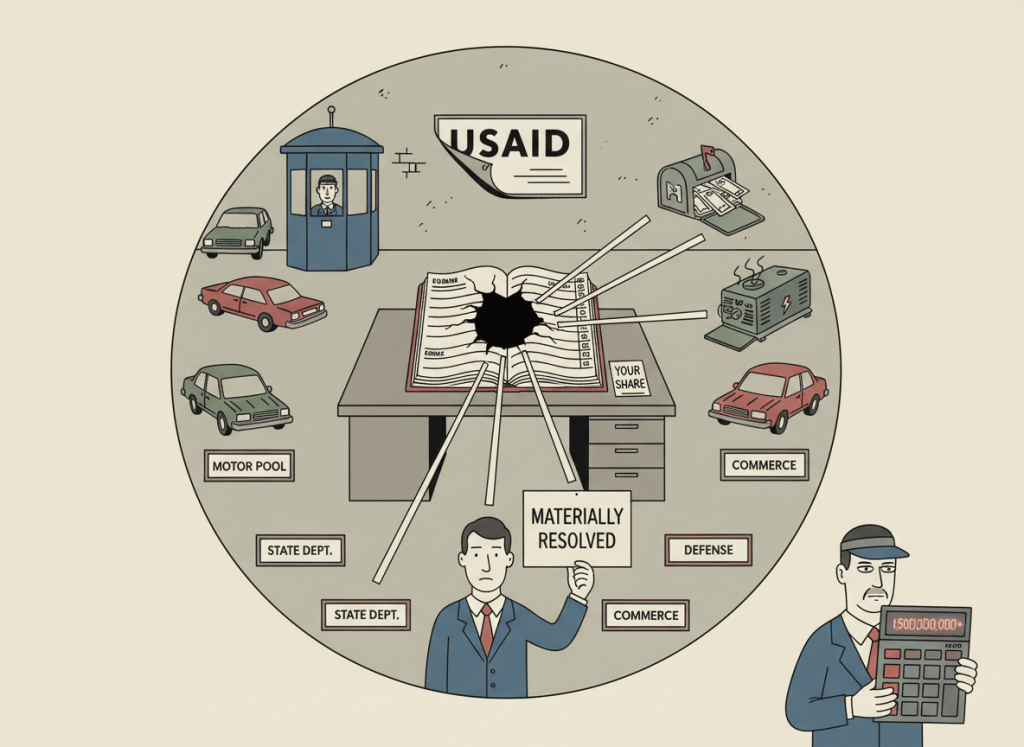
The Department of State says the money problem created by USAID’s exit from the overseas embassy cost-sharing program was “materially resolved” by May 2026. The department’s own watchdog looked at the same books and counted a bigger bill, not a smaller one.
The Office of Inspector General’s audit (AUD-FM-27-02), published this month, found that State never built a long-term strategy to absorb the loss of its second-largest customer. State asked OIG to delete the finding. OIG declined.
The Second-Largest Customer Leaves
The International Cooperative Administrative Support Services program, known as ICASS, is how agencies with staff at more than 200 overseas posts share the cost of motor pools, guards, building operations, and the rest of the embassy plumbing. In FY 2025, 35 agencies paid more than $3.4 billion into it.
The system runs on a break-even principle. Each agency pays for what it uses.
USAID was the second-largest payer, at about $254 million in FY 2025. Of that, $237 million covered costs at posts. On April 3, 2025, USAID notified the program’s service center that it was leaving, effective FY 2026.
The guards still need paying. The generators still need diesel. The embassy compound does not shrink because an agency’s letterhead was retired.
Unless State cut costs by at least $237 million before the FY 2026 budget was finalized in June 2026, the remaining agencies would absorb the difference. According to OIG, State did not cut it.
“Materially Resolved”
State’s response to the draft audit called the shortfall finding “inaccurate and misleading.” It said the department had “materially resolved” the budget problem by May 2026 and asked OIG to remove the language.
OIG’s reply, in Appendix F, is arithmetic. The initial FY 2026 ICASS budget was $361.5 million above the final FY 2025 figure. State trimmed about $176 million from that. The final FY 2026 budget still landed $185.6 million above FY 2025, rising from roughly $3.40 billion to $3.59 billion.
In fairness to State, four of the six regional bureaus did lower their final targets below FY 2025 levels. Two regional bureaus, Diplomatic Security, and the Bureau of Overseas Buildings Operations went the other way, which pushed post-related targets up about $40 million overall.
State also pointed out that it plans to seek money from Congress, which is one of five lines of effort in a reform initiative it described to OIG in August. OIG noted that State’s documents did not say what happens if that money does not arrive.
An inference, labeled as one. “Resolved” may mean “paid for” rather than “eliminated.” This rests on two things in the audit: OIG’s statement that the budget increase may be covered by carryover funds and higher invoices to customer agencies, and OIG’s account that State officials said in June 2025 that carryover would be depleted quickly and that remaining agencies would eventually have to absorb USAID’s share. State has not said publicly what it means by the word.
Who Pays the Difference
OIG estimated what the shortfall and the budget increase could mean for each customer agency’s FY 2026 bill. Its total is $422.7 million, or about 14 percent on average.
State carries the largest share at an estimated $325.2 million. Defense follows at $20.1 million, then the Army at $17.7 million, Justice at $13.2 million, Homeland Security at $8.5 million, and Health and Human Services at $7.5 million.
These are estimates, not invoices. OIG built them by applying each agency’s FY 2025 share of non-USAID costs to the $237 million shortfall plus the $185.6 million budget increase. They exclude centrally funded costs, and the $237 million itself is the ICASS Service Center’s calculation.
The weight falls unevenly. Posts under the Bureau of African Affairs lose $121.3 million of USAID funding, 51 percent of the total and about 20 percent of the bureau’s ICASS costs. The bureau cut its FY 2026 target by $11.6 million.
At Embassy Juba, USAID’s money covered 53 percent of FY 2025 ICASS costs. In Kampala, 37 percent.
A second inference. State’s FY 2027 request for Diplomatic Programs is roughly flat, up $10 million or 0.1 percent, according to the U.S. Global Leadership Coalition’s analysis. A flat top line does not show a large new ICASS appropriation. The caution is that ICASS is a working capital fund fed by payments from many agencies, so a flat Diplomatic Programs line does not prove the bill went unpaid. It does leave open who is paying it.
Nobody Was in Charge
OIG’s explanation for the missing strategy is blunter than the audit’s language. It found no headquarters office that believed it had authority to set global ICASS goals.
The service center said it does not make financial decisions. The Bureau of Budget and Planning said it advises. Regional bureaus report to the Under Secretary for Political Affairs, while other bureaus involved report to the Under Secretary for Management, so cutting costs worldwide would take a decision above both.
The office that used to issue cost guidance to bureaus was abolished in the 2025 reorganization. The Transition Assistance Working Group, set up to manage the USAID realignment, was disbanded on July 1, 2025, the day State planned to finish the initial phase. OIG had warned in May 2025 that sunsetting it would leave the department without dedicated leadership.
The results show up in the survey data. Personnel at 53 posts answered OIG’s survey. Of those respondents, 72 percent said they had no plan or guidance for reducing ICASS costs, and 85 percent said unclear guidance made cost-cutting hard. One department official told OIG that regional bureaus likely held back guidance out of concern that decisions might not align with senior leadership priorities.
State objected that survey responses are subjective and do not prove guidance was never issued. OIG answered that it also checked the responses against documents from headquarters and the bureaus.
The transition work shows the same pattern. Before the working group disbanded, it completed 3 of 29 transition tasks. As of February 2026, 9 remained unfinished. State told OIG the transition plan was completed in September 2026.
Then there is severance. Three regional bureaus had still not estimated FY 2026 severance costs as of July and August 2026. Conflicting guidance on rehiring former USAID staff may also have set up a second severance payout for people who already received a full one.
State concurred in principle or in intent with the first three recommendations and called a new mechanism unnecessary for the fourth. It asked OIG to close the first and to remove or close the third. OIG kept all four open pending documentation.
Inquiries are being directed to the Department of State. Three questions remain unanswered:
- What specific actions closed the $237 million gap by May 2026, and how much was covered by carryover funds or higher invoices to other agencies?
- Who sits on the ICASS implementation team State says already exists, and when was it formed?
- What is the estimated severance cost of the ICASS staff reductions?
The shortfall was announced in April 2025 and, by State’s account, solved by May 2026. By the auditors’ account, it was handed to whoever opens the next invoice.

