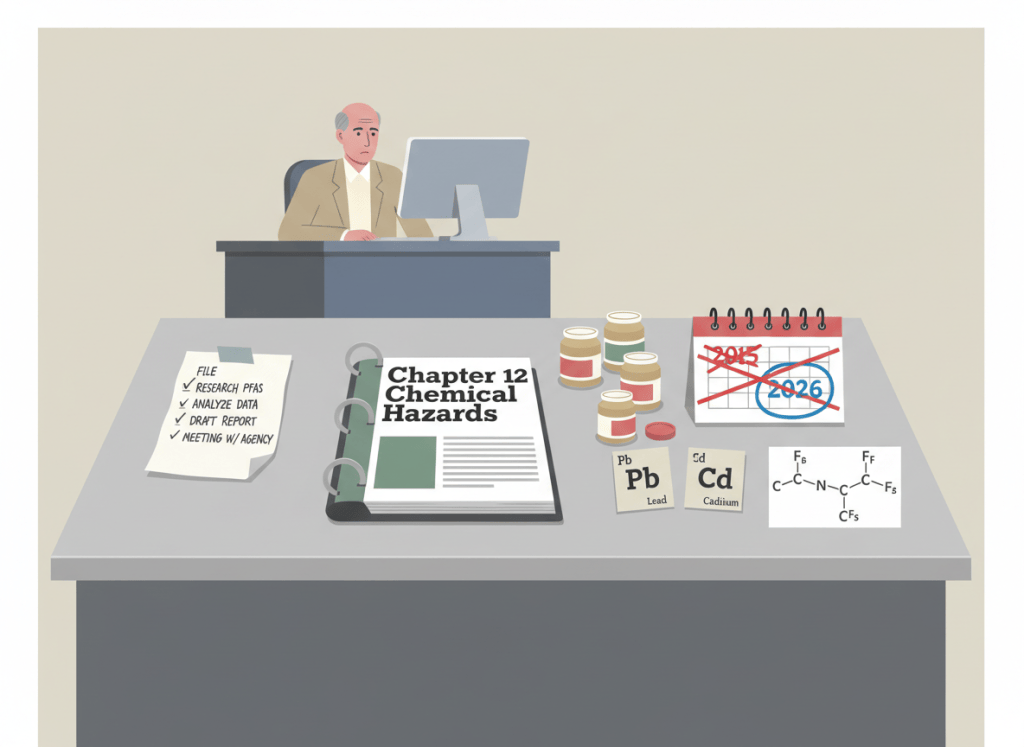
More than a decade after the Food and Drug Administration established sweeping preventive food safety requirements, the agency is still completing the guidance intended to help manufacturers understand how to comply with them.
On October 22, 2026, the FDA released a 49-page draft of Chapter 12, addressing the identification, evaluation, and control of chemical hazards in food manufacturing. The document covers pesticide residues, naturally occurring toxins, and environmental contaminants including lead, arsenic, cadmium, and PFAS.
The guidance arrives approximately 10 years after the FDA began releasing chapters of its broader Hazard Analysis and Risk-Based Preventive Controls for Human Food guidance series. FDA acknowledges that it has not established contaminant levels for toxic elements in most foods, leaving potential hazards to be evaluated case by case. That does not mean manufacturers lack enforceable food safety requirements, but it illustrates how much detailed technical guidance remains under development.
A Regulatory Framework Established in 2015
The Food Safety Modernization Act, enacted in 2011, shifted federal policy toward preventing contamination. In September 2015, FDA finalized its preventive controls regulation, codified at 21 CFR Part 117. Covered facilities must analyze hazards, establish appropriate controls, monitor effectiveness, maintain records, and take corrective action.
FDA began releasing accompanying draft guidance chapters in 2016, publishing individual installments rather than waiting for the entire series. Its guidance index still identifies six chapters as forthcoming. The underlying regulatory obligations have remained in force.
In an October 28 written response to Bureaucracy Times, HHS attributed the lengthy development of Chapter 12 to scientific complexity and competing agency priorities. “Important competing priorities and the breadth of topics under chemical hazard analysis accounts for the time required to develop this chapter with the rigor it demands,” the department stated. HHS did not identify those priorities, provide development milestones, or give completion dates for remaining chapters.
What the Chemical Hazard Guidance Says
Chapter 12 recommends how manufacturers can identify chemical hazards and decide whether routine good manufacturing practices suffice or specific preventive controls are necessary. It covers environmental contaminants, natural toxins, unlawful pesticide and animal drug residues, unauthorized additives, and chemicals introduced during processing.
Examples involving baby foods describe supplier-history reviews, ingredient testing, certificates of analysis, and verification procedures for lead, arsenic, and cadmium. Another example concerns infant rice cereal. These are illustrative approaches, not universal testing mandates.
HHS emphasized that the chapter is draft, nonbinding guidance reflecting FDA’s current thinking on best practices. Existing law, rather than this guidance document, establishes manufacturers’ enforceable duties.
Contaminant Standards Still Under Development
FDA acknowledges that it has not established contaminant levels for toxic elements in most foods. It assesses detected contaminants using their concentrations, the food involved, consumption patterns, and toxicological evidence. An action level can help manufacturers assess regulatory concern, but the absence of one does not prevent FDA from acting against adulterated food under existing law.
Nor does the public record establish that manufacturers have broadly failed to comply because particular thresholds are missing. What it shows is that contaminant-specific guidance continues to develop alongside a longstanding risk-based regulatory framework.
Baby Food and Closer to Zero
On October 22 FDA also proposed cadmium action levels for processed foods intended for babies and young children under its Closer to Zero initiative. FDA previously established an inorganic arsenic action level for infant rice cereal and issued final lead guidance for processed baby and toddler foods in January 2025.
Toxic elements can occur naturally in soil and water, enter crops during growth, or result from pollution and agricultural practices. Reducing them may require supply-chain decisions rather than simply removing a chemical from a factory process. Chapter 12 offers practical examples of such controls.
FDA Warned Manufacturers Years Earlier
In a March 2021 letter to industry, FDA reminded baby and toddler food manufacturers of their existing responsibilities to evaluate toxic elements and other chemical hazards. The agency was therefore communicating these obligations years before Chapter 12 appeared.
The chapter is not the beginning of federal chemical-contaminant oversight. It is another installment explaining how requirements already on the books should be implemented. The available evidence does not show that its delay caused unsafe food to enter commerce.
New Hazards, Older Guidance
Chapter 12 notes that the original 2016 draft of Chapter 3 did not discuss PFAS or perchlorates as environmental contaminants. FDA intends to add them when Chapter 3 is finalized. The example illustrates how scientific developments can require updates to earlier installments while other chapters remain unfinished.
Public Comments Remain Open
FDA is accepting Chapter 12 comments through January 21, 2027, under docket FDA-2016-D-2343. A separate cadmium proposal is under docket FDA-2025-D-4023; its comment deadline should be checked against the controlling Federal Register notice before publication because FDA materials have displayed conflicting dates.
HHS said work on the remaining chapters continues but provided no schedule. More than a decade after the preventive-controls framework was established, FDA is still explaining some of its most technically demanding provisions while developing additional contaminant benchmarks. Chapter 12 adds detail to that framework. It does not complete it.

