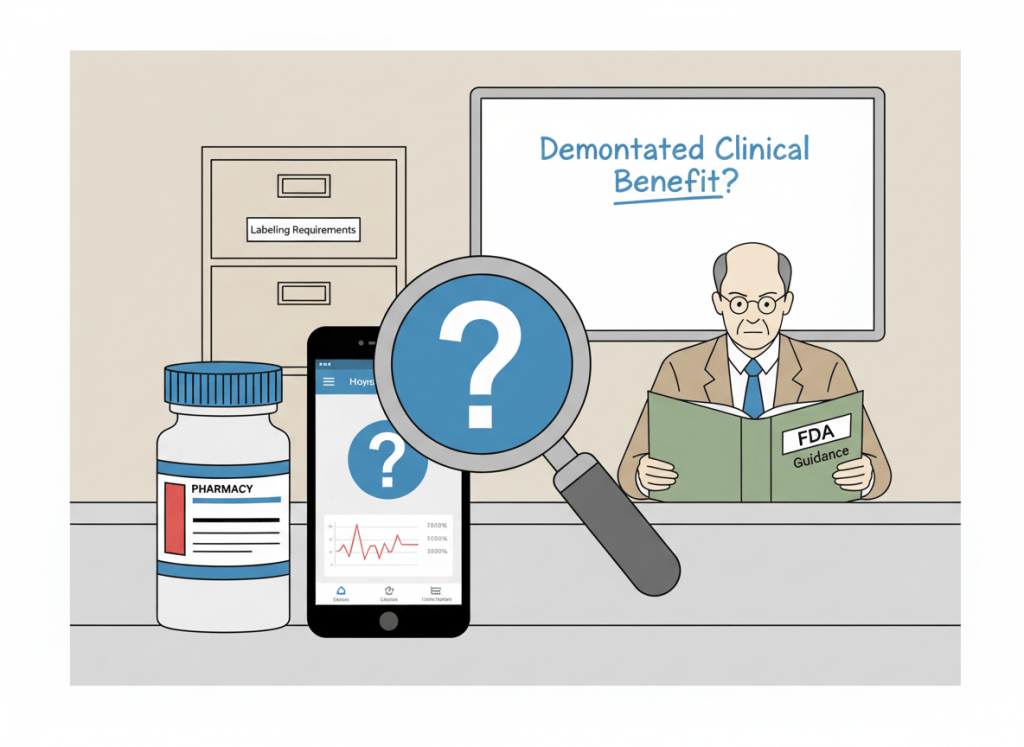
The agency has clarified how pharmaceutical companies must handle software associated with prescription medications. The history of digital inhalers and ingestible sensors shows why the distinction between functionality and proven clinical benefit matters.
The Food and Drug Administration has finalized guidance governing software distributed alongside prescription medications, clarifying when digital applications belong in official drug labeling and when their content constitutes promotional material. The policy addresses an increasingly common feature of modern medicine: prescription drugs accompanied by applications that monitor treatment, track symptoms, or provide patients with additional information.
The more consequential question is not whether those applications work as software. It is whether they improve the medical outcomes associated with the drugs they accompany.
The FDA’s October 2026 guidance, described in the Federal Register notice published October 21, finalizes guidance first proposed in September 2023.
The guidance distinguishes software connected to medical devices from standalone applications offering services such as medication reminders, symptom tracking, and health coaching.
Device-connected software generally should be described in the drug’s official prescribing information. Standalone applications ordinarily warrant inclusion when they are essential to safe and effective treatment or when evidence demonstrates meaningful improvement in a clinical outcome.
In most circumstances, information generated for patients by companion applications is considered promotional labeling, subject to existing federal drug-labeling requirements.
The distinctions may appear technical, but they determine how manufacturers present digital features to physicians and patients, what supporting evidence is expected, and how the FDA reviews the information those applications produce.
A Digital Inhaler and an Unproven Benefit
The history of Teva Pharmaceuticals’ Digihaler products illustrates the difference between incorporating digital technology into medication delivery and demonstrating that the technology improves treatment outcomes.
In December 2018, the FDA approved ProAir Digihaler, an albuterol inhaler equipped with sensors capable of recording information about inhaler use. The associated mobile application allowed patients to review inhalation information and share data with healthcare professionals.
The system offered capabilities beyond those of a conventional inhaler, but the prescribing information acknowledged an important limitation. Use of the application was not necessary to administer the medication, and clinical benefits attributable to the application had not been established.
Researchers subsequently evaluated the digital inhaler system in clinical studies.
A randomized trial known as CONNECT2, published in 2023, examined outcomes among 391 patients with uncontrolled asthma over 24 weeks. The investigators reported findings favoring the digital inhaler system, although the reported credible interval for a principal treatment comparison included the possibility of no difference.
The study provides evidence relevant to digital treatment support, but it does not independently establish that the companion application, separated from the broader inhaler system and associated interventions, improved clinical outcomes.
In June 2024, Teva discontinued U.S. distribution of its Digihaler products, including ProAir Digihaler, ArmonAir Digihaler, and AirDuo Digihaler. The company also discontinued the associated mobile application and healthcare-provider dashboard.
Patients could continue using existing inhalers until their expiration dates because medication delivery did not depend on the application.
The episode raises a question that extends beyond Teva’s products. When digital functionality accompanies a prescription medication, what happens to the information and services associated with that functionality when the manufacturer withdraws the software?
The new FDA guidance concentrates on labeling and submission requirements. It does not establish a comprehensive software-continuity policy addressing every consequence of discontinued companion services.
When Monitoring Does Not Establish Better Treatment
Another example comes from Abilify MyCite, a drug-device combination incorporating aripiprazole tablets with an ingestible sensor.
The system was designed to record medication ingestion through associated electronic components and software. Its FDA-approved labeling, however, distinguished the ability to detect ingestion from evidence that the technology improves medication adherence or supports changes in drug dosing.
Those benefits had not been established in the labeling.
The distinction is important. A system capable of recording an event does not necessarily establish that collecting the information improves a patient’s treatment.
The labeling also cautioned that ingestion detection could be delayed or fail, making the technology unsuitable for emergency or real-time monitoring.
Abilify MyCite and Digihaler involve different technologies and regulatory histories. Neither example establishes that a manufacturer violated FDA requirements.
Together, however, they demonstrate why the agency’s new guidance distinguishes the existence of a digital feature from evidence of meaningful clinical improvement.
What the FDA Changed
The final guidance introduces a decision tree to help manufacturers determine whether software output constitutes FDA-required labeling or promotional labeling.
It also provides examples of how software functions should be described in official prescribing information.
One notable revision concerns device-connected software for which meaningful improvement in a clinical outcome has not been demonstrated. FDA recommends additional prescribing-information language addressing that limitation.
The agency also distinguishes whether software is necessary for safe and effective drug use from whether it provides a clinical benefit. These are separate questions, and the absence of one does not automatically establish the absence of the other.
The distinction matters because software may provide information or convenience without being necessary to administer medication. Conversely, a software function may be essential to a particular drug-device system without having demonstrated an additional improvement in clinical outcomes.
The guidance does not prohibit pharmaceutical manufacturers from offering optional companion applications. Nor does it authorize unsupported claims about their benefits.
Instead, it describes how existing drug-labeling requirements apply to information generated by software distributed by manufacturers or on their behalf.
The guidance is nonbinding and permits alternative approaches consistent with applicable laws and regulations.
Industry Wanted Greater Clarity
The FDA’s proposal generated questions about how broadly the agency should treat software-generated information as prescription drug labeling.
In comments on the 2023 draft, Eli Lilly argued that broadly classifying disease-management software as promotional labeling could impose unnecessary regulatory burdens on functions such as symptom tracking and lifestyle management.
The Digital Therapeutics Alliance also sought greater clarity concerning the clinical evidence manufacturers could use to support software-related claims, including the potential role of real-world evidence.
These concerns illustrate the regulatory challenge.
Manufacturers want sufficient flexibility to develop and update digital products without subjecting every software feature to unnecessary review. FDA, meanwhile, must apply existing drug-labeling requirements to information that can change more frequently than traditional printed prescribing materials.
Software that adapts to individual patients complicates that task further.
A printed medication guide presents relatively fixed information. An application may generate individualized messages, interpret patient-entered data, or change its output following a software update.
The resulting regulatory question is how manufacturers and FDA distinguish ordinary software changes from modifications that alter information patients or healthcare professionals use to make treatment decisions.
The Limits of Regulatory Clarity
FDA’s guidance addresses when software-generated material must be submitted for agency review, including circumstances in which promotional content is submitted under existing requirements.
That process should not be confused with FDA approving every message displayed by a companion application before a patient receives it.
Promotional labeling generally operates under a different submission framework from FDA-required prescribing information, and separate medical-device requirements may apply to particular software functions.
The October guidance clarifies the agency’s interpretation of those overlapping responsibilities, but it does not establish that every digital feature has undergone clinical testing demonstrating better patient outcomes.
The question becomes especially significant when software moves beyond recording medication use and begins influencing dosing, treatment selection, or other clinical decisions.
Whether those functions require additional device oversight depends on their intended uses and applicable regulatory requirements.
For patients and healthcare professionals, the essential distinction remains straightforward. A digital feature may be technologically capable, clinically useful, or necessary for administering a medication. Those are different propositions, requiring different supporting evidence.
An Accountability Question Beyond the App Store
The FDA’s new guidance provides pharmaceutical manufacturers with a clearer explanation of how software fits within existing drug-labeling requirements.
What it does not do is eliminate the need to scrutinize the evidence behind digital treatment claims.
The experiences of Digihaler and Abilify MyCite show that sophisticated medication-monitoring technology can reach the market with explicitly acknowledged limitations concerning demonstrated clinical benefits.
They also show why the continued availability of software services deserves attention when digital features are offered alongside prescription medications.
The FDA has clarified how manufacturers should describe those features. The next accountability question is how consistently the agency evaluates the evidence supporting them, monitors changing software output, and ensures that patients understand what the technology has, and has not, been demonstrated to accomplish.
A companion application can record an inhalation, document a swallowed tablet, or remind a patient to take medication. Whether doing so improves treatment is a different question, and one that deserves an answer grounded in clinical evidence rather than the mere presence of an app.

