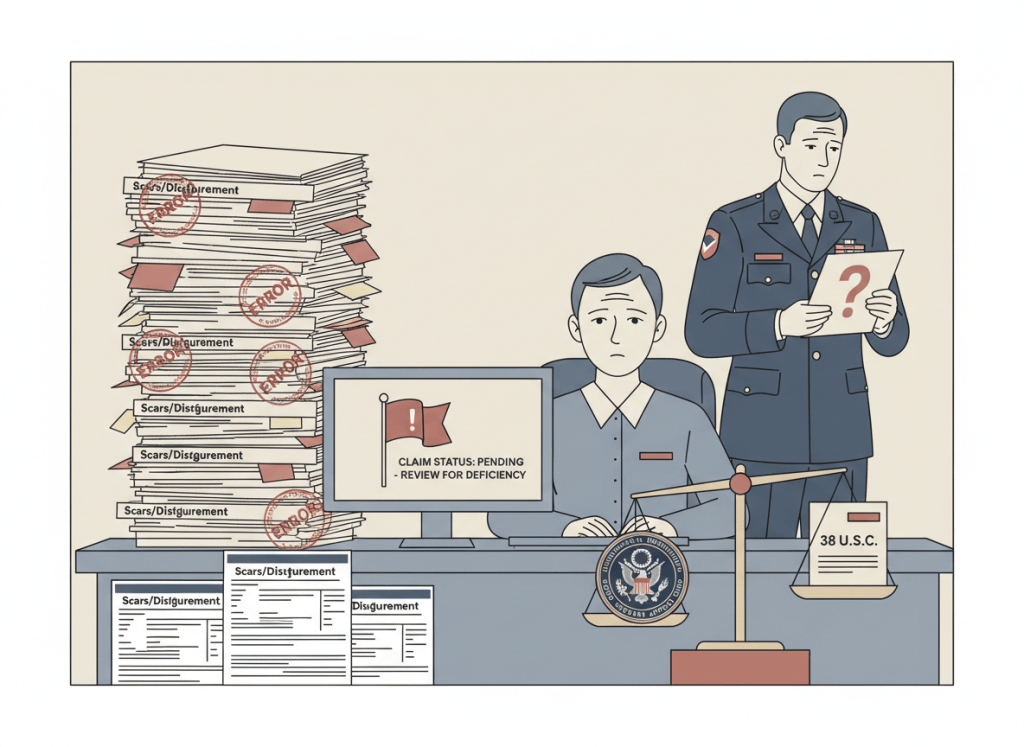
The Department of Veterans Affairs has a problem with disability decisions involving painful scars. According to its inspector general, the agency made errors in an estimated 17,900 decisions over a one-year period, producing at least $5.6 million in estimated overpayments. But whether veterans who received those payments could be required to return the money is another question entirely.
That distinction is absent from the headline numbers in the October 21 report, which examined how the Veterans Benefits Administration evaluates scars caused or aggravated by military service.
The Office of Inspector General estimated that approximately 38 percent of the relevant decisions completed between June 2024 and May 2025 contained at least one error. Its findings implicated confusing medical examination forms, inadequate software safeguards, and failures by claims processors to apply existing disability evaluation requirements.
The mistakes did not all favor the government or the veterans. Some resulted in excessive compensation, while others involved failures to assign separate evaluations to veterans whose previously service-connected scars had become painful.
For an agency responsible for determining how much compensation disabled veterans receive, the findings raise questions extending beyond accounting accuracy.
Thousands of errors, but not thousands of confirmed debts
The OIG examined a statistical sample of 130 disability decisions involving painful scars. Seventy concerned grants of service connection, while 60 involved increased evaluations for previously recognized disabilities.
From those samples, investigators projected approximately 17,900 erroneous decisions across the review population. They estimated that at least 920 decisions produced approximately $5.6 million in overpayments.
The $5.6 million figure is a statistical lower-bound estimate of questioned costs, not a tally of debts individually established against veterans. Nor does it establish that the government is legally entitled to recover those payments.
That distinction matters under federal veterans benefits law.
Under 38 U.S.C. § 5112(b)(10), certain erroneous awards attributable solely to VA administrative error or error in judgment receive special treatment when the agency determines the effective date of a reduction or discontinuance.
When the provision applies, VA generally cannot retroactively create an overpayment for the period covered by the protected award. Whether it applies depends on the circumstances, including whether the veteran contributed to the error or knew, or should have known, that the payments were incorrect.
The OIG’s findings raise the possibility that some erroneous payments could fall within that protection. They do not establish that every affected veteran qualifies.
The report does not identify how many, if any, veterans have received debt notices or been subjected to recovery actions arising from these decisions.
A paperwork problem with financial consequences
The inspector general identified approximately 7,400 decisions in which claims processors lacked the objective evidence required by VBA procedures to support a painful-scar evaluation.
Under the procedures examined by the OIG, a veteran’s report of pain generally needed support from documented physical findings, such as tenderness during an examination.
The problem was partly administrative. Claims processors told investigators that the Scars/Disfigurement Disability Benefits Questionnaire, the form used to document medical examinations, was confusing.
Investigators found that the questionnaire did not clearly distinguish subjective complaints from the objective evidence required by agency procedures.
Another estimated 5,500 decisions involved improper use of multiple diagnostic codes for painful scars. Federal disability evaluation rules generally prohibit compensating the same manifestations of a disability more than once, a practice known as pyramiding.
VBA’s electronic rating system already contained safeguards against certain duplicate evaluations for other disabilities. The corresponding protection for painful scars was inadequate during the review period.
The agency reported implementing a new warning in April 2026.
Meanwhile, approximately 1,300 decisions involved failures to assign separate evaluations when previously service-connected scars became painful.
The OIG found no underpayments resulting from the errors it reviewed, although some decisions did not comply with evaluation requirements.
VA disputes the projections
The Veterans Benefits Administration challenged the inspector general’s presentation of its findings.
In comments reported by Stars and Stripes, VA press secretary Quinn Slaven emphasized that the inspector general examined 130 decisions and identified seven cases involving benefit overpayments before projecting broader problems.
The agency questioned the reliability of drawing population-wide conclusions from those cases.
The OIG defended its statistical methodology, which used separate samples of grants and increased evaluations to estimate errors across the relevant populations.
The two positions address different measurements. Seven is the number of overpayment cases identified in the sample. Approximately 920 is the OIG’s minimum population estimate derived from its statistical analysis.
The distinction does not make either figure interchangeable with the other.
The OIG also examined 30 additional decisions completed in January 2026, finding errors in approximately 43 percent. That follow-up suggested the underlying problems had persisted beyond the original review period.
Correcting an error can create another problem
The VA has encountered difficulties with compensation debt collection before.
In a September 2022 investigation, the inspector general found that some veterans were not provided legally required notice and procedural protections before VA collected compensation debts.
Among the documented cases was a veteran whose compensation was withheld after agency employees had indicated that a debt resulting from VA administrative mistakes would not be collected.
The earlier investigation does not establish that similar misconduct has occurred in the painful-scar cases. It does, however, demonstrate why correcting disability decisions and recovering money from veterans require separate scrutiny.
Under 38 CFR § 3.105, certain proposed reductions in disability evaluations require advance notice and an opportunity to submit evidence.
When VA establishes a debt, 38 CFR § 1.911 provides additional notification and procedural requirements. Veterans may dispute a debt’s validity or amount and, where eligible, request a waiver of collection.
Those protections do not mean that every erroneous payment is exempt from recovery. They mean the government must determine whether a legally valid debt exists before treating an accounting error as money owed by a veteran.
The question is particularly important when the original mistake arose from the agency’s own documentation, software, or claims processing.
Corrective action remains unfinished
VBA agreed with all three recommendations in the October report.
The agency revised its Scars/Disfigurement Disability Benefits Questionnaire and provided a schedule for implementation, with release tentatively planned for January 2027.
The OIG closed that recommendation because VBA had initiated the revision and supplied a timeline. Closure did not mean the revised questionnaire had already been deployed.
Two recommendations remained open as of the report’s publication.
They concern correcting the erroneous decisions identified by investigators and ensuring that employees understand how to evaluate painful scars accurately.
VBA has indicated that it will reexamine the incorrect decisions identified by the OIG. The report does not establish whether the agency intends to conduct a broader review of the thousands of additional decisions projected to contain errors.
It also does not establish whether the new software warning has measurably reduced mistakes.
Those are significant omissions from the public record, particularly because the inspector general concluded that erroneous payments would continue accumulating until corrective action was taken.
The question behind the $5.6 million
The inspector general’s findings establish a serious administrative problem. They do not establish widespread veteran misconduct, nor do they demonstrate that thousands of beneficiaries knowingly received compensation to which they were not entitled.
The report instead describes a disability evaluation process in which the agency’s own forms, software, and claims-processing practices contributed to inaccurate decisions.
Federal law recognizes that mistakes made solely by the government may require a different remedy from mistakes attributable to beneficiaries.
Whether VBA will apply that distinction to the painful-scar decisions remains unresolved.
The agency faces two obligations that are not necessarily in conflict: correcting disability evaluations that violate governing requirements and ensuring that veterans are not improperly held financially responsible for errors they did not cause.
For the approximately 538,000 veterans receiving benefits for service-connected painful scars as of July 2026, the distinction between an inaccurate rating and a collectible debt is more than an accounting technicality.
The government can correct its paperwork. Whether it can send the bill to the veteran is a separate legal question.

