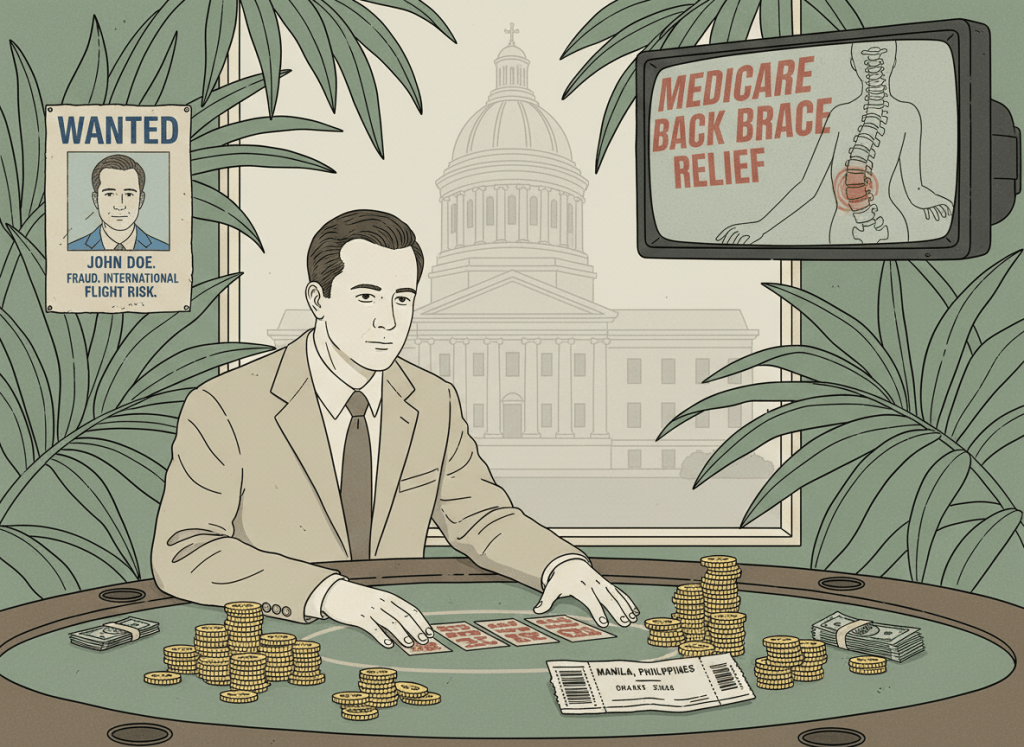
The Scoreboard
On Monday, a federal judge in Columbia, South Carolina, sentenced Herbert Leon Kimble to 20 years in prison. The case began with a plea deal that promised him none.
Kimble, 60, ran the Philippines call-center arm of a nationwide Medicare brace scheme. The Justice Department says he caused $365 million in fraudulent claims, that Medicare paid $199 million of them, and that he personally kept more than $195 million. He was ordered to repay the $199 million and forfeit the $195 million.
Those are three different numbers. Claims are what suppliers billed. Payments are what Medicare handed over. Profit is what Kimble kept.
Then there is the $1.2 billion. The FBI’s wanted notice credits his “enterprise” with more than $1.2 billion in Medicare charges. In June, Vice President JD Vance said Kimble was “costing taxpayers over a billion dollars.”
Inference: the $1.2 billion appears to be the network-wide figure from the 2019 takedown, not Kimble’s share. It rests on 2019 coverage that put the whole operation at $1.2 billion, and on DOJ’s own sentencing figure being less than a third of that. No document reviewed states the reconciliation outright.
A Commercial, a Call Center and a Co-Signer
The machinery was simple. Afternoon television ads asked Medicare-age viewers whether they wanted a back brace at little or no cost, and a toll-free number routed callers to the Philippines.
Call-center workers, known as “chasers,” collected the callers’ information. According to court documents described by the SC Daily Gazette, many callers had cognitive impairments such as dementia.
Doctors and nurses at telemedicine practices were paid to sign prescriptions, often for patients they never met. The signed orders were then sold to equipment suppliers, who billed Medicare.
Why did this run so long? The HHS Inspector General’s 2024 review of brace oversight offers a clue. It found providers ordering braces for people they had no treating relationship with, and new suppliers clustering in known fraud areas. It also found Medicare paying more than private insurers and suppliers using prohibited telemarketing.
A summary of the report says 92 percent of the $395 million paid to new suppliers in high-fraud areas was ordered by providers with no treating relationship. Medicare paid about $5.3 billion for braces from 2014 through 2020, according to OIG.
The scheme ran from about 2014 to March 2019, per the FBI. The 2019 takedown then hit 130 equipment firms that had billed Medicare $1.7 billion and been paid more than $900 million. A program that pays for orders signed by strangers, for patients who never asked, has built the fraud a runway.
A Deal, a Flight and a Casino
In April 2019, Kimble pleaded guilty. His agreement called for no prison time, based on his cooperation and a promise to pay $40 million. He also agreed to keep assisting investigators through at least 2029.
The cooperation was real. Per the Gazette, he held wiretapped interviews with business partners and turned over his company’s financial records. More than 80 people have been charged in the scheme, prosecutors say.
Prosecutors defended the deal in a 2022 filing as a “binary choice.” Wealthy defendants living where they cannot be extradited rarely face prosecution at all, the government argued, so it was probation and cooperation or nothing. The judge later said he had serious reservations about the agreement.
Then Kimble stopped showing up. He skipped a status conference and two sentencing hearings in 2024. The judge ruled he had breached the deal and released the government from it. Prosecutors said he had also stopped the required quarterly check-ins with law enforcement.
By then he had paid about $7.75 million of the promised $40 million.
He spent nearly two years in the Philippines. In June 2026, days after he was added to the FBI’s Most Wanted Fraudsters list, he was in custody. DOJ says he was “apprehended” and “returned.”
Philippine immigration officials say their fugitive unit arrested him in Pasig City and deported him. The lead prosecutor says the arrest happened at a casino. It was a deportation, not an extradition, the route prosecutors had called difficult in 2024.
He pleaded guilty again in August to conspiracy and three failure-to-appear counts. The new plea stipulated a sentence of 15 to 20 years. Prosecutors asked for 20, the maximum.
Inference: most of the 20 years reflects the flight, not the fraud. It rests on FITSNews’ description of the plea, which reports a five-year maximum for the conspiracy and five years for each failure-to-appear count, served consecutively. Five plus three times five is 20, so at least 15 years would sit on the failure-to-appear counts. The count-by-count breakdown has not been reported.
Forty Million Dollars Is Not a Rounding Error
In 2019, according to his attorneys, the $40 million figure was what Kimble was estimated to have in money and real estate. DOJ now says he profited more than $195 million. Court testimony in an earlier proceeding put his take near $230 million.
The only explanation on the public record for the missing money comes from his own side. His lawyer, Jim Griffin, told the court that Kimble gave $10 million to a concert promoter who promised $17 million back and delivered nothing. Kimble told the court he panicked when he realized he could not pay.
Griffin says Kimble has repaid $9 million toward restitution, plus the $5 million bond. He called that a small fraction of what is owed. The Gazette reports it is unclear how Kimble can pay the rest.
The sentencing release does mention one purchase: a luxury condominium at the Shangri-La hotel in the Philippines.
Three questions remain unanswered:
- How was the $40 million asset estimate verified in 2019, and what changed once investigators priced his profit at $195 million?
- How did the $1.2 billion in charges the FBI attaches to Kimble become $365 million in attributed claims?
- Where did the rest of the roughly $195 million go, and how much of the $199 million in restitution can realistically be collected?
Inquiries on these questions are being directed to the U.S. Attorney’s Office for the District of South Carolina and to Kimble’s defense counsel.
The government can say it found him. It has been much quieter about what he was found with.

