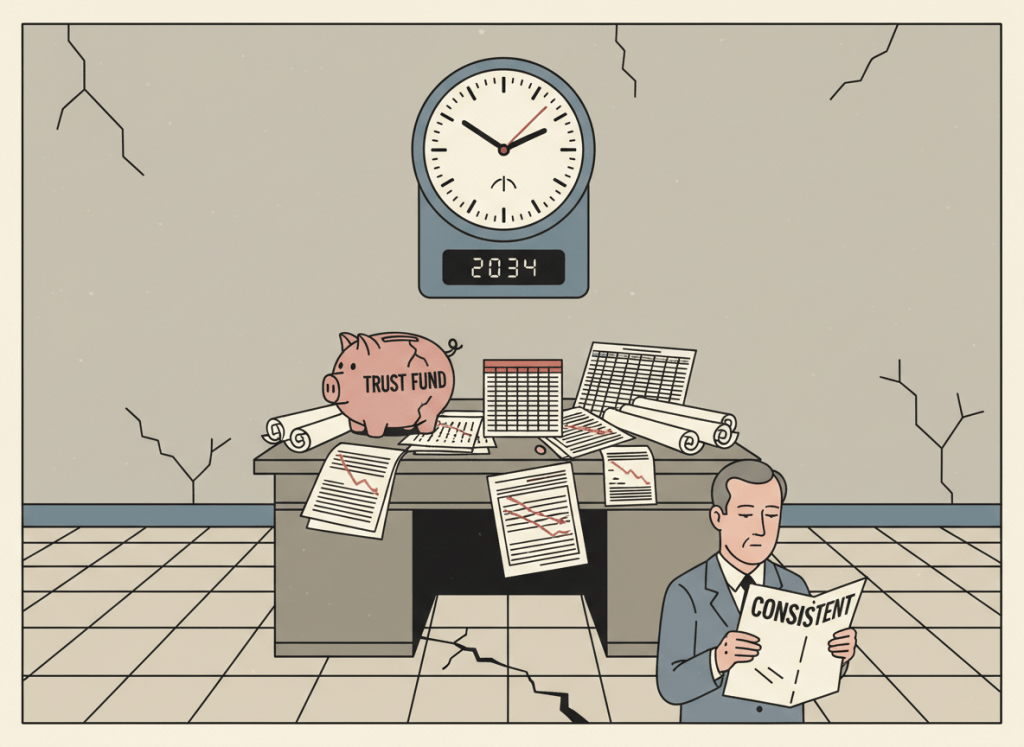
The agency’s headline called it consistent. The actuaries’ own slides tell a different story.
Social Security’s trustees delivered this year’s report the way agencies prefer: lead with the number that didn’t change. Combined trust fund depletion stayed at 2034. SSA’s release was headlined to say the combined projection remained consistent with the prior year.
Consistent, much like a house with a cracked foundation is consistent, so long as nobody repaints.
Underneath, the 75-year deficit jumped from 3.82% of payroll to 4.42%. The Committee for a Responsible Federal Budget calls that the largest since 1977, equal to about $31 trillion in present value.
The retirement fund now runs dry in the fourth quarter of 2032, one quarter sooner.
The 2034 date is a legal fiction
It only works if Congress merges the retirement and disability funds, which requires a change in law. Without that, the Trustees say the retirement fund alone could pay 78% of benefits at depletion.
At this week’s Society of Actuaries conference, an SSA briefing deck repeated the 83% combined figure. The 78% never appeared. Neither did the caveat.
The long view is bleaker. The deck shows 65% of scheduled benefits payable by 2100. The June version of the same deck put last year’s figure at 72%.
The 2034 figure did improve, from 81% to 83%. Congratulations are in order for a cut that arrives slightly smaller.
What changed
Three things drove the 0.60-point slide: lower assumed fertility (-0.35), lower assumed immigration (-0.21) and the One Big Beautiful Bill Act (-0.16). A better near-term economy clawed back 0.10.
The immigration line is mostly about the unlawfully present population. Enforcement policy now has a price tag in the actuarial balance.
The OBBBA’s share deserves a second look next time someone says Social Security is now tax-free. One analysis finds the cost comes almost entirely from the permanent rate and standard deduction changes, not the senior deduction that expires in 2028.
Fine print
The disability fund never depletes, credited largely to low applications and awards. Low numbers can mean fewer people need help. They can also mean fewer people get it. The deck doesn’t say which.
The deck’s “myths” slides cite a $30 million figure for billionaire benefits and claim wage growth would have to triple to close the gap. No sources are given for either.
The June briefing admitted that how a benefit cut would actually be carried out was “TBD.” That line did not make the October edition. Presumably it was settled in the interim.
Inquiries are being directed to SSA and Treasury, whose Secretary is the Trustees’ managing trustee. Among the unanswered questions:
- How would benefits actually be reduced at depletion, and why was the “TBD” admission cut from the latest deck?
- Why does the deck present the 83% figure without the 78% retirement-fund-only figure or the legal condition it depends on?
- What are the sources for the billionaire-benefit and wage-growth claims?
The deck advises Congress to act by 2034, or 2032 for the retirement fund. Congress has been advised before.

