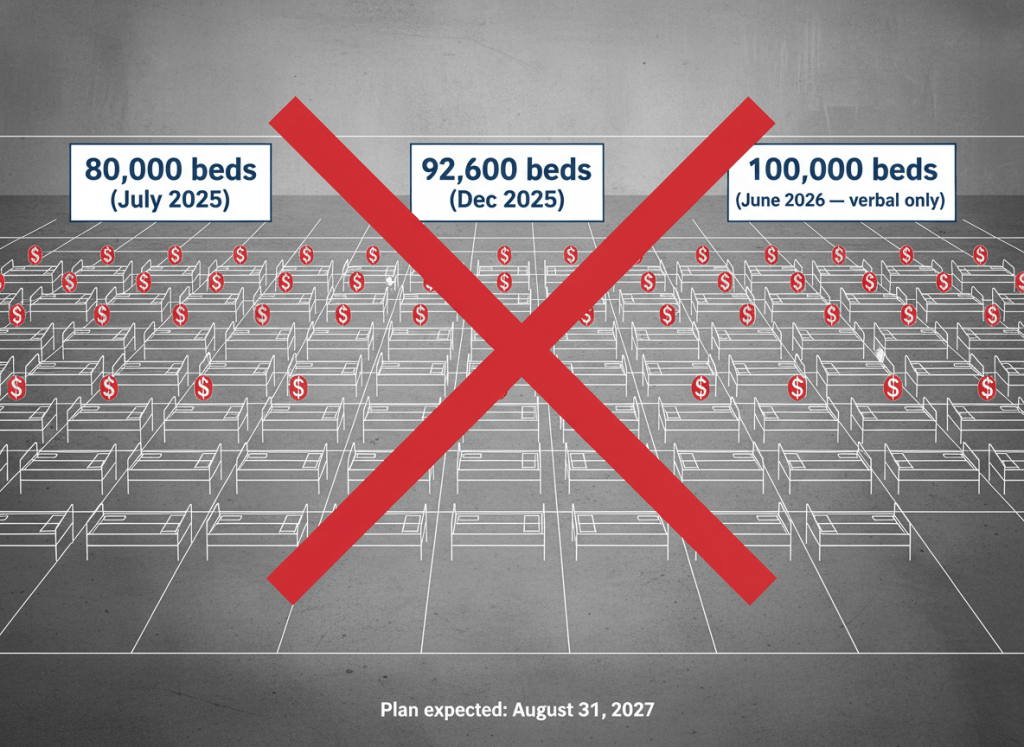
The Number That Keeps Moving
Here is a question you would think somebody at Immigration and Customs Enforcement had answered before the agency started spending forty five billion dollars. How many detention beds does ICE actually need? As of this month, the honest answer is that ICE has given at least three different numbers, and none of them appear in the same document twice, according to a new GAO report examining the agency’s detention expansion since January 2025.
In July 2025, DHS told the public that funding from the One Big Beautiful Bill Act (OBBBA) would support roughly 80,000 new detention beds. Seven months later, ICE’s own warehouse initiative paperwork cited a target of 92,600 beds. By June 2026, ICE officials were telling GAO investigators, verbally, that the administration’s real goal was 100,000 beds, a figure that appears nowhere in ICE’s actual documents. Three numbers, three different sources, zero reconciliation.
This is not a rounding error. ICE’s average daily detained population rose 71 percent between January 2025 and July 2026, from 39,314 to 67,180, while the number of authorized detention facilities roughly doubled, from 134 to 272. That is the kind of growth that normally comes with a plan attached. GAO’s Program and Project Management Guide treats a clearly stated goal as the first prerequisite for managing a large investment responsibly. ICE skipped it and kept spending anyway, and GAO’s report, Immigration Detention: Urgent Planning Needed to Avoid Further Waste of Taxpayer Dollars, spends thirteen pages documenting what that produced.
A Contract Is Optional If You Just Don’t Sign One
Consider the Florida Soft Sided Facility, the tent complex at a former training airport in Ochopee known to most people as Alligator Alcatraz. The state of Florida opened it in July 2025. ICE never signed a contract or intergovernmental agreement authorizing it as a federal detention facility; officials instead pointed to an existing 287(g) agreement with Miami Dade County that, per GAO, does not mention the facility at all. ICE used it anyway, processing and housing every male detainee in the state there before transfers or removals, at an average population of 1,386 people through fiscal year 2026.
Skipping the contract meant skipping the part where ICE negotiates a price. The facility ended up reimbursed through a FEMA grant program at $249 per detainee per day, 171 percent above ICE’s own median bed rate of $92. Then in January 2026, DHS’s Inspector General inspected the facility and found it did not meet basic detention standards, including insufficient living space and recreation time. The facility closed in June 2026. Baker Correctional Institution, a nearby facility ICE also uses without a contract, gets the identical $249 rate under the same arrangement, an average daily population of 959 people billed at nearly triple the going federal rate, negotiated by nobody.
Eleven Warehouses, Four Wanted, One Billion Spent
In December 2025, ICE launched what it called the Detention Reengineering Initiative, an effort to buy and renovate warehouses nationwide, 24 of them eventually, some as 1,500 bed processing centers, others as 10,000 bed long term facilities. Between January and April 2026, ICE bought 11 of them for about $1.07 billion. Then in June 2026, the Secretary of Homeland Security announced that DHS was re evaluating the whole model because it had never done proper due diligence in the first place, and ICE started trying to sell seven of the eleven warehouses back.
The nonrecoverable costs, zoning assessments, title insurance, do not come back with the property. ICE reports $7.7 million spent on those alone, plus another $12.8 million so far just keeping the lights and security running at buildings the agency is actively trying to unload. If the sale price comes in under the $707 million ICE paid for those seven, that gap is additional waste, and GAO does not sound optimistic about the resale market for purpose modified detention warehouses. Meanwhile the four warehouses ICE is keeping have their own problem; renovation contracts worth $113 million in Maryland and $313 million in Arizona are largely on hold because the state attorneys general in both places sued over the missing environmental review that should have happened before construction started, not after.
Separately, in July 2026, ICE spent another $1.5 billion buying two existing detention facilities outright, a decision GAO says was made without any assessment of what it will cost to own and operate them once the current multi year funding runs out.
The Plan Arrives in 2027. The Money Left in 2025.
GAO’s recommendation is almost insultingly modest. ICE should write down its goals, its planned activities, and what it will cost, before spending any more of the money. DHS agreed. DHS’s timeline for delivering that plan is August 31, 2027, nearly two years after the executive order that started this spending spree and roughly a year and a half after most of the money GAO is describing had already gone out the door.
GAO’s own line on this, tucked into the agency’s usual understated register, is that “more timely completion may be warranted.” That is about as close as a federal auditor gets to saying the plan is showing up to the fire after the building has finished burning down. ICE has, by GAO’s own count, already scaled back four of its six new detention expansion initiatives since January 2025, among them Guantanamo Bay, where DOD spent $2.85 million assembling tents that never held a single detainee before being torn down; Camp East Montana, where ICE paid $7.1 million for meals nobody ate because the Army never bothered to write flexible pricing into the contract; the warehouses; and the Florida facility, now closed.
None of this required hindsight to predict. It required somebody to write down a number and a plan before the checks went out. ICE has forty five billion dollars and counting through fiscal year 2029, and by GAO’s account, still does not know how many beds it is buying, what those beds should cost, or what happens to any of it once the money stops.

