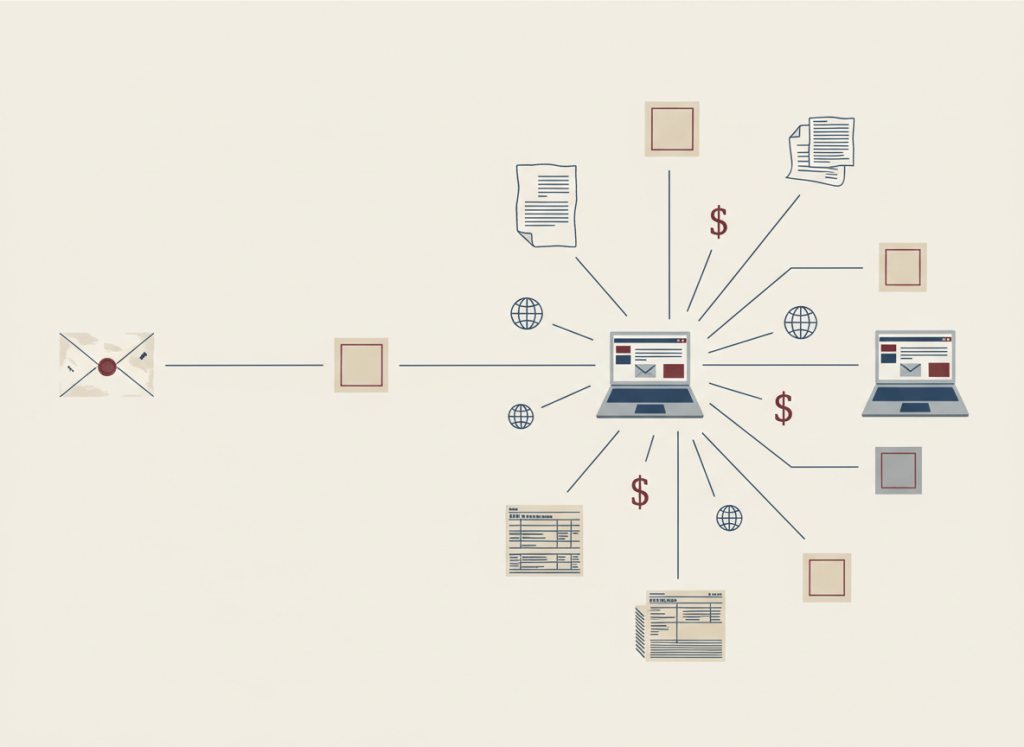
An unsolicited election email claimed public voter records identified its recipient as an American with overseas connections. A Bureaucracy Times investigation traced the message’s technical origins and uncovered millions in nonprofit funding, Democratic-aligned financial relationships, shared advertising contractors, and an extensive overseas-voter outreach operation. But where did the recipient’s information come from?
On September 4, 2026, an email arrived with an unusual subject line: “Outside the U.S.? You can vote in 2026.” The message came from an organization calling itself US Voters Abroad. It offered to help the recipient register to vote and request an absentee ballot from overseas.
There was one problem. The recipient was not living overseas.
The November 4, 2026 midterm elections are now three weeks away.
“You’re receiving this message because public voter records list you as a U.S. voter with an overseas connection.”
It was addressed personally, referenced Virginia’s election procedures, and was signed by Michael Peñuelas, executive director of the Center for U.S. Voters Abroad (CUVA). Peñuelas is listed as executive director on the organization’s own website; prior to leading CUVA he was a legislative assistant to Washington state Representative Sharon Shewmake and, as a Stanford undergraduate, led the Fossil Free Stanford divestment campaign. He appeared on an America Votes 2024 State Summit agenda, a coalition that supports Democratic voter-registration efforts.
The footer repeated the assertion that public voter-file records identified the recipient as someone who might be eligible to vote from overseas.
What public voter records had identified this American as having an overseas connection?
Who had obtained those records?
And how had that information found its way into a campaign encouraging participation in the November 2026 election?
Bureaucracy Times began investigating.
The inquiry eventually extended through nonprofit tax filings, Federal Election Commission records, political grantmaking, advertising contractors, voter-registration technology, university partnerships, and a Virginia Freedom of Information Act request. Months later, the original email was recovered in its complete electronic form. Its technical contents supplied a new layer of evidence, while sharpening the distinction between what could be proved and what remained unknown.
Inside the email
Unlike a screenshot or forwarded message, the original email file preserves message headers, transmission records, HTML content, and embedded links. Those records establish that the September 4 solicitation was transmitted using Amazon Simple Email Service (SES).
The message originated from hello@centerusvotersabroad.org and passed Gmail’s SPF, DKIM, and DMARC authentication checks. Its headers identify an Amazon SES outbound server at 54.240.9.67, with Gmail recording delivery at approximately 1:03 p.m. Eastern. These results support the conclusion that the message was sent through infrastructure authorized to use the organization’s domain. They do not identify who assembled the mailing list or initiated the campaign.
The ballot-request URL contained four campaign parameters:
utm_source=coldemailutm_medium=emailutm_campaign=vf_email_rct_2026utm_content=flight1
The “flight1” content label suggests this message was the first in a planned series of outreach waves. Whether subsequent flights were deployed, and whether the recipient was targeted by them, is not established by the available records.
The sender’s own metadata classified the outreach source as “coldemail.” That label does not establish how the recipient’s address was acquired, but it corroborates that the message was configured as an outbound solicitation. The campaign identifier and content label suggest a structured outreach campaign; their internal meanings remain unverified.
In particular, the letters “vf” do not definitively establish that Vote Forward supplied this mailing list, though the article documents a confirmed outreach relationship between Vote Forward and CUVA elsewhere. The letters could equally stand for a voter-file data source, an internal project code, or Vote Forward itself. The record does not resolve which.
The string “rct” in the same campaign identifier warrants separate attention. In voter-outreach research, “rct” commonly refers to a randomized controlled trial, which is a structured experiment in which recipients are divided into test and control groups to measure the effect of a contact.
If that is the intended meaning here, it suggests the recipient may have been enrolled as a subject in a research study, not merely targeted as a prospective voter. That would be a materially different and more significant finding than routine outreach. The internal meaning of the identifier is unverified.
The ballot-request link also contained a hexadecimal t= parameter whose purpose is unverified. Its full value is withheld because it may identify an individual recipient or referral.
Even the government link was tracked
The message offered a path through CUVA’s ballot-request service and another through the government’s FVAP.gov site. In the HTML version, both links were routed through t.centerusvotersabroad.org. The message also contained an invisible one-pixel image hosted through that tracking infrastructure.
Those elements show that the email was configured for message-level interaction tracking, including clicks and potentially opens. They do not prove that the recipient clicked, that every open was accurately recorded, or that engagement records were shared with political advertisers. Even the link visibly labeled FVAP.gov was configured to pass through the sender’s tracking domain.
The native message has been preserved as source evidence. Complete tracking URLs and message-specific identifiers are retained in the investigative record rather than reproduced publicly, to avoid exposing recipient-specific identifiers or generating additional campaign interactions. The forensic evidence establishes how the email was delivered and how engagement could be measured. It does not explain why the recipient was classified as an overseas voter.
Two nonprofit organizations, one public-facing brand
The Center for U.S. Voters Abroad (CUVA) presents itself as a nonpartisan voter-assistance organization. Its published materials identify two related legal entities: Act Now Project, EIN 92-2517254, a 501(c)(4) social-welfare organization doing business as CUVA, and Act Now Coalition, EIN 85-0613766, a 501(c)(3) charity doing business as the Center for U.S. Voters Abroad Foundation.
The distinction matters. A 501(c)(3) cannot intervene in candidate elections, whereas a 501(c)(4) can undertake certain political activities subject to applicable restrictions. Even so, affiliated charitable and social-welfare organizations are not inherently improper. The question is whether their activities and resources are appropriately separated.
Act Now Coalition’s 2024 tax records report approximately $10.05 million in revenue and $7.50 million in expenses, including approximately $7.2 million in spending on a major overseas voter-registration and education program. Act Now Project separately reported approximately $4.52 million in 2024 revenue.
Historical records also connect the CUVA name to Hopewell Fund. A reported $335,600 Hopewell Fund grant went to Act Now Coalition in 2024. Hopewell Fund is a 501(c)(3) nonprofit that has been administered as part of the Arabella Advisors network, a Washington-based consulting operation that manages several fiscal sponsorship organizations associated with Democratic-aligned philanthropic funding. Arabella’s fiscal sponsorship operations were acquired by a successor entity, Sunflower Services, in late 2025. Available records did not establish whether any transition involved transferring voter databases, software, contracts, or other operational assets.
The funding network
Records associated with Future Forward USA Action, a politically active 501(c)(4), identify a $2.5 million grant to Act Now Project in 2024, following a reported $150,000 grant in 2023. The 2024 grant represented roughly 55 percent of Act Now Project’s annual revenue.
Future Forward USA Action also reported providing approximately $251.5 million to FF PAC in 2024. FF PAC was a major independent-expenditure organization supporting Kamala Harris. These were separate grants to separate organizations. The relationships do not establish that FF PAC controlled CUVA or that their activities were coordinated.
Federal law prohibits coordination between independent-expenditure committees and candidate campaigns, but it does not prohibit a single donor from funding both a voter-mobilization operation and a separate independent-expenditure committee. The legal question is whether the activities of those funded entities remained operationally independent.
Additional records reviewed during the investigation identified 2024 grants of $500,000 from Evidence for Impact and $400,000 from Bright Future Fund to Act Now Project. Together with the Future Forward USA Action contribution, those three reported relationships totaled $3.4 million, approximately three-quarters of Act Now Project’s annual revenue.
On the charitable side, reported grants included $470,000 from Marin Community Foundation and $140,000 from Educational Foundation of America for overseas-voter-related purposes.
The investigation also identified a $450,000 grant from Act Now Coalition to Act Now Project in 2023, described in tax-derived records as supporting a voter project. That establishes a direct financial relationship between the entities. Without the underlying grant agreement and detailed accounting, it does not establish that charitable funds were improperly spent on candidate-related activities.
The political spending was real
Under Federal Election Commission identification number C90022112, Act Now Project reported $54,663.83 in independent expenditures during the 2023–2024 reporting cycle. Transaction-level disclosures identified spending involving C Plus K LLC and Meta for digital advertising encouraging overseas Americans to register. Certain expenditures were reported as opposing Donald Trump.
In an August 2024 response to the FEC, Act Now Project said general-purpose donations, rather than donations earmarked for those expenditures, financed the spending. These records establish candidate-related political activity by the 501(c)(4). They do not establish unlawful coordination or improper financing by the affiliated charity.
One contractor serving both organizations
Financial records reviewed during the investigation identified C Plus K LLC (C+K) as an advertising contractor for both entities. Act Now Coalition reported approximately $1.9 million in 2024 advertising payments to the firm; Act Now Project separately reported approximately $143,000.
C+K describes itself on its own website as an agency with “roots in progressive politics and advocacy.” Federal Election Commission records show the firm has received payments from Democratic-aligned independent-expenditure operations including LCV Victory Fund, the political arm of the League of Conservation Voters, and WinSenate, a Democratic Senate super PAC. A shared commercial contractor is not evidence of misconduct. The unanswered questions concern whether advertising audiences, accounts, personnel access, costs, and voter data were maintained separately. Public filings identified the relationship and payments, but not the internal safeguards or any improper transfer.
Finding Americans abroad
The original email’s claim about public voter records prompted examination of the network’s outreach methods. One documented pathway involved Vote Forward, which described CUVA-associated letter campaigns sending federal ballot-request forms to thousands of identified Americans overseas and extensive cleaning of international mailing addresses before records were made available to volunteers.
That demonstrates organized overseas-voter contact records in at least one outreach channel. It does not establish where those records originated or that Vote Forward supplied the September 4 email list.
CUVA also developed relationships with universities and study-abroad organizations, distributing voter-assistance information through educational networks. Some published materials reported institution-specific conversion figures. Those metrics do not prove confidential student records were transferred or that each conversion became an accepted voter registration.
Other outreach channels included digital advertising, expatriate-focused creators, podcast sponsorships, and communications directed toward Americans living abroad. Multiple potential contact pathways existed; the public evidence does not establish which one produced this recipient’s classification.
The voter information question
CUVA’s January 2026 privacy disclosures describe processing names, contact details, citizenship-related information, U.S. voting addresses, and overseas addresses, as well as analytics and advertising technologies associated with Google and Meta. Its services also involve ongoing voter reminders and AI-supported customer service.
These disclosures raise legitimate questions about retention, consent, third-party access, and the boundaries between charitable assistance and political advertising. They do not establish that every disclosed practice occurred in every case or that sensitive registration data was improperly shared.
The recovered email strengthens one specific finding: tracking was not merely a hypothetical capability described in a policy. Tracked links and a tracking image were present in the original solicitation. That is direct evidence of tracking infrastructure, not proof of voter-data transfer to political advertisers.
From private software to public election offices
CUVA’s published services help eligible military and overseas voters prepare the Federal Post Card Application (FPCA), obtain state-specific instructions, and identify local election offices. The September 4 email promised that forms would go directly to those offices and that users would receive deadline reminders. That establishes what the organization represented, not how every individual form was transmitted or processed.
CUVA also invited reports of ballot-delivery problems and stated that it tracks such issues and raises them with election officials. It is not an election authority: it does not determine eligibility, maintain official voter rolls, or count ballots. But private software that generates official forms and directs users through election procedures warrants scrutiny for accuracy, transparency, and recordkeeping.
The investigation found no evidence that CUVA’s services caused unlawful registrations, duplicate voting, or improperly issued ballots.
Testing the Virginia voter-records claim
The email specifically referenced Virginia voting procedures. On September 5, 2026, Bureaucracy Times submitted a Freedom of Information Act request to the Virginia Department of Elections seeking records concerning requests for, purchases of, subscriptions to, or deliveries of voter-list products involving the parties named in the inquiry.
The department replied around September 15–16:
“Please note ELECT received no requests for, purchases of, subscriptions to, or delivery of voter-list products maintained by the Virginia Department of Elections from the requested parties. Therefore, ELECT has no records responsive to your request.”
Within the request’s scope, the department identified no responsive records documenting the specified direct transactions. That does not exclude commercial intermediaries, other sources of voter information, or self-submitted data. Nor does it establish how the sender concluded that the recipient had an overseas connection. The Virginia response meaningfully narrows one hypothesis: that CUVA or its affiliated entities obtained this recipient’s information directly from the Virginia Department of Elections. Within the scope of the FOIA request, that direct transaction is not supported by the record. What remains open is whether the recipient’s data reached the organization through a commercial voter-file vendor, a self-submission to a third-party service, or another source the request did not reach.
What we could prove, and what we couldn’t
The strongest findings were documentary: legal identities, major reported financial relationships, independent expenditures, a shared advertising contractor, outreach channels, and voter-assistance practices. The original email added authenticated Amazon SES delivery, cold-email campaign attribution, structured campaign identifiers, tracked links, and a tracking image. Virginia reported no responsive records for the specified direct voter-list transactions.
We could not identify the source of the recipient’s overseas-voter classification or the supplier of the September 4 mailing list. We could not establish improper sharing of voter information, funds, or audiences between the charitable and political entities; operational control by donors; or unlawful voting resulting from CUVA’s activities.
The evidence therefore does not support an allegation that CUVA operated an illegal voter-registration scheme. It supports a narrower, documented account of how a substantial overseas-voter outreach network was financed and operated, and where transparency remains incomplete.
The unanswered question
The September 4 email was not an anonymous message from an unknown server. It came from an identifiable organization, through authenticated commercial infrastructure, with campaign parameters and interaction-tracking technology embedded in its links.
The sender claimed public voter records identified the recipient as having an overseas connection. Our investigation reconstructed much of the financial and organizational network behind that message and established that Virginia found no responsive records for the direct voter-list transactions we asked it to examine. None of those findings establishes unlawful conduct.
Americans living abroad have legitimate voting rights, and private organizations may lawfully help eligible citizens exercise them. But when private organizations identify potential voters through purported public records, contact them through measurable digital campaigns, collect personal information, and assist with official election paperwork, data provenance and operational transparency are legitimate public concerns.
What information caused the organization to classify this particular American as someone with an overseas connection?
The email’s source code revealed the campaign that delivered the message. The financial records revealed much of the network supporting it. The Virginia FOIA eliminated one potential direct source of state voter-list records within the scope of the request. None disclosed the original data source or matching process.
That is where the evidence stops. The investigation did not uncover proof of a scandal. It uncovered a substantial, privately financed overseas-voter mobilization infrastructure and specific questions about its funding, contractors, data practices, and interactions with public election systems.
Sometimes an investigation establishes wrongdoing. Sometimes it disproves a theory. Sometimes it reveals a consequential system while leaving the initial question unresolved. This investigation produced the third result.
The email can now be authenticated, dissected, and traced to its sending infrastructure. What cannot yet be traced is the information that put its recipient on the mailing list.
Reporting methodology: Bureaucracy Times examined the original September 4, 2026 email in its native electronic format, including message headers, HTML, and embedded URLs; IRS-derived nonprofit filings and grant records; Federal Election Commission disclosures; published organizational and technical materials; outreach partnerships; and a Virginia FOIA response to a request submitted September 5, 2026. The original email and its technical identifiers have been preserved. Recipient-specific tracking URLs are not reproduced in full. Financial and organizational relationships are not presented as proof of unlawful coordination or misuse of voter information.

