The federal judiciary spent more than a billion dollars in rent last year, and nobody in the building can tell you whether anyone is using the space. Not because the technology doesn’t exist. Not because the data would be too expensive to collect. Because, in the words of officials at the Administrative Office of the U.S. Courts, they have not identified a “business need” to find out.
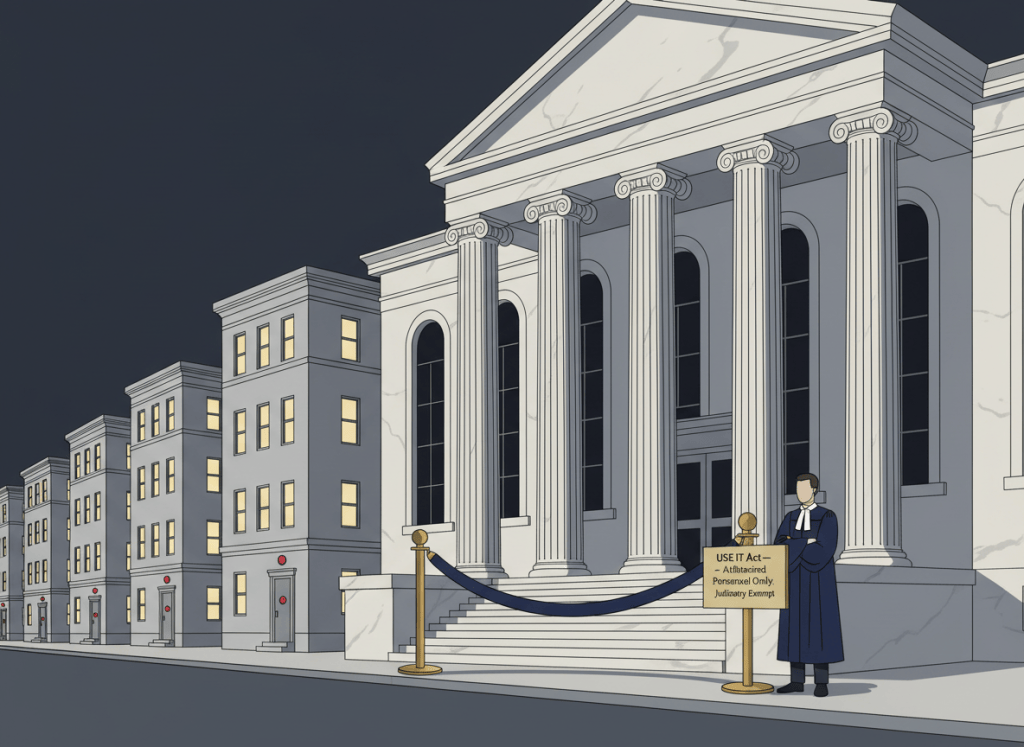
That phrase, buried in a new Government Accountability Office report, is doing an enormous amount of quiet work. It is the sound of an institution that watched Congress diagnose this exact failure in the executive branch, watched Congress legislate a fix, and then declined to apply the fix to itself on the technicality that the law never used the word “judiciary.”
A Diagnosis Written for Someone Else
The origin story here is almost too tidy. In October 2023, GAO found that seventeen of twenty four federal agencies were using a quarter or less of their headquarters capacity, a finding embarrassing enough that it fed directly into a recommendation that the Office of Management and Budget develop government wide benchmarks for measuring building utilization. Congress agreed the problem was real. In January 2025 it enacted the Utilizing Space Efficiently and Improving Technologies Act, better known by the acronym its drafters clearly enjoyed a little too much, USE IT, which now compels the twenty four agencies covered by the Chief Financial Officers Act to install occupancy tracking, calculate utilization rates against a 150 square foot per person benchmark, and hold themselves to a 60 percent minimum or start shedding space.
It is a real law with real teeth, summarized helpfully by the Congressional Research Service and now visibly enforced enough that GSA has begun publishing occupancy data for the agencies it covers. The judiciary read all of this happen in real time. It sits on the same High Risk List, for the same underlying reason, that GAO has maintained since 2003. And the USE IT Act simply does not apply to it, because the judicial branch is not one of the twenty four CFO Act agencies and Congress did not think, or did not choose, to reach across the separation of powers and say otherwise.
The Institution Grades Its Own Homework
So GAO did what it apparently now does whenever it wants to know whether a self governing branch of government is holding itself to the standard it just imposed on everyone else. It asked. Surveys went out to all thirteen judiciary circuit executives, the officials who oversee space decisions in every circuit in the country. The response rate was a genuinely impressive 100 percent. The answer, unanimous, was no. Not one court unit, not one federal public defender organization, anywhere in the federal judiciary, uses occupancy data from any of twelve listed sources, ranging from badge swipes to daily check in surveys to Wi Fi tracking, to regularly review how much of its space is actually occupied.
This is not a data collection failure in the sense of an agency trying and stumbling. It is closer to a policy choice dressed up as an operational limitation. AOUSC officials told GAO plainly that measuring utilization “is not part of the judiciary’s practices because it has not identified a business need to do so.” Some AOUSC officials privately thought it might be useful. Officials at the nine facilities GAO visited generally did not, preferring instead to report that they simply know their space is used, because they and their staff are there every day, a form of evidence that would not survive first contact with an auditor in any other line of work.
What the Space Actually Looks Like Up Close
GAO’s field visits supply the texture that survey data never does. At one facility, investigators photographed a cubicle installed inside a private office that was already sized to the U.S. Courts Design Guide’s standard for that employee’s role, the rest of the office having quietly absorbed a second, unrecorded function as a workroom. At another, a conference room had been split by an accordion partition, one half still hosting meetings, the other now somebody’s office, a solution officials described as faster and cheaper than doing it properly through GSA. At a third, GAO photographed a large, empty room that once held filing cabinets for more than 80,000 case files, destroyed after digitization; because nobody had records on how the room was actually used afterward, staff had to be assigned to sit in it for days just to log its activity by hand. That is the entire measurement system in miniature, a person, physically present, watching a room, because the alternative would require admitting the judiciary needs the same instrumentation everyone else was just ordered to install.
None of this is cheap improvisation born of poverty. Administrative space, the district clerks’ offices, probation offices, bankruptcy clerks’ offices, and federal public defender operations that keep the courts running, makes up 40 percent of the judiciary’s entire footprint and has held steady there since fiscal 2021, while rent for it rose $32.4 million in nominal terms over the same period. Ninety six percent of the commercially owned buildings that hold nothing but administrative space belong to public defenders and probation offices specifically, the parts of the judiciary serving indigent defendants and people on supervised release, tucked into leased office parks while the marble courthouses keep the judges.
An Inconvenient Time to Make This Argument
The timing does the judiciary no favors. In February 2026, the AOUSC formally told Congress that courthouses are in crisis and asked for independent authority to manage and maintain its own space, cutting GSA out of the loop. Legislation to that effect followed in July. GAO’s report, commissioned by two senators and delivered in September, lands as the most awkward possible rebuttal, an institution that cannot currently say whether the space it already controls is being used is simultaneously lobbying for the authority to control more of it, with less outside checking than it has now.
GAO’s fix is modest to the point of being difficult to argue with. Collect occupancy data, calculate utilization at a regular interval, set benchmarks, wire the results into actual space decisions. The AOUSC’s response, reproduced in the report, promises to “carefully consider” the finding and coordinate with the Judicial Conference “as appropriate.” Which is, roughly, what an institution says when it has already decided the business need still has not arrived.

