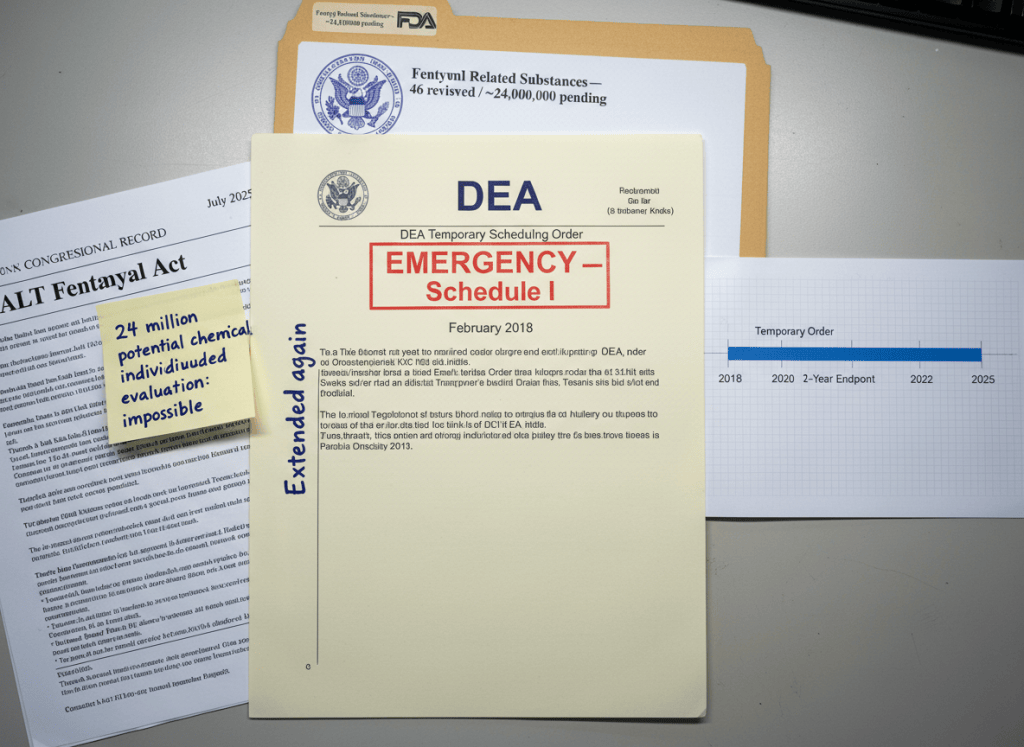
In February 2018, the DEA declared an emergency. Fentanyl related substances, a class of chemicals built by tweaking fentanyl’s molecular structure just enough to dodge existing schedules, were flooding the illicit drug supply, and DEA used its statutory power to temporarily place the entire class into Schedule I. Temporary scheduling orders under the Controlled Substances Act are built to last two years, occasionally three if a permanent scheduling case is pending. This one lasted more than seven, according to a new GAO report on federal drug scheduling, because the process built to handle individual substances had no idea what to do with a class that might contain twenty four million of them.
The math is not a typo. FDA officials told GAO that depending on which chemical variations you count as valid modifications, the fentanyl related substance class could encompass close to twenty four million distinct chemicals. The Controlled Substances Act requires an individualized scientific and medical evaluation for each substance before it can be permanently scheduled through the normal administrative process. Evaluating twenty four million compounds one at a time, within any statutory deadline that has ever existed, was never going to happen.
An Emergency Order Standing In for a Law
DEA formally asked HHS to begin evaluating fentanyl related substances in April 2019, more than a year after the temporary order took effect. HHS did not start sending evaluations back until July 2020. By then the original two year clock was already running out, and Congress had to step in repeatedly just to keep the temporary order from lapsing entirely, extending it in pieces until a hard deadline of September 30, 2025. For most of a decade, in other words, the legal basis for federal fentanyl prosecutions rested not on a permanent, individually justified schedule placement, but on a standing emergency declaration that kept getting renewed because nobody had a better option.
GAO’s report treats this almost gently, as a case study in “how legislative scheduling can address certain challenges with administrative scheduling.” That framing undersells what actually happened. The administrative process is the one Congress designed to require scientific rigor, an eight factor analysis of abuse potential, medical use, and public health risk, substance by substance. When that process could not scale, the answer was not to fix the process. It was to let an emergency order function as de facto permanent law for seven years, then have Congress skip the individualized evaluation requirement entirely.
Congress Legislates Around Its Own Statute
In July 2025, Congress passed the HALT Fentanyl Act, permanently placing all fentanyl related substances into Schedule I as a class, with mandatory minimum sentences including ten years for trafficking one hundred grams or more of any fentanyl analog. Legislative scheduling does not require a scientific and medical evaluation of any kind. Congress can schedule a substance by simple statute regardless of whether it independently meets the Controlled Substances Act‘s own criteria, and in this case it scheduled millions of substances that had never been individually evaluated, because the agency process that was supposed to evaluate them had spent seven years failing to keep pace with the chemistry.
GAO’s own prior work flagged what this means in practice. Research organizations interviewed for a 2021 GAO report on the same subject warned that class wide scheduling without individualized review risks convicting people over substances that later analysis might show have little or no actual abuse potential. Criminal justice stakeholders went further, warning that sweeping penalties onto an undefined and expanding chemical class could produce lengthy federal sentences for trace amounts and deepen existing racial disparities in sentencing, concerns that did not stop the legislation and do not appear to have been resolved by it. The HALT Act’s fix for a broken administrative process was not to make that process work. It was to make the process legally irrelevant for this entire category of drugs.
Congress did carve out one narrow accommodation while it was at it. The Act eased registration requirements for research institutions studying fentanyl analogs, allowing multi site studies under a single license instead of the old substance by substance paperwork. That provision quietly concedes the same point the rest of the law ignores, that these chemicals are different enough from one another to require individual study when the purpose is understanding them, but not different enough to require individual review when the purpose is prosecuting someone for possessing them. The bar for scientific caution turned out to depend entirely on which side of the courtroom was asking.
What Happens Now That the Science Stopped Mattering
Since the HALT Act passed, FDA told GAO it has not received a single new request to evaluate a fentanyl related substance for the purpose of scheduling, because there is nothing left to schedule; Congress already did it, permanently, for the whole class, present and future. FDA officials said they may still occasionally review a specific substance, mostly to authorize research into it rather than to inform any scheduling decision, since the scheduling decision has already been made regardless of what the research finds. As of this spring, FDA had evaluated forty six fentanyl related substances at DEA’s request under this narrower, research only track.
That is the actual shape of where this ended up. A federal drug law that was supposed to run on individualized scientific findings now runs, for an entire and still expanding class of substances, on a blanket legislative designation passed because the science could not keep pace with the chemistry and nobody wanted to say so out loud for seven years. The emergency order worked exactly as designed, as a stopgap. The failure was in treating the stopgap as an acceptable substitute for the law it was supposed to hold a place for, for longer than most federal sentences run.
Nobody in this story made an obviously wrong call at any single step. DEA was right to act fast in 2018 against a genuine public health emergency. HHS was not unreasonable to take time evaluating chemistry nobody fully understood yet. Congress was arguably right that waiting for twenty four million individual evaluations was never a serious option. The failure is structural rather than personal, which is exactly why GAO’s report treats it as a footnote to a larger story about missing paperwork rather than the headline it probably deserves on its own. A statute built around individualized scientific findings quietly stopped requiring any, for the drug category currently killing more Americans than any other, and it took seven years and an act of Congress for anyone to say so plainly.
Sources: U.S. Government Accountability Office, Drug Scheduling: DEA and HHS Face Challenges in the Administrative Process (GAO-26-108623, September 2026); GAO-21-494, Fentanyl Analogues: Agencies Addressing Scheduling Challenges But Face Broader Issues (2021); HALT Fentanyl Act, Public Law 119-26 (signed July 16, 2025).

