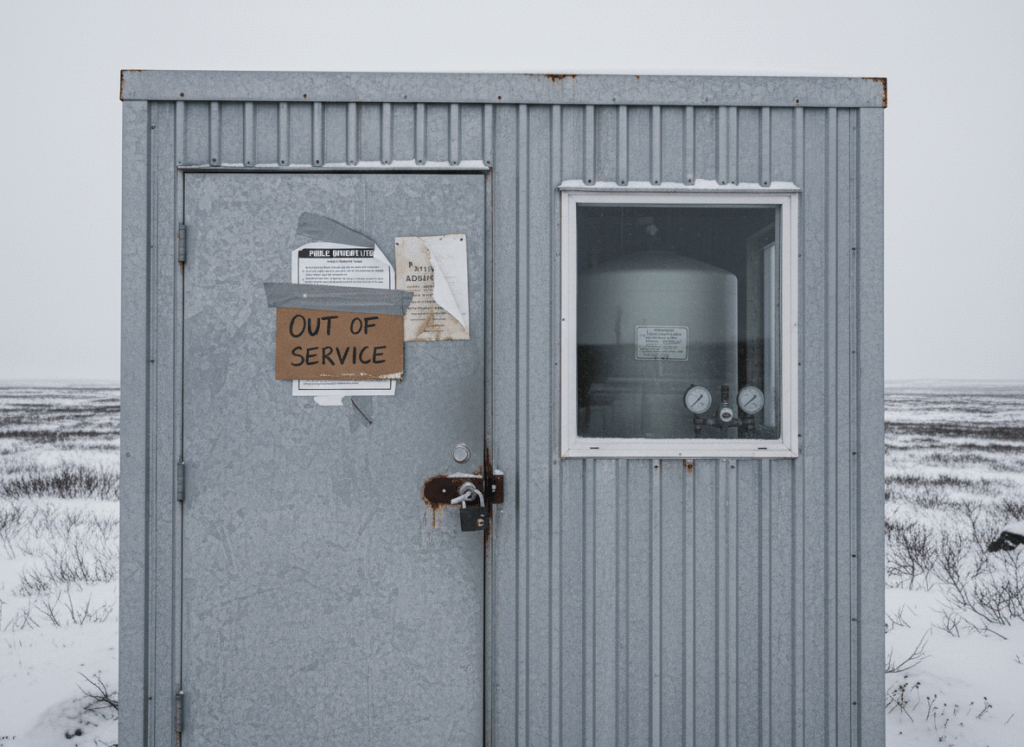
Somewhere in Alaska in 2025, tribal members turned on a tap and got water contaminated with E. coli, a bacterium capable of causing gastrointestinal illness serious enough, in vulnerable people, to become life threatening. The cause was not a burst pipe or a natural disaster.
According to a new Government Accountability Office report on tribal water infrastructure, it happened because the utility did not have enough qualified personnel on staff to make sure its chlorination equipment was actually working (Government Accountability Office, GAO-26-107178).
This was not an isolated incident. It happened twice in 2025 alone, and it fits inside a much larger, quietly alarming statistic buried in the same report, that nearly half of Alaska Native village drinking water systems had no primary certified operator on staff during that same fiscal year.
The Job Nobody Explains Until Something Breaks
Water operators are, in the most literal sense, the reason a water system does what it is supposed to do after the ribbon-cutting ends. GAO’s report spells out exactly what that job entails, running the equipment, controlling the treatment processes, and monitoring the plants that make water safe to drink, while wastewater operators do the equivalent work removing pollutants before water is released back into the environment.
These are not entry level positions filled on a whim; operators need specialized training and must earn and maintain certifications tied to the specific complexity of the system they run, certifications that exist precisely because getting this work wrong has direct public health consequences.
A water system without a certified operator is not simply understaffed in the abstract sense that any workplace might be short a hand. It is a facility that treats and delivers drinking water without anyone certified to confirm it is doing so correctly.
That is the exact condition GAO found across a huge share of Alaska Native villages. Citing State of Alaska data, GAO reports that about 46 percent of Alaska Native village drinking water systems, 73 out of 157, did not have a primary water operator certified to the level required for that system on staff in fiscal year 2025.
That figure applies specifically to systems that were required to have a certified primary operator in the first place, meaning it is not padded by facilities too small to need one. Nearly half of the systems that were supposed to have a qualified person running them did not.
Why Nobody Stays
GAO and the State of Alaska both point to the same root cause, and it is not a mystery requiring further study. Rural utilities in Alaska experience high operator turnover, and IHS senior officials attributed that turnover directly to a lack of tribal funding for water operator salaries.
This is not a story about a shortage of qualified people willing to do specialized technical work in remote communities; it is a story about tribal water systems that, once built, frequently lack the money to pay the specialized staff needed to keep them running, so operators leave for jobs that pay better, and the system cycles through vacancy after vacancy. One utility, unable to afford the energy costs required to run its wastewater aeration system, simply stopped aerating its wastewater, a direct, documented consequence of an operating budget too thin to cover routine costs.
This turnover and funding problem sits at the center of one of the report’s core findings, that IHS generally does not fund routine operations and maintenance for the water systems it helps build.
IHS pays to construct the plant. It largely does not pay to keep qualified people running it afterward. The system gets built, the ribbon gets cut, and then the ongoing cost of the one thing that actually keeps water safe, namely a trained person watching the equipment, becomes the tribe’s problem alone, in communities that GAO’s own broader report describes as chronically underfunded relative to the tax base and financing options available to non tribal communities.
What an Empty Operator Position Actually Costs
GAO does not let this stay abstract. In 2025, two tribes experienced E. coli contamination in their water systems specifically because they lacked adequate operations and maintenance capacity, including not having enough qualified personnel on hand to ensure chlorination equipment was functioning properly.
E. coli contamination in a drinking water system is not a paperwork violation; it is a direct threat of gastrointestinal illness and, in vulnerable populations, more serious health outcomes. In a separate 2024 incident, a different tribe lacked enough wastewater utility operators to perform routine maintenance on a lift station, and when the pump inevitably failed, the result was prolonged sewage overflow.
These are not edge cases dredged up to make a point. They are what GAO explicitly identifies as the predictable consequence of a system where nearly half of a state’s tribal water utilities cannot keep a certified operator on staff, wired directly to a funding structure that pays for construction but not for the ongoing salaries needed to run what gets built.
The connection between the abstract 46 percent figure and an actual gastrointestinal illness outbreak is not speculative; it is the same causal chain GAO lays out explicitly, funding gap, operator turnover, unmonitored equipment, contamination event.
A Pilot Program, Finally Proposed
GAO’s response here goes further than most of its recommendations elsewhere in the report, because this is the one place where GAO does not simply ask an agency to fix its own paperwork. GAO suggests Congress consider authorizing and directing IHS, working with tribes and in collaboration with EPA, to establish a pilot program that would actually help fund tribes’ routine operations and maintenance costs, specifically things like water operator salaries and the energy costs needed to run treatment equipment.
It is worth noting what this recommendation implicitly concedes, that the current system, in which the federal government funds construction but not the staffing needed to safely operate what it built, is not working, and IHS itself has acknowledged its statutory authority does not currently extend to covering routine operations and maintenance costs at all.
A pilot program is a modest first step relative to the scale of the problem GAO documents. Forty six percent is not a rounding error or a temporary staffing hiccup; it is essentially a coin flip on whether any given Alaska Native village’s water system currently has a certified professional watching over it. Every one of those vacant positions is a system running, or not running, on borrowed time, waiting for the next equipment failure nobody catches until people start getting sick.

