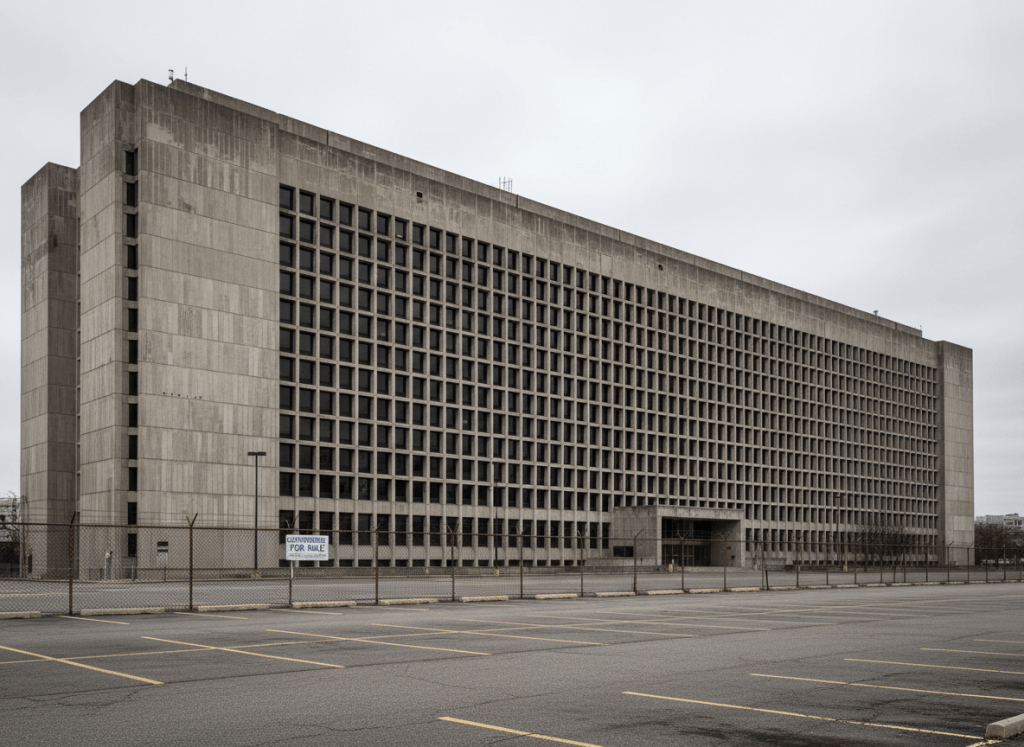
The James V. Forrestal Federal Building has been marked for disposal twice now. The first attempt began around 2010, ran for roughly six years as a joint effort with the District of Columbia government, and was quietly terminated in 2016 without a sale. The second attempt started in earnest in 2024. As of this writing, it has produced a construction project, a proposed swap with a different federal agency, and no actual disposal.
This is what “getting rid of a building” looks like inside the federal government. It is never one transaction. It is a chain of contingent moves, each one waiting on the one before it, and Forrestal is the clearest illustration on offer.
The Wrong Size Building at the Wrong Time
Forrestal serves as headquarters for the Department of Energy, and it is enormous, about 1.8 million gross square feet, with roughly 967,000 square feet of usable space. The plan, according to a GAO report issued this month, is to move Energy into the Lyndon B. Johnson Federal Building, which currently houses the Department of Education and offers about 385,000 usable square feet. Do the arithmetic. Energy is being asked to fit an agency built for nearly a million square feet into a building less than half that size, and Energy officials have said they may need to find supplemental space elsewhere just to make the numbers work.
There’s a reason this particular move was chosen anyway. Energy’s headquarters requires a substantial footprint of Sensitive Compartmented Information Facilities, the secure spaces where classified work happens, and those aren’t rooms you rent off the shelf. A construction project is already underway to add 20,000 square feet of classified space to accommodate the move, at an estimated cost of $22 million. That’s before anyone has resolved where the current occupant of the smaller building goes.
Education’s Problem Is Now Energy’s Problem
The Department of Education occupies the Lyndon B. Johnson building today, and moving Energy in requires moving Education’s staff out first, to space that, as of August 2026, GSA has not identified. This is the part of the disposal process that rarely makes it into a press release. Selling Forrestal isn’t just a real estate transaction between the government and a buyer. It’s a relocation puzzle with at least three agencies in it, one of which hasn’t been told where it’s going yet, and the timeline for the whole sequence is described by GSA’s own officials as uncertain, contingent on investment that hasn’t been finalized.
Estimated disposal costs for Forrestal stood at roughly $300 million as of December 2025, and GAO reports that figure remains in flux nearly a year later. Costs going up over time is not a surprising feature of federal disposals. It is close to the default setting. What makes Forrestal notable is how transparently the cost estimate depends on decisions that haven’t been made yet, namely where Education goes and how much classified buildout Energy ultimately needs.
A Decade and a Half, Twice
The first Forrestal disposal effort ran from roughly 2010 to 2016 and accomplished nothing that shows up in any completed-sale column. The current effort has been underway since 2024, gained real momentum when the Public Buildings Reform Board recommended the property in May 2025, and produced its first concrete milestone, the announced relocation to the Johnson building, in March 2026. That’s fifteen years, across two separate administrations of the same idea, to get from “we should sell this building” to “here is a building we might move the tenant into, contingent on evicting somebody else.”
None of the individual actors here are behaving irrationally. Energy has a legitimate classified space requirement. GSA has to solve for Education’s relocation before it can hand Forrestal’s keys to anyone. The Public Buildings Reform Board did its job and made a recommendation on schedule. The dysfunction isn’t in any single decision. It’s in the fact that disposing of one federal building routinely requires resolving the housing needs of at least one other federal agency first, a dependency chain that the disposal process was never designed to shorten.
The Punchline Is the Timeline
Forrestal is not a story about waste, exactly, or fraud, or a single villain who mismanaged the file. It is a story about how the federal government’s real estate is load bearing in a way that makes disposal structurally slow no matter who is in charge or how much political will exists behind it. You cannot sell a headquarters building until you’ve solved for where its occupant goes, and you cannot solve for where its occupant goes until you’ve solved for where that building’s occupant goes. Fifteen years into trying to get rid of one building, the government has a construction contract, a proposed swap, and a two-step relocation problem it still hasn’t finished solving. Call it progress if you’re feeling generous. Call it the process working exactly as slowly as designed if you’re not.

