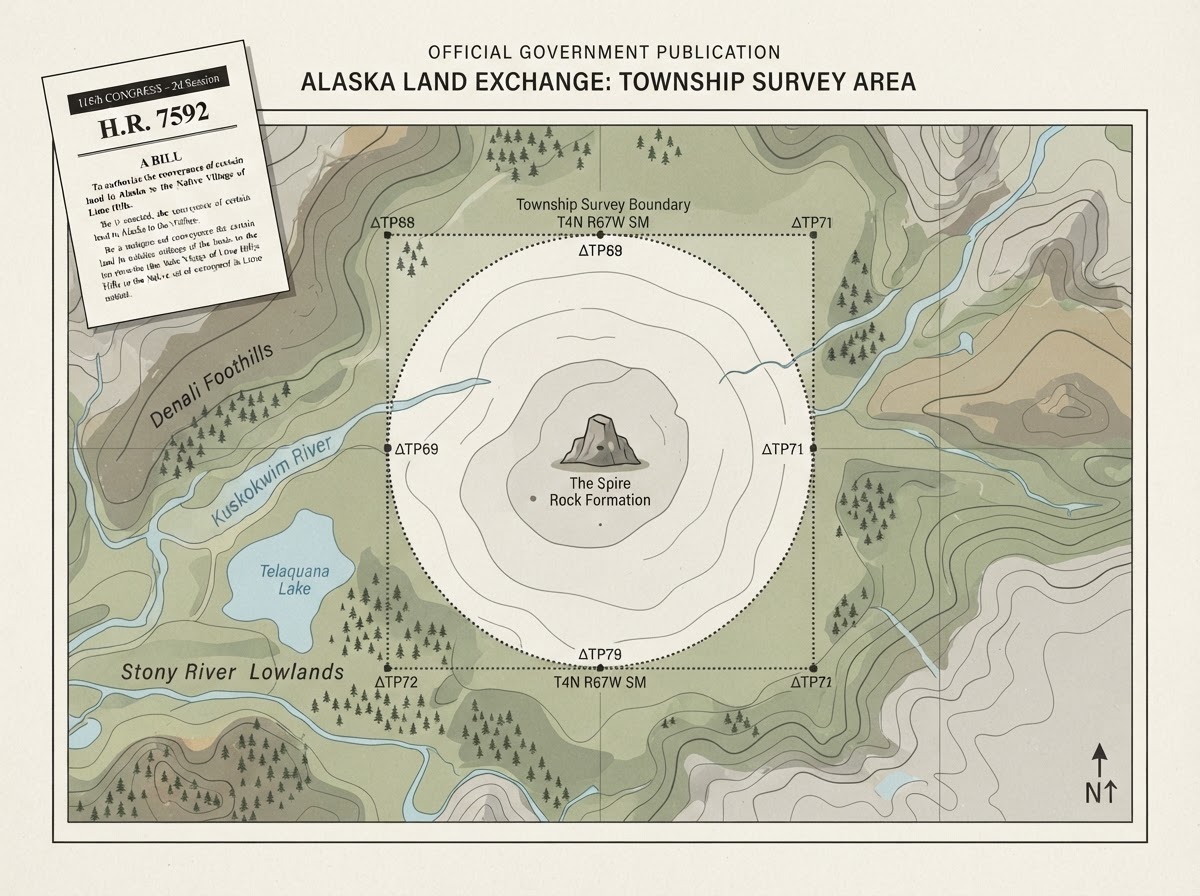
The Geese House Site Conveyance Act transfers land in Denali National Park to an Alaska Native corporation. The name says ‘site.’ The bill delivers nearly a township. This is the second installment of a weekly series reading bills by their name, their text, and what’s hiding inside.
The Geese House Site Conveyance Act has one of the more honest names in Congress. It says what it does: it conveys a site. What the name does not say is how much.
The bill would hand Doyon, Limited, an Alaska Native regional corporation, about 21,578 acres of Denali National Park and Preserve. The site itself is a rock.
This is the second in a weekly series that reads a bill three ways: by its name, by its text, and by anything tucked inside that has nothing to do with either.
The Name on the Door
Sen. Lisa Murkowski (R-Alaska) introduced S. 4399 on April 27, 2026. Rep. Nick Begich (R-Alaska) filed the House companion, H.R. 8674, on May 7. The Congressional Research Service lists the two as identical.
“Site” does a lot of work. Doyon describes the Geese House as a geological formation near Lake Minchumina, not a structure, and central to the oral traditions of the Upper Kantishna region.
The bill never says where the formation is. It does not locate it, define it, or measure it. Murkowski told the Senate committee that the parcel is sized to avoid publicly revealing the exact site, according to a transcript of her remarks.
The name is accurate about the action and silent about the scale.
What the Bill Does
Section 2 orders Interior to convey the land to Doyon within a year of enactment. The land is what Doyon selected on September 18, 1978, described as sections 1 to 36 of one township, less a couple of lots and two lakes.
A standard survey township is 36 sections. By that arithmetic, the bill covers close to a full township, which is why a rock needs 21,578 acres. That is my math, not the bill’s language.
Doyon would be barred from selling the land to anyone but the United States. It could not authorize mining. It could not permit development that would derogate the cultural value of the Geese House. Public access easements required by ANCSA stay in place.
Two problems with those limits. The development ban protects a feature the bill never defines or locates. And the text names no one to decide what “derogate” means and no remedy if Doyon crosses the line. That is my reading of the text.
The land would be treated as an ANCSA 14(h)(8) conveyance. The Congressional Budget Office says it counts toward the acreage Doyon is already entitled to, so it draws down an existing entitlement rather than adding to it. CBO also finds no federal receipts lost and Interior costs under $500,000 through 2031.
Section 3 exempts the conveyance from the ANCSA land-selection regulations at 43 C.F.R. part 2650 and from any past or existing withdrawal. Interior describes those regulations as the ones that normally govern how selections are processed. Survey corrections need Doyon’s written approval.
Doyon’s own summary says the exemption reaches public land orders and provisions of the Alaska lands act, known as ANILCA. The text says only “any past or existing withdrawal” and names neither.
The Park Service Said Yes
At a July 21 Senate subcommittee hearing, the National Park Service testified on 24 bills. It opposed or declined to support roughly ten, nearly all citing the deferred maintenance backlog. The list included heritage area designations, river studies and a 551-acre boundary expansion at Mammoth Cave.
On S. 4399, it supported the bill. It said the conveyance aligns Denali’s boundary with selections Doyon made more than four decades ago. Interior repeated that support in a September 17 statement to the House subcommittee.
The pattern fits the agency’s stated objection: new parks cost money to manage. A bill that shrinks a park does not. That is an inference from the testimony, not something the agency said.
The park once saw other options. At its fall 2025 subsistence commission meeting, staff said that if the land stayed federal, they would work to designate it a sacred site. They had also worked with Doyon on joint management. Murkowski says the Park Service later concluded existing law gave it no authority to transfer the land administratively.
Whether a sacred-site designation could protect a rock without conveying a township is a question the testimony and releases do not answer.
The Other Transfer
The same weeks produced a smaller cousin. The Pit River Land Transfer Act, H.R. 2400, cleared Congress on November 17 and goes to the President. It takes roughly 557 acres of Forest Service land in California into trust for the Pit River Tribe and bars gaming on it.
The comparison is instructive. Geese House conveys land in fee to a corporation and bars mining. Pit River puts land in trust for a tribe and bars gaming. Geese House is roughly 39 times larger. Each bill writes its own bespoke limit.
The Scorecard
- Name vs. text: Accurate on the action. “Site” hides 21,578 acres and a formation the bill never locates.
- Text: Short and clean. House and Senate versions match. The restrictions hinge on an undefined feature and name no enforcer. Two waivers.
- Extras: None found. No riders in either text, and Interior supports the bill.
S. 4399 was reported by the Senate Energy and Natural Resources Committee on July 29. H.R. 8674 was ordered reported by House Natural Resources on November 18, according to Congress.gov status data. Neither has reached a floor vote.
The Geese House has waited since 1978. The bill protects it by conveying a township the bill describes to the section, while declining to say where the rock is.