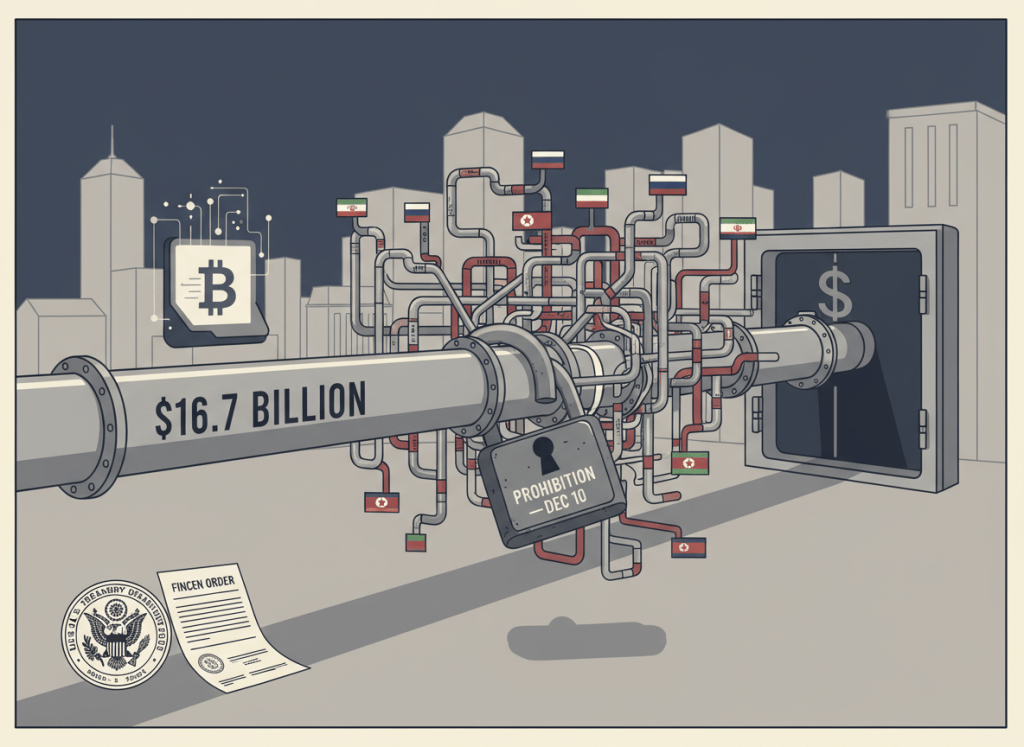
The cryptocurrency exchange MEXC Global spent years moving billions of dollars through financial networks connected to sanctioned Russian entities, Iranian organizations, North Korean facilitators, and cybercriminals, according to a sweeping determination issued by the U.S. Treasury Department.
Now Washington is moving to cut the exchange off from the American financial system.
On November 6, the Financial Crimes Enforcement Network (FinCEN) issued an order under Section 9714 of the Combating Russian Money Laundering Act, finding MEXC Global to be a financial institution of primary money-laundering concern in connection with Russian illicit finance. The order, published in the Federal Register on November 10, prohibits covered U.S. financial institutions from transmitting funds involving MEXC Global, its foreign subsidiaries, branches, offices, and successor entities.
The prohibition takes effect December 10. FinCEN estimates that MEXC Global facilitated at least $16.7 billion in likely illicit financial activity between May 2021 and May 2026. Those figures are Treasury’s assessments, not findings from a criminal trial. Some categories may overlap.
The Russian connection
FinCEN reports approximately $232 million in direct transactions with entities sanctioned by the United States, European Union, or United Kingdom in connection with Russian illicit finance. Among the counterparties were Garantex and Grinex. Treasury sanctioned Garantex in April 2022, citing its role in ransomware-related and other criminal transactions. Grinex subsequently emerged as a successor exchange associated with Garantex personnel and operations.
The order identifies approximately $129 million in direct activity with Garantex and $4.1 million with Grinex following their public sanctions designations. Transactions involving both reportedly continued as recently as June 2026, more than four years after Garantex’s designation.
FinCEN also documented at least $26 million in transactions benefiting the Russian-linked A7 network and nearly $200 million associated with the ruble-backed A7A5 stablecoin. The order separately describes more than $13 billion in direct transactions with at least four high-risk exchanges sanctioned by the United Kingdom, measured from May 2018 through July 2026. That longer-period amount should not be added to the $16.7 billion assessment or equated automatically with proven illicit proceeds.
An international problem, not merely a Russian one
The order identifies approximately $1.87 billion in transactions with exposure to Iran, including roughly $1 billion in direct transactions with more than 40 Iranian cryptocurrency exchanges. It also identifies approximately $22 million in transactions associated with the Central Bank of Iran, the Islamic Revolutionary Guard Corps, and its Qods Force.
FinCEN alleges that MEXC facilitated approximately $350,000 received by sanctioned North Korean financial facilitator Sim Hyon Sop between June and September 2025. It estimates approximately $1.99 billion connected to illicit cyber actors, including more than $37.9 million in suspected ransomware payments between January 2022 and July 2024.
These findings do not establish that MEXC organized attacks, directed sanctioned networks, or knowingly participated in every transaction. They describe a platform repeatedly used by counterparties associated with activities its compliance policies purported to restrict.
The compliance problem
MEXC Global has represented that it maintains customer-identification and anti-money-laundering procedures, including restrictions affecting certain jurisdictions. FinCEN concluded that its controls were insufficient to prevent substantial illicit financial activity. The published order does not provide enough underlying evidence to establish whether the failures resulted from evasion through intermediaries, inadequate screening, or knowingly tolerated risks in each case.
FinCEN relied on public and nonpublic information, including blockchain analysis. The complete transaction records, attribution methods, internal compliance communications, and any prior warnings to MEXC have not been publicly released in the order. Identifying suspicious transactions and proving an operator’s knowledge or intent are different evidentiary questions.
The Seychelles licensing trail
On May 26, 2026, the Seychelles Financial Services Authority identified MX Global Ltd, IBC No. 238047, as operating the MEXC platform without the required authorization under the Virtual Asset Service Providers Act, 2024.
A previously associated Seychelles company, MEXC Global LTD, IBC No. 218833, had been struck off the register in August 2023 and later dissolved. The authority’s May 2026 announcement identifies December 18, 2024 as the dissolution date, while an earlier regulatory statement identifies August 17, 2024. That discrepancy remains unresolved in the published materials.
The regulator said no associated entity applied for licensing during the transition period ending December 31, 2024. It determined that MX Global Ltd operated without authorization from January 1, 2025, and announced enforcement measures including referral for consideration of legal action. It also warned that its supervisory framework could not facilitate recovery of funds for customers of an unlicensed operator.
FinCEN’s order covers successor entities and current or former affiliates across multiple jurisdictions. That breadth raises questions about the exchange’s ownership and operational structure but does not itself establish an independent violation by every named company.
Why Treasury chose a prohibition
Section 9714 allows FinCEN to prohibit specified fund transmissions involving a foreign financial institution presenting a primary money-laundering concern connected to Russian illicit finance. FinCEN concluded that lesser measures, such as enhanced reporting or recordkeeping, would not sufficiently address the risk of indirect access through foreign intermediaries.
Treasury acknowledged that some MEXC activity was legitimate, while stating that it lacked complete visibility into that activity. It reported that the exchange processed more than $1 billion daily in 2026 and maintained approximately $5 billion in reserve assets. FinCEN consulted other federal agencies and reported that none objected based on the information provided.
The order is not a criminal conviction or a worldwide shutdown. It restricts specified transfers by covered U.S. financial institutions beginning December 10; other sanctions and Bank Secrecy Act requirements remain applicable.
MEXC responds: lawyers, FinCEN contact, and an operating exchange
In a response to Bureaucracy Times, MEXC pointed to a November 9 public statement by CEO Vugar Usi, saying it had opened communications with FinCEN with assistance from U.S. law firms. The company said it was prepared to cooperate and that deposits, withdrawals, and trading continued normally.
“We have established communication with FinCEN through the support of top-tier U.S. law firms. FinCEN confirmed receipt of our written request on Monday morning (U.S time). We are ready to fully cooperate.”
Vugar Usi, MEXC CEO, November 9 statement
Monday was November 9, three days after FinCEN issued its order. Usi also said, “The platform continues to operate normally. Deposits, withdrawals and trading are fully functioning.” The exchange’s operational claims have not been independently verified across customers and jurisdictions. Receipt of a written request does not establish that FinCEN has granted reconsideration, delayed the December 10 effective date, or changed its findings.
MEXC’s emailed response did not directly address whether it disputes FinCEN’s $16.7 billion assessment, how it screened sanctioned counterparties, the Seychelles licensing findings, or which corporate entity holds customer assets. Nor did it specify whether its written request seeks modification or rescission of the order. Those questions remain open; silence on them should not be treated as an admission. Usi said the company had “a clear plan and a lot of work ahead,” without describing the plan.
Questions Treasury and MEXC have been asked to answer
On November 10, Bureaucracy Times sent separate media inquiries to FinCEN, MEXC Global, and the Seychelles Financial Services Authority. FinCEN was asked about transaction methodology, prior warnings, Russian-linked counterparties, and why less restrictive measures were rejected. MEXC was asked whether it disputes the findings, how it screened sanctioned parties, its corporate structure, and how legitimate customers will be affected. Seychelles regulators were asked about licensing, enforcement, corporate succession, and interagency cooperation.
All three were asked to respond by Friday, November 13, 2026, at 5 p.m. Eastern Time. MEXC has since provided a response and directed the publication to its CEO’s public statement. FinCEN and the Seychelles Financial Services Authority did not respond to the inquiries by the deadline.
The larger accountability question
Some relationships described by FinCEN allegedly continued years after counterparties were publicly sanctioned. Meanwhile, regulators in Seychelles raised corporate and licensing concerns. Whether warnings were shared effectively, acted upon promptly, or sufficient to support earlier intervention remains unclear.
For regulators, the question is why activity described in Treasury’s order continued for so long before the restriction. For legitimate customers, the question is more immediate: what happens to their money?
Source documentation: FinCEN order; Treasury announcement; Federal Register; Seychelles FSA announcement; Earlier FSA statement; MEXC CEO statement.

