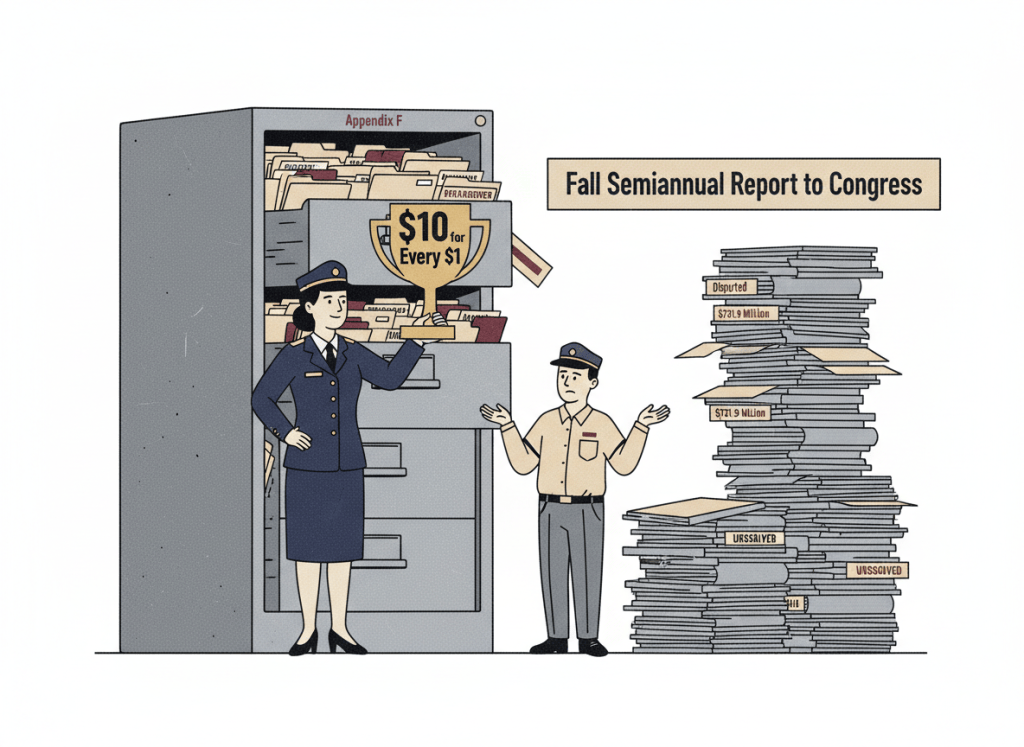
The Postal Service Inspector General’s fall report to Congress opens with a boast. Inspector General Tammy Hull writes that her office returned $10 for every $1 invested in its budget.
Fair enough. Then the appendices begin, and the boast acquires company.
The Letter and the Ledger
The narrative portion of the report covers counterfeit postage, mail theft and a Detroit check-stealing ring. These are real problems with real dollar figures, and the report tells them well.
The ledger tells a second story. Audits issued between April 1 and September 30 questioned $754,954,103 in costs. Appendix B shows that Postal Service management declined to disallow $731,913,216 of it, roughly 97 percent.
The report’s summary table totals $2,807,377,381 in financial impact. That combines questioned costs, funds put to better use and revenue impact. It is the number the OIG can point to. What the Postal Service accepted is a different number.
Appendix F goes further. It lists 17 reports and 41 recommendations where the Inspector General disagrees with a significant management decision still sitting in audit resolution. The monetary impact attached to them is $777,990,946.
The report does not say which four audits make up that $731.9 million. What follows is an inference, resting on the report’s own Appendix A. Three audits carry questioned costs of $271,916,465, $436,952,791 and $23,043,960, and those three add up to $731,913,216 to the dollar.
They are the contract practices audit, the regional performance audit and the non-revenue transactions audit. The narrative never mentions the first or the last. It describes the middle one’s best practices but leaves out the dollar figure and the dispute.
More Than a Quarter Billion Dollars of Missing Paperwork
Start with the largest. In fiscal 2025 the Postal Service spent over $15 billion on goods and services, and the OIG audited how it manages those contracts.
Auditors sampled 203 time-and-materials invoices. In 151 of them, or 74 percent, the contract system lacked a description of the tasks performed to justify the payment.
The OIG projected that sample across $371.3 million in such contracts from fiscal 2024 and 2025. It reported at least $271,121,756 in unsupported questioned costs, using the lower bound of its estimate.
Unsupported is a documentation finding. It is not a finding of theft.
Management disagreed. It said task descriptions live in task orders, not on each invoice, and that the OIG misapplied the invoice policy. It also said the OIG did not provide its full testing data for validation, and pointed to its own annual compliance reviews, which it says show different results.
The OIG stood by its methodology and said it gave management the detail. Recommendations 1, 2, 3 and 6 remain unresolved.
The rest of the audit reads like a list of questions a contracting office ought to be able to answer. Of 70 unauthorized contractual commitments in fiscal 2024 and 2025, 42 lacked critical documentation. Of 124 sampled noncompetitive purchases, 72 were not publicized as required.
Purchase plan requirements were waived on 54 of those 124, covering about $2.8 billion. Five contracts went to three suppliers carrying exclusions from another federal agency, without the required executive approval.
In four of the five, according to the report, staff found the exclusion and awarded anyway because it was old and not contract related. Meanwhile contracting staff shrank 12 percent from fiscal 2020 to 2025 while contract spending rose 8 percent.
A Stopwatch and a Shrug
Nearly half of the Postal Service’s 1.1 billion retail transactions in fiscal 2025 were non-revenue: change-of-address requests, mail pickups, directions. They cost over $276 million in clerk workhours.
The OIG’s audit of those transactions found over 43 million of them, 36 percent, ran past their time targets. One package pickup exceeded its 98-second target by 380 minutes.
The Postal Service’s own data sources also disagreed on the year’s total, from 455 million to 503 million transactions. The OIG estimated $23 million in questioned costs and another $23 million in funds that could be put to better use.
Management disagreed with the finding, all three recommendations and the dollar figures, saying it could not replicate the calculations. It made one fair point: exceeding an average time target does not by itself prove wasted labor.
The OIG conceded that individual instances may not signal poor performance. Its argument is that the Postal Service lacked visibility into the scale of the problem.
Then there is the $437 million. The regional performance audit compared five low-performing and five high-performing postal districts. It estimated nearly $437 million in annual questioned costs from facilities operating below the national efficiency average.
That is an estimate of exposure, not a bill the Postal Service paid. Management disagreed with both recommendations.
Where Findings Go to Wait
Audit resolution is the formal process in which the OIG and Postal Service management try to settle recommendations they disagree on. Appendix F is the waiting room.
Some occupants have waited a long time. A June 2024 recommendation to update the Delivering for America plan’s financial projections is still listed. So is a March 2023 recommendation to analyze Election Mail costs and explore compensation for them.
The newest entry may matter most to readers who never see a postal contract. The Customer Survey Integrity audit, issued September 15, produced six recommendations, and Appendix F lists all six.
They include guidance telling area and district managers not to set artificial, unrealistic performance goals. They also include changes to the Customer 360 scoring system to address pressure to manipulate survey scores, and corrected scores for fiscal 2023 through 2025 reported to the Postal Regulatory Commission. The fall report’s narrative does not mention the audit.
The report does not say how far along any of these disputes is, or when the OIG expects them to be settled. It also does not say whether the Postal Service plans to produce its own figures to replace the ones it rejects.
Disagreement is not misconduct. Inspectors general are required to report these disputes, and the report states that the OIG recorded no attempts to interfere with its independence this period.
But a reader who stopped at the Inspector General’s letter would learn about the $10 and none of the $732 million. The same pattern surfaced earlier this month in the OIG’s last-mile white paper, where management filed objections to the OIG’s own analysis.
Neither rain nor snow nor gloom of night stays the couriers from their rounds. Audit resolution, it turns out, is another matter.

